
Family is one of the first personal topics that tends to come up in conversation. You might be showing someone a photograph, explaining who you live with or simply getting to know a new friend.
Spanish family words are quite regular, but they also introduce a few useful features of the language. Words often change according to gender, plurals can refer to mixed groups, and a single possessive such as mi (“my”) can help you describe several different relationships.
You can hear every main phrase spoken by a native Latin American Spanish speaker. The pronunciation guides are approximate, but they can help English speakers get close to the sound.
Asking who someone is
¿Quién es?
Natural translation: Who is this?
Pronunciation: KYEN ehs
Word for word: Quién = who es = is
You can use ¿Quién es? (“Who is this?” or “Who is he/she?”) when asking about someone in a photograph or someone already being discussed.
Spanish doesn’t need to include a separate word for “this,” “he” or “she” here. The context usually makes it clear whom you’re asking about.
The accent in quién shows where the stress falls. The combination qu is pronounced like an English k, while the following ie sounds roughly like “ye.”
Introducing close family members
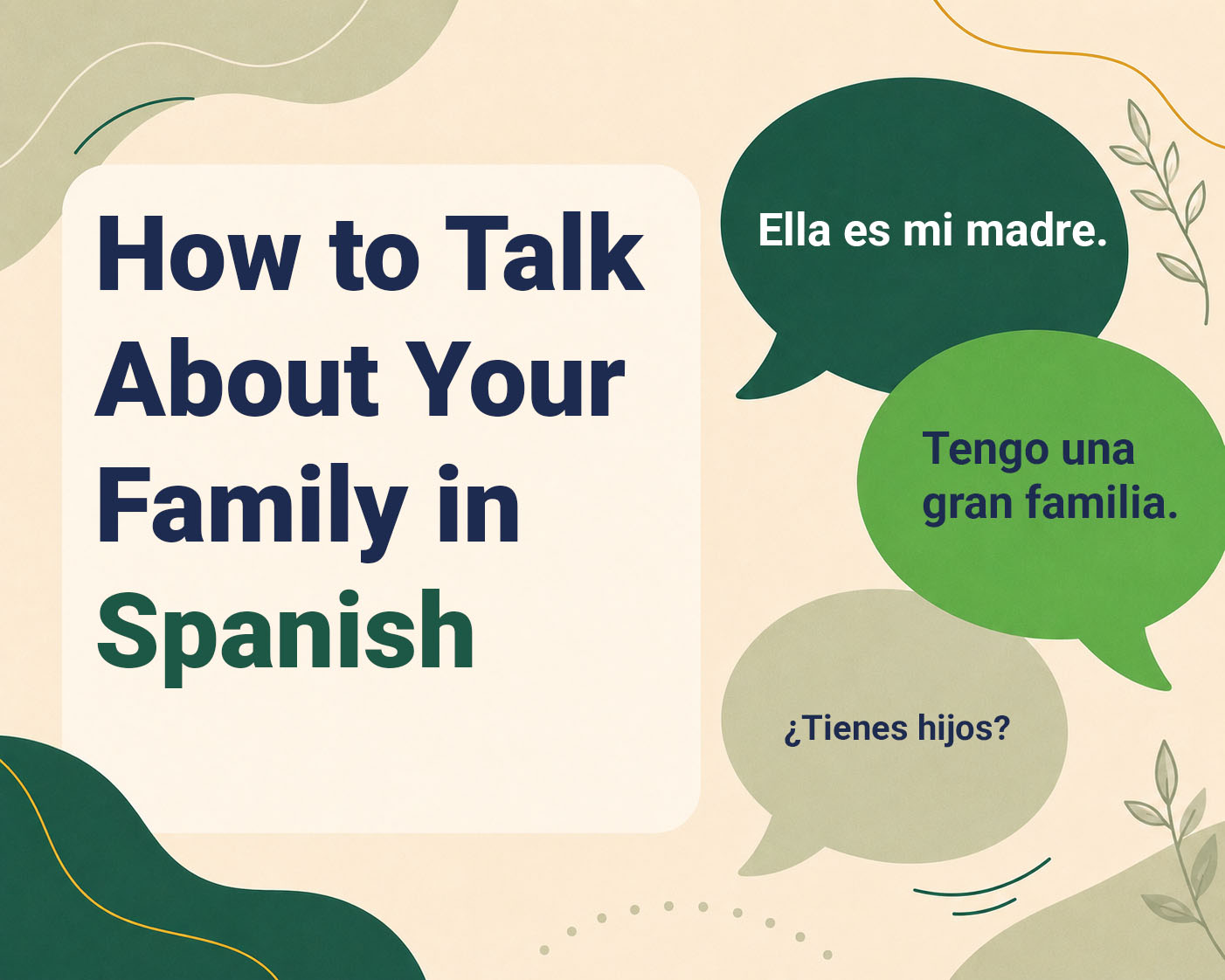
Ella es mi madre.
Natural translation: This is my mother.
Pronunciation: EH-yah ehs mee MAH-dreh
Word for word: Ella = she es = is mi = my madre = mother
The literal meaning is “She is my mother,” but when pointing someone out or showing a photograph, the natural English translation is often “This is my mother.”
In most of Latin America, the ll in ella sounds similar to the English y in “yes.” The exact sound varies between regions.
Él es mi padre.
Natural translation: This is my father.
Pronunciation: el ehs mee PAH-dreh
Word for word: Él = he es = is mi = my padre = father
The written accent distinguishes él (“he”) from el (“the”). They sound the same when spoken, but the accent makes the meaning clear in writing.
As with the previous phrase, Él es mi padre literally means “He is my father,” but “This is my father” may sound more natural when introducing someone.
Talking about brothers and sisters
Él es mi hermano.
Natural translation: This is my brother.
Pronunciation: el ehs mee ehr-MAH-noh
Word for word: Él = he es = is mi = my hermano = brother
The h in hermano is silent, just as it is in ¡Hola! Begin directly with the vowel sound.
Ella es mi hermana.
Natural translation: This is my sister.
Pronunciation: EH-yah ehs mee ehr-MAH-nah
Word for word: Ella = she es = is mi = my hermana = sister
The relationship between hermano (“brother”) and hermana (“sister”) shows a common Spanish pattern. The masculine form ends in -o, while the feminine form ends in -a.
The same pattern appears in several other family words:
| English | Masculine | Feminine |
|---|---|---|
| Brother / sister | hermano | hermana |
| Son / daughter | hijo | hija |
| Husband / wife | esposo | esposa |
| Grandfather / grandmother | abuelo | abuela |
Not every Spanish word follows this pattern, but it appears frequently enough to be useful.
Describing your family
Tengo una gran familia.
Natural translation: I have a large family.
Pronunciation: TEN-goh OO-nah grahn fah-MEE-lyah
Word for word: Tengo = I have una = a gran = large familia = family
Tengo means “I have” and appears in many conversations about family, possessions and personal circumstances.
In this phrase, gran means “large” or “great.” It appears before familia, rather than taking the longer form that you may see in some other positions.
The i in familia joins the following vowel, producing a sound similar to “lyah” at the end.
Talking about marriage
¿Estás casado? / ¿Estás casada?
Natural translation: Are you married?
Pronunciation: ehs-TAHS kah-SAH-doh / ehs-TAHS kah-SAH-dah
Word for word: Estás = are you casado/casada = married
The ending of casado or casada usually agrees with the gender of the person being addressed:
- ¿Estás casado? when speaking to a man.
- ¿Estás casada? when speaking to a woman.
This is an informal question for one person. Depending on the culture and situation, asking about marriage may feel perfectly natural or rather personal. It is more likely to come up once a conversation has moved beyond the first greeting.
Estoy casado. / Estoy casada.
Natural translation: I am married.
Pronunciation: ehs-TOY kah-SAH-doh / ehs-TOY kah-SAH-dah
Word for word: Estoy = I am casado/casada = married
The speaker chooses casado or casada according to their own gender.
The question begins with estás (“you are”), while the answer begins with estoy (“I am”). This contrast appears in many useful Spanish exchanges.
The formal version
¿Está casado? / ¿Está casada?
Natural translation: Are you married?
Word for word: Está = are you (formal) casado/casada = married
Pronunciation: ehs-TAH kah-SAH-doh / ehs-TAH kah-SAH-dah
As with ¿Cómo está? (“How are you?”), the formal form drops the final s found in the informal estás.
Introducing a husband or wife
Él es mi esposo.
Natural translation: This is my husband.
Pronunciation: el ehs mee ehs-POH-soh
Word for word: Él = he es = is mi = my esposo = husband
Ella es mi esposa.
Natural translation: This is my wife.
Pronunciation: EH-yah ehs mee ehs-POH-sah
Word for word: Ella = she es = is mi = my esposa = wife
The pair esposo and esposa follows the same -o/-a pattern as hermano and hermana.
As before, these phrases literally mean “He is my husband” and “She is my wife,” but “This is…” is often the more natural translation when you’re introducing someone.
Talking about children
¿Tienes hijos?
Natural translation: Do you have children?
Pronunciation: TYEH-nehs EE-hohs
Word for word: Tienes = do you have hijos = children
The h in hijos is silent. The Spanish j has a breathy sound similar to a strong English h.
Hijos can mean “sons,” but it can also mean “children” when referring to sons and daughters together. Spanish traditionally uses the masculine plural for a mixed group.
Like questions about marriage, this may be considered fairly personal in some situations. Context and familiarity matter.
Tengo un hijo.
Natural translation: I have a son.
Pronunciation: TEN-goh oon EE-hoh
Word for word: Tengo = I have un = a hijo = son
Tengo una hija.
Natural translation: I have a daughter.
Pronunciation: TEN-goh OO-nah EE-hah
Word for word: Tengo = I have una = a hija = daughter
Notice that both the noun and the word for “a” change:
- un hijo = a son
- una hija = a daughter
Asking how many children someone has
¿Cuántos hijos tienes?
Natural translation: How many children do you have?
Pronunciation: KWAHN-tohs EE-hohs TYEH-nehs
Word for word: Cuántos = how many hijos = children tienes = do you have
The informal and formal versions differ only in the final verb:
| Style | Spanish | Natural translation |
|---|---|---|
| Informal | ¿Tienes hijos? | Do you have children? |
| Formal | ¿Tiene hijos? | Do you have children? |
| Informal | ¿Cuántos hijos tienes? | How many children do you have? |
| Formal | ¿Cuántos hijos tiene? | How many children do you have? |
Useful family words in Spanish
Here are some of the family words used in this article, together with a few closely related terms:
| English | Spanish | Approximate pronunciation |
|---|---|---|
| Brother | hermano | ehr-MAH-noh |
| Children | hijos | EE-hohs |
| Daughter | hija | EE-hah |
| Family | familia | fah-MEE-lyah |
| Father | padre | PAH-dreh |
| Grandfather | abuelo | ah-BWEH-loh |
| Grandmother | abuela | ah-BWEH-lah |
| Grandparents | abuelos | ah-BWEH-lohs |
| Husband | esposo | ehs-POH-soh |
| Mother | madre | MAH-dreh |
| Parents | padres | PAH-drehs |
| Sister | hermana | ehr-MAH-nah |
| Son | hijo | EE-hoh |
| Wife | esposa | ehs-POH-sah |
The plural padres usually means “parents,” although padre by itself means “father.” Similarly, abuelos can refer to a grandfather and grandmother together, as well as to a group of grandparents.
Using mi and mis
Spanish makes a useful distinction between one possession and more than one:
- mi madre = my mother
- mi padre = my father
- mi hermano = my brother
- mi familia = my family
- mis padres = my parents
- mis hijos = my children
- mis abuelos = my grandparents
The choice between mi and mis depends on whether the following noun is singular or plural—not on whether the family member is male or female.
That makes mi especially convenient: the same word works in mi madre, mi padre, mi esposo and mi esposa.
A typical family conversation
Person 1: ¿Quién es?
Person 2: Ella es mi hermana.
Person 1: ¿Estás casada?
Person 2: Estoy casada.
Person 1: ¿Tienes hijos?
Person 2: Tengo un hijo.
A real conversation might include many more details, but these phrases cover several of the questions and answers that commonly arise when people begin talking about their families.
Talking about the people in your life
Family conversations can quickly become detailed, but the basic structures are quite economical. Él es mi… (“He is my…”), Ella es mi… (“She is my…”) and Tengo… (“I have…”) can introduce many of the people who matter to you.
They also reveal patterns that appear throughout Spanish: masculine and feminine endings, singular and plural possessives, and verb forms that change according to who is speaking.
The main examples in this article are taken from the LinguaBoost Spanish course and recorded by a native Spanish speaker.
Ready to speak more Spanish?
Build on the phrases in this article with structured practice, native-speaker audio and built-in review designed for everyday conversation.
Explore the Spanish course