
Talking about what you like is one of the easiest ways to make a Spanish conversation personal. Food, music, books, travel and television all create natural opportunities to discover what you have in common with someone—or where your tastes are completely different.
The familiar expression me gusta is central to these conversations, but it does not behave exactly like English “I like.” Spanish changes gusta to gustan in some situations, uses different small words for the person experiencing the preference and has several other ways to express stronger likes, dislikes and choices.
You can hear each main phrase in this article spoken by a native Latin American Spanish speaker. The pronunciation guides are approximate, but they can help English speakers get close to the sound.
Asking what someone likes to do
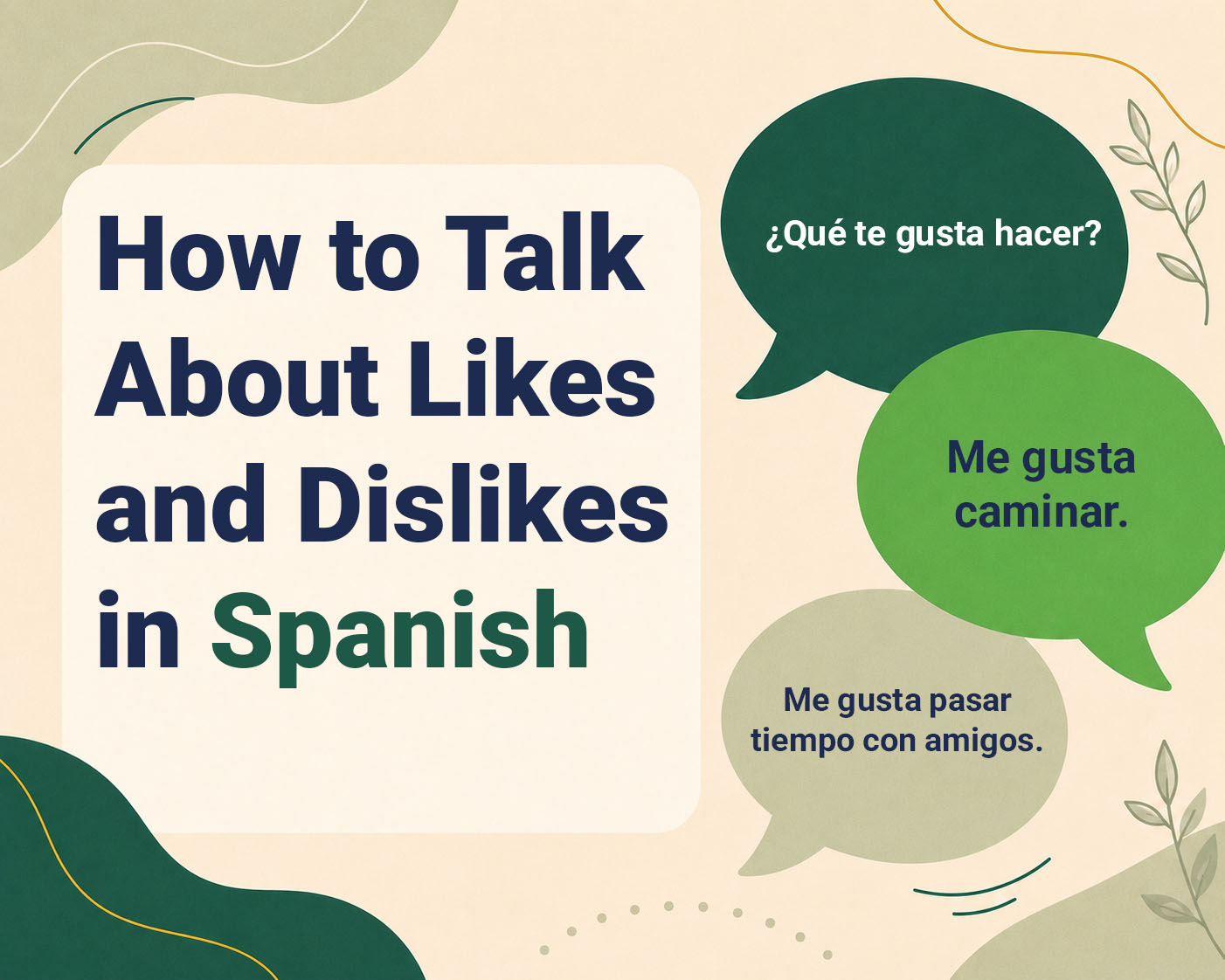
¿Qué te gusta hacer?
Natural translation: What do you like to do?
Pronunciation: keh teh GOOS-tah ah-SEHR
Word for word: Qué = what · te = to you · gusta = is pleasing · hacer = to do
This is an informal question addressed to one person. Although the natural translation is “What do you like to do?”, the Spanish structure is closer to “What is pleasing to you to do?”
That difference explains the small word te. Spanish is not treating “you” as the person performing the action of liking. Instead, te identifies the person to whom the activity is pleasing.
The letter h in hacer is silent, so the word begins with the vowel. In Latin American Spanish, c before e usually sounds like English s, giving the approximate pronunciation ah-SEHR.
With someone you address formally, te becomes le:
¿Qué le gusta hacer? — What do you like to do? (formal)
The same question can also mean “What does he/she like to do?” when the person is clear from context. If clarification is needed, Spanish can add a usted, a él or a ella.
For more than one person in Latin America, use:
¿Qué les gusta hacer? — What do you all like to do?
In Spain, you will also hear the informal plural ¿Qué os gusta hacer? with vosotros.
Me gusta followed by an activity
Me gusta caminar.
Natural translation: I like to walk. / I like walking.
Pronunciation: meh GOOS-tah kah-mee-NAHR
Word for word: Me = to me · gusta = is pleasing · caminar = to walk
When the thing you like is an activity, Spanish normally places the infinitive—the unchanged verb form—after me gusta.
English can use either “to walk” or “walking.” Spanish simply uses caminar:
Me gusta + infinitive
This pattern appears in several useful examples:
- Me gusta leer libros. — I like to read books.
- Me gusta escuchar música. — I like to listen to music.
- Me gusta ir a nadar. — I like to go swimming.
- Me gusta dormir mucho. — I like to sleep a lot.
Notice that gusta remains singular even when several words follow it. The entire activity—reading books, listening to music or going swimming—is treated as one thing that is pleasing.
Spanish infinitives end in -ar, -er or -ir. Their final r should be audible, but it is lighter than the typical English r.
Likes connected to people and everyday life
Me gusta pasar tiempo con amigos.
Natural translation: I like to spend time with friends.
Pronunciation: meh GOOS-tah pah-SAHR TYEHM-poh kohn ah-MEE-gohs
Word for word: Me = to me · gusta = is pleasing · pasar tiempo = to spend time · con amigos = with friends
This sentence follows the same me gusta + infinitive pattern, even though the activity contains several words.
A related recorded phrase Me gusta pasar tiempo con la familia means “I like to spend time with family.”
Spanish commonly says con la familia with the definite article la, where English often says simply “with family.” By contrast, the recorded phrase uses con amigos without an article to refer to friends in general.
Me gusta viajar.
Natural translation: I like to travel. / I like travelling.
Pronunciation: meh GOOS-tah vyah-HAHR
Word for word: Me = to me · gusta = is pleasing · viajar = to travel
The j in viajar has a breathy sound similar to a strong English h. The final syllable is stressed: vyah-HAHR.
Another useful example is Me gusta visitar Italia—“I enjoy visiting Italy.” Spanish still uses the ordinary verb gustar, even though “enjoy” is the more natural English translation in that sentence.
This is a useful reminder that natural translations do not always preserve the same verb. Both English “I like visiting Italy” and “I enjoy visiting Italy” can correspond naturally to Me gusta visitar Italia.
Liking a thing: me gusta la pizza
Me gusta la pizza.
Natural translation: I like pizza.
Pronunciation: meh GOOS-tah lah PEET-sah
Word for word: Me = to me · gusta = is pleasing · la pizza = the pizza
When Spanish talks about liking something in general, it commonly includes the definite article el or la. English says “I like pizza,” but Spanish says Me gusta la pizza, literally closer to “Pizza is pleasing to me.”
The same pattern works with other singular or uncountable nouns:
- Me gusta el café. — I like coffee.
- Me gusta la música. — I like music.
- Me gusta el silencio. — I like silence.
The article agrees with the noun: el with a masculine singular noun and la with a feminine singular noun.
In most of Latin America, the z in pizza is pronounced like s, although the pronunciation of this borrowed word can vary somewhat by speaker and region.
Gusta or gustan?
The form of gustar agrees with the thing that is liked, not with the person who likes it.
Use gusta before:
- one singular thing: Me gusta la pizza.
- an activity expressed by an infinitive: Me gusta cocinar.
- a longer activity: Me gusta pasar tiempo con amigos.
Use gustan before plural things:
- Me gustan los libros. — I like books.
- Me gustan las comedias románticas. — I like romantic comedies.
- Me gustan las matemáticas. — I like mathematics.
The person can change without automatically changing gusta:
- Me gusta... — I like...
- Te gusta... — You like... (informal singular)
- Le gusta... — You like... (formal), or he/she likes...
- Nos gusta... — We like...
- Les gusta... — You all like..., or they like...
Only the thing or activity after the verb determines whether the usual form is gusta or gustan.
Asking about food preferences
¿Qué te gusta comer?
Natural translation: What do you like to eat?
Pronunciation: keh teh GOOS-tah koh-MEHR
Word for word: Qué = what · te = to you · gusta = is pleasing · comer = to eat
This question keeps the same structure as ¿Qué te gusta hacer?, but replaces hacer with comer.
The written accent in qué marks it as a question word. Without the accent, que usually means “that” or “which.”
Possible answers do not have to repeat comer. You can answer with a food directly:
Me gusta la pizza. — I like pizza.
The formal question is ¿Qué le gusta comer? For a group in Latin America, use ¿Qué les gusta comer?
Saying that you do not like something
No me gusta el café.
Natural translation: I don’t like coffee.
Pronunciation: noh meh GOOS-tah ehl kah-FEH
Word for word: No = not · me = to me · gusta = is pleasing · el café = the coffee
To make me gusta negative, place no before the whole expression:
- Me gusta el café. — I like coffee.
- No me gusta el café. — I don’t like coffee.
The article el remains because the sentence refers to coffee in general.
For a softer dislike, Spanish can add mucho to the negative expression:
No me gusta mucho. — I don’t like it very much.
This can sound less blunt than a direct No me gusta. It is useful when commenting on someone’s suggestion, a meal or an activity without expressing a strong aversion.
If you want to say “I don’t like it,” the pronoun lo can refer to the situation or thing already being discussed:
No me gusta. — I don’t like it.
Spanish does not need to add a separate word equivalent to English “it” in this structure because the subject can remain understood.
A stronger dislike: odio
Odio el queso.
Natural translation: I hate cheese.
Pronunciation: OH-dyoh ehl KEH-soh
Word for word: Odio = I hate · el queso = the cheese
Odio is much stronger than no me gusta. It means “I hate,” so it is best reserved for a genuinely strong dislike or an intentionally emphatic comment.
Unlike gustar, odiar behaves more like the English verb “to hate.” The ending of odio identifies the speaker as “I,” and the thing hated follows as the object.
Other useful examples include:
Odio mi trabajo. — I hate my job.
This is a forceful statement. No me gusta mi trabajo would mean “I don’t like my job” and sound less intense.
The qu in queso represents a k sound, while the u is silent: KEH-soh.
Talking about another person’s likes
A ella le gusta su trabajo.
Natural translation: She likes her job.
Pronunciation: ah EH-yah leh GOOS-tah soo trah-BAH-hoh
Word for word: A ella = to her · le = to her · gusta = is pleasing · su trabajo = her job
Le gusta su trabajo could mean “he likes his job,” “she likes her job” or formal “you like your job.” The phrase a ella removes the ambiguity and emphasizes that the person is a woman.
Spanish keeps both a ella and le. The longer phrase clarifies or emphasizes the person, while le remains part of the normal gustar structure.
The ll in ella is commonly pronounced like English y in much of Latin America, although regional pronunciations vary.
A él no le gusta ver televisión.
Natural translation: He doesn’t like to watch television.
Pronunciation: ah ehl noh leh GOOS-tah behr teh-leh-bee-SYOHN
Word for word: A él = to him · no = not · le = to him · gusta = is pleasing · ver televisión = to watch television
Here, a él makes “he” explicit, while no creates the negative. The written accent distinguishes masculine él (“he/him”) from the article el (“the”).
As with other activities, gusta remains singular before the infinitive phrase ver televisión.
For more than one person, le becomes les:
Les gusta el silencio. — They like silence.
Without more context, les can also refer to “you all.” Spanish can add a ellos, a ellas or a ustedes when clarification is useful.
Formal and informal questions
¿Te gusta cocinar?
Natural translation: Do you like to cook? / Do you like cooking?
Pronunciation: teh GOOS-tah koh-see-NAHR
Word for word: Te = to you · gusta = is pleasing · cocinar = to cook
This is the informal singular form used with tú. Spanish does not add an auxiliary verb equivalent to English “do.” The statement and question contain the same words; punctuation and intonation show that this is a question.
One recorded answer gives a preference and then adds a limitation:
Me gusta cocinar, pero no soy bueno en eso. — I like to cook, but I’m not good at it.
The speaker uses masculine bueno. A woman would normally say buena.
¿Le gusta este?
Natural translation: Do you like this one? (formal)
Pronunciation: leh GOOS-tah EHS-teh
Word for word: Le = to you · gusta = is pleasing · este = this one
In a shopping context, ¿Le gusta este? is a polite question addressed to a customer. The form le corresponds to formal usted.
The ending of este is masculine because it replaces a masculine item. For a feminine item, use esta:
¿Le gusta esta? — Do you like this one? (feminine item)
Informally, the question becomes ¿Te gusta este? or ¿Te gusta esta?
Because le can also mean “to him” or “to her,” context tells you whether the question means formal “Do you like this one?” or “Does he/she like this one?” In a face-to-face shop exchange, the formal meaning is usually clear.
Expressing a preference with preferir
¿Prefieres té o café?
Natural translation: Do you prefer tea or coffee?
Pronunciation: preh-FYEH-rehs teh oh kah-FEH
Word for word: Prefieres = you prefer · té = tea · o = or · café = coffee
Use preferir when choosing between alternatives or saying that one option suits you better than another.
Prefieres is informal singular. The formal question is ¿Prefiere té o café? For a group in Latin America, ask ¿Prefieren té o café?
The written accent distinguishes té (“tea”) from te, the object pronoun seen in te gusta.
Prefiero el café negro.
Natural translation: I prefer black coffee.
Pronunciation: preh-FYEH-roh ehl kah-FEH NEH-groh
Word for word: Prefiero = I prefer · el café negro = black coffee
The answer changes preferir to prefiero. Both prefiero and prefieres contain the vowel change e → ie in the stressed part of the verb.
Another recorded phrase uses preferir before an activity:
Prefiero quedarme en casa. — I prefer to stay at home.
Here, quedarme includes me, giving the meaning “to stay myself” or simply “to stay.” The pronoun attaches to the end of the infinitive.
Preferir does not require you to name both options. Prefiero quedarme en casa can be understood as a preference over going out, even if the alternative has already been established by the conversation.
Saying what you like most
¿Qué asignaturas te gustan más en el colegio?
Natural translation: What subjects do you like the most at school?
Pronunciation: keh ah-seeg-nah-TOO-rahs teh GOOS-tahn mahs ehn ehl koh-LEH-hyoh
Word for word: Qué asignaturas = what subjects · te = to you · gustan = are pleasing · más = more/most · en el colegio = at school
This sentence shows gustan because asignaturas is plural. It also uses más to ask which subjects the person likes most.
The phrase lo que más me gusta means “what I like most” or “the thing I like most.” It is useful when highlighting a favourite part of something:
- Lo que más me gusta es la música. — What I like most is the music.
- Lo que más me gusta es viajar. — What I like most is travelling.
When the answer names several subjects directly, a simple and natural structure is Me gustan más las matemáticas y las ciencias (“I like mathematics and science the most”).
Talking about favourites
Es mi plato favorito.
Natural translation: It’s my favourite dish.
Pronunciation: ehs mee PLAH-toh fah-boh-REE-toh
Word for word: Es = it is · mi = my · plato = dish · favorito = favourite
Spanish can describe a favourite directly with favorito or favorita. The adjective agrees with the noun:
- mi plato favorito — my favourite dish
- mi comida favorita — my favourite food
- mi libro favorito — my favourite book
- mi película favorita — my favourite film
In most of Latin America, the letter v in favorito is pronounced much like Spanish b, not like the English v.
¿Tienes algún programa de televisión favorito?
Natural translation: Do you have any favourite TV shows?
Pronunciation: TYEH-nehs ahl-GOON proh-GRAH-mah deh teh-leh-bee-SYOHN fah-boh-REE-toh
Word for word: Tienes = you have · algún = any/some · programa de televisión = TV show · favorito = favourite
The Spanish sentence is singular—literally, “Do you have any favourite TV show?”—although the natural English question commonly uses plural “shows.”
Programa is masculine despite ending in -a, so the phrase uses algún programa and favorito.
The informal tienes can become formal tiene:
¿Tiene algún programa de televisión favorito? — Do you have any favourite TV shows? (formal)
Another recorded example uses preferida with the same general idea:
Es mi estación preferida. — It’s my favourite season.
Both favorito/a and preferido/a can express “favourite.” The best choice often depends on the noun and individual usage rather than a sharp difference in meaning.
Likes in conversations about television
¿Qué te gusta ver en la televisión?
Natural translation: What do you like to watch on TV?
Pronunciation: keh teh GOOS-tah behr ehn lah teh-leh-bee-SYOHN
Word for word: Qué = what · te = to you · gusta = is pleasing · ver = to watch · en la televisión = on television
Once again, gusta is followed by an infinitive activity: ver (“to watch”).
There are several useful ways to continue the topic:
- Me gusta ver programas de televisión basados en historias reales. — I like to watch TV shows based on true stories.
- Entre tú y yo, me gusta ver comedias románticas en la televisión. — Between you and me, I like to watch romantic comedies on TV.
These examples show how a simple me gusta ver can introduce a much more specific preference. Once the opening is familiar, the rest of the sentence carries the information that makes the conversation personal.
In entre tú y yo, Spanish uses tú and yo, not the forms ti and mí that appear after many other prepositions. The expression is fixed as “between you and me.”
Liking an idea or someone’s way of thinking
¡Me gusta la forma en que piensas!
Natural translation: I like the way you think!
Pronunciation: meh GOOS-tah lah FOHR-mah ehn keh PYEHN-sahs
Word for word: Me = to me · gusta = is pleasing · la forma = the way/form · en que = in which/that · piensas = you think
Preferences are not limited to objects and activities. Me gusta la forma en que... lets you express approval of how someone does something.
The recorded phrase is informal because piensas corresponds to tú. Formally, it becomes:
Me gusta la forma en que piensa. — I like the way you think. (formal)
The same structure can be adapted to other ideas:
- Me gusta la forma en que hablas. — I like the way you speak.
- Me gusta la forma en que escribes. — I like the way you write.
These additional examples are not separate recordings, but they show how the recorded phrase provides a reusable structure.
Liking something is different from feeling like doing it
Spanish distinguishes a general preference from a desire at a particular moment.
Compare:
- Me gusta salir. — I like going out in general.
- Tengo ganas de salir esta noche. — I feel like going out tonight.
The second sentence describes the speaker’s present inclination, not necessarily a lasting preference.
¿Qué tienes ganas de hacer?
Natural translation: What do you feel like doing?
Pronunciation: keh TYEH-nehs GAH-nahs deh ah-SEHR
Word for word: Qué = what · tienes = you have · ganas de = desire to/feel like · hacer = to do
The expression tener ganas de + infinitive means “to feel like doing something.” The plural-looking ganas remains part of the expression.
Both positive and negative examples are useful here:
- Tengo ganas de salir esta noche. — I feel like going out tonight.
- No tengo ganas de ir a casa. — I don’t feel like going home.
This distinction makes your meaning more precise. No me gusta ir a casa would suggest that going home is something you generally dislike. No tengo ganas de ir a casa means that you do not feel like going home now.
Stronger enthusiasm: me encanta
Another common expression is me encanta, meaning “I love” something or “I really like” it.
It follows a structure similar to me gusta:
- Me encanta la música. — I love music.
- Me encanta viajar. — I love travelling.
- Me encantan los libros. — I love books.
As with gusta/gustan, singular encanta becomes plural encantan when the things that delight you are plural.
Me encanta is stronger and more enthusiastic than me gusta, but usually less harsh in social effect than odio on the negative side. These examples provide useful additional context, although they are not among the recorded phrases featured in this article.
Agreeing and disagreeing about preferences
When someone shares a preference, a natural conversation often continues with agreement or contrast.
Useful responses include:
- A mí también. — Me too.
- A mí tampoco. — Me neither.
- A mí sí. — I do. (in contrast to someone who does not)
- A mí no. — I don’t. (in contrast to someone who does)
For example:
Me gusta el café.
I like coffee.
>
A mí también.
Me too.
Or:
No me gusta el café.
I don’t like coffee.
>
A mí tampoco.
Me neither.
The phrase a mí adds emphasis. The written accent distinguishes mí (“me” after a preposition) from possessive mi (“my”), as in mi plato favorito.
These short responses are useful additions for real conversations, and are presented here as supplementary, unrecorded examples.
A more natural range than like or hate
Every preference does not have to be expressed as either me gusta or odio. Spanish offers several degrees:
| Spanish | Natural meaning |
|---|---|
| Me encanta. | I love it. |
| Me gusta mucho. | I like it a lot. |
| Me gusta. | I like it. |
| No me gusta mucho. | I don’t like it very much. |
| No me gusta. | I don’t like it. |
| Odio... | I hate... |
This range helps you match the strength of the language to the strength of the opinion. Odio can sound exaggerated if you merely prefer tea to coffee. No me gusta mucho may be a better social choice when you want to express a mild dislike.
Prefiero... adds another possibility. It does not necessarily mean that you dislike the alternative; it simply identifies the option you would choose.
The useful patterns behind everyday preferences
Once the main structures are familiar, many conversations about tastes become easier to understand:
- ¿Qué te gusta hacer? — What do you like to do?
- Me gusta + infinitive. — I like doing something.
- Me gusta + singular noun. — I like one thing or an uncountable thing.
- Me gustan + plural noun. — I like several things.
- No me gusta... — I don’t like...
- Odio... — I hate...
- Prefiero... — I prefer...
- Lo que más me gusta... — What I like most...
- Es mi ... favorito/a. — It’s my favourite...
- Tengo ganas de... — I feel like...
These are not only grammar patterns. They are ways to continue a conversation: ask what someone enjoys, explain your own interests, compare options, discover shared tastes and disagree without making the exchange uncomfortable.
The native-speaker recordings also reveal details that a written explanation cannot fully show, including the rhythm of me gusta, the vowel change in prefiero, and the natural connection between short words in questions such as ¿Qué te gusta hacer?
Hear likes and dislikes in complete Spanish phrases
The recorded examples in this article are spoken by a native Latin American Spanish speaker.
Complete everyday sentences, native-speaker audio and regular review help these expressions become familiar.
The main examples in this article are taken from the LinguaBoost Spanish course and recorded by a native Spanish speaker.
Ready to speak more Spanish?
Build on the phrases in this article with structured practice, native-speaker audio and built-in review designed for everyday conversation.