
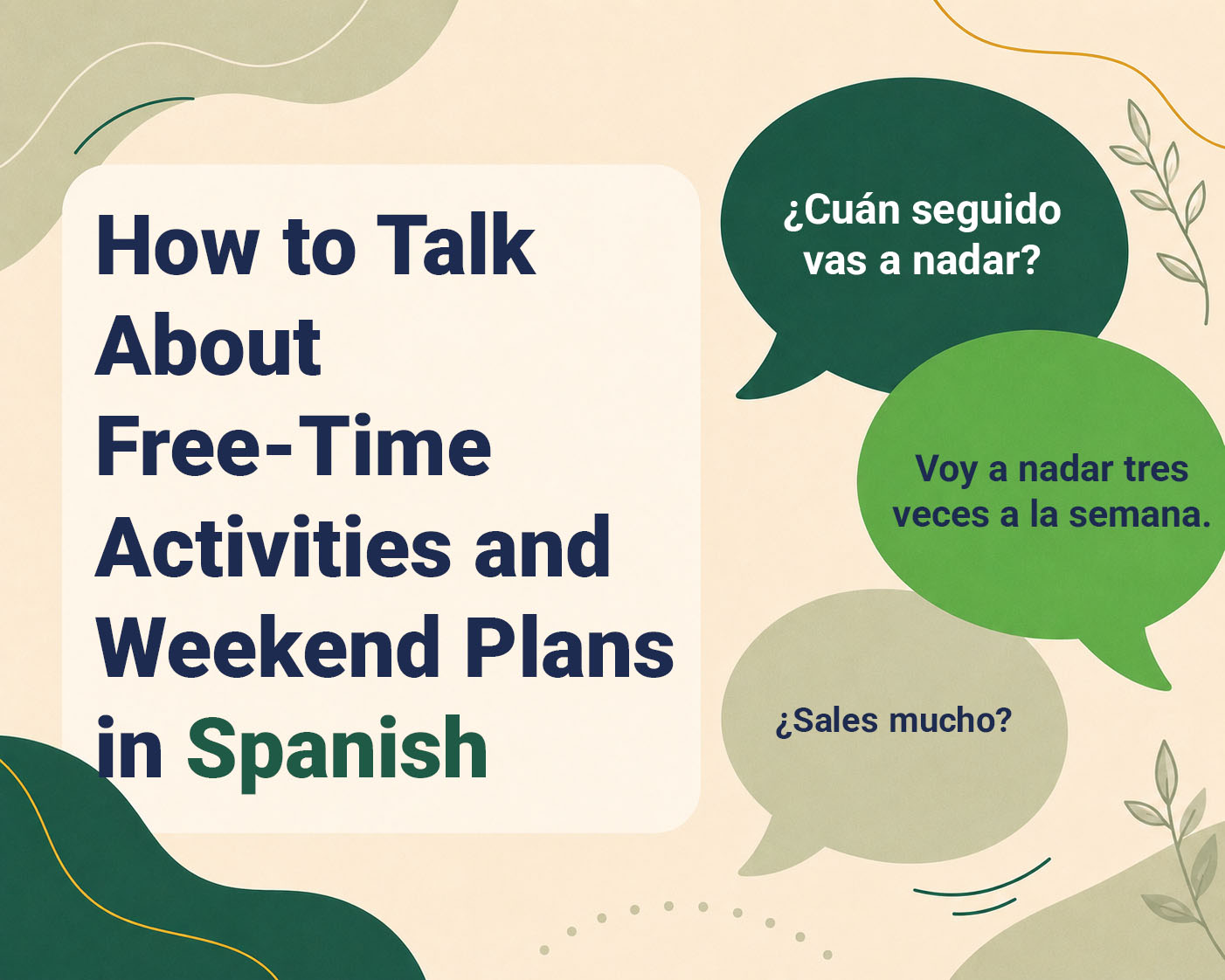
A conversation about free time becomes more useful when it moves beyond naming hobbies. You may want to ask how often someone does an activity, explain whether you usually go out, describe a weekend plan or suggest doing something together.
This article focuses on those conversational steps. For me gusta, no me gusta, odio and prefiero, see the separate article about likes and dislikes in Spanish. The main phrases below are spoken by a native Latin American Spanish speaker.
Asking about frequency
¿Cuán seguido vas a nadar?
Natural translation: How often do you go swimming? Pronunciation: kwahn seh-GHEE-doh bahs ah nah-DAHR
Playback: Normal speed and 0.5× slow speed
¿Cuán seguido…? asks how frequently something happens. The wording is understood in Latin America, although regional preferences vary. Two useful alternatives are ¿Con qué frecuencia…? and the conversational ¿Cada cuánto…? The formal version is ¿Cuán seguido va a nadar?
Voy a nadar tres veces a la semana.
Natural translation: I go swimming three times a week. Pronunciation: boy ah nah-DAHR trehs BEH-sehs ah lah seh-MAH-nah
Playback: Normal speed and 0.5× slow speed
The pattern [number] veces a la semana works with many activities:
- una vez a la semana — once a week
- dos veces a la semana — twice a week
- todos los fines de semana — every weekend
Keep the time expression and replace the activity: Corro dos veces a la semana or Juego al tenis los sábados.
Talking about going out
¿Sales mucho?
Natural translation: Do you go out much? Pronunciation: SAH-lehs MOO-choh
Playback: Normal speed and 0.5× slow speed
Here salir means going out socially. The question can lead naturally to restaurants, friends, films, concerts or weekend routines. The formal form is ¿Sale mucho? Short answers include Sí, bastante, A veces and No mucho.
Prefiero quedarme en casa.
Natural translation: I prefer to stay home. Pronunciation: preh-FYEH-roh keh-DAHR-meh ehn KAH-sah
Playback: Normal speed and 0.5× slow speed
The pronoun is attached to the infinitive: quedarme, quedarte, quedarse. En casa normally appears without an article when it means “at home.” This phrase answers a question about someone’s social routine; the broader use of preferir belongs in the likes-and-dislikes article.
Describing a weekend plan
Planeo ir a pescar.
Natural translation: I plan to go fishing. Pronunciation: plah-NEH-oh eer ah pehs-KAHR
Playback: Normal speed and 0.5× slow speed
Planeo + infinitive states a plan directly:
- Planeo visitar a unos amigos. — I plan to visit some friends.
- Planeo descansar. — I plan to rest.
- Planeo salir el sábado. — I plan to go out on Saturday.
In everyday speech, Voy a… is also common: Voy a ir a pescar means “I’m going to go fishing.” Ask another person ¿Qué planeas hacer este fin de semana? The formal form is ¿Qué planea hacer…?
Suggesting something together
¿Qué tal un paseo en bicicleta?
Natural translation: How about a bike ride? Pronunciation: keh tahl oon pah-SEH-oh ehn bee-see-KLEH-tah
Playback: Normal speed and 0.5× slow speed
¿Qué tal…? introduces a friendly suggestion:
- ¿Qué tal una película? — How about a film?
- ¿Qué tal mañana? — How about tomorrow?
- ¿Qué tal un café? — How about a coffee?
Vamos de picnic.
Natural translation: Let’s go on a picnic. Pronunciation: BAH-mohs deh peek-NEEK
Playback: Normal speed and 0.5× slow speed
Vamos can work as a direct invitation. Spanish also uses Vamos a + infinitive, as in Vamos a caminar (“Let’s go for a walk”). A natural positive response is Claro, ¡suena divertido! To decline politely, say Lo siento, no puedo este fin de semana and suggest another time.
Build a short free-time conversation
Practise the phrases as a sequence:
¿Sales mucho?
Do you go out much?
>
No mucho. Planeo ir a pescar este fin de semana.
Not much. I plan to go fishing this weekend.
>
¿Qué tal un paseo en bicicleta el domingo?
How about a bike ride on Sunday?
>
Claro, ¡suena divertido!
Sure, that sounds fun!
Change the activity, day and frequency while keeping the sentence frames. The practical goal is to move from a routine to a plan and then to a shared suggestion.
Practise Spanish for Real Weekend Conversations
Learn practical Spanish phrases through native-speaker recordings and regular review.
Habits, current plans and future intentions
Spanish uses different structures depending on whether an activity is habitual or planned for a particular weekend. Los fines de semana juego al tenis describes a regular habit. Este sábado juego al tenis con Marta can use the present tense for a fixed arrangement. Voy a jugar al tenis presents the activity as an intention, while Me gustaría jugar al tenis expresses a wish rather than a confirmed plan.
| Meaning | Spanish pattern | Example |
|---|---|---|
| Regular habit | los fines de semana + present | Los fines de semana salgo con mis amigos. |
| Fixed arrangement | time + present | El sábado cenamos en casa de Ana. |
| Intention | ir a + infinitive | Voy a visitar a mis padres. |
| Wish or tentative idea | me gustaría + infinitive | Me gustaría ir a la playa. |
| Possibility | quizá(s) + verb | Quizá vayamos al cine. |
Useful activity combinations
Many weekend activities are learned most effectively as verb-and-noun combinations. Spanish says hacer deporte, dar un paseo, ver una película, escuchar música, salir con amigos and quedar con alguien. The verb quedar is especially useful in Spain for arranging to meet: He quedado con Laura a las cinco. In much of Latin America, speakers may prefer voy a ver a Laura, voy a reunirme con Laura or a locally common equivalent.
| Activity | Complete Spanish phrase | Useful detail |
|---|---|---|
| Go for a walk | Voy a dar un paseo por el parque. | por el parque describes movement through the park. |
| Meet friends | Voy a quedar con unos amigos. | unos amigos means some friends, not necessarily all of them. |
| Stay home | Prefiero quedarme en casa. | quedarse needs the reflexive pronoun: me quedo. |
| Go out for dinner | Vamos a salir a cenar. | salir a + infinitive gives the purpose of going out. |
| Rest | El domingo quiero descansar. | querer + infinitive states what the speaker wants to do. |
Making, accepting and declining an invitation
An invitation needs more than the name of an activity. ¿Quieres ir al cine? is direct and friendly. ¿Te apetece ir al cine?, common in Spain, asks whether the idea appeals to the listener. ¿Por qué no vamos al cine? presents the activity as a suggestion. A useful invitation normally adds a day or time: ¿Quieres ir al cine el sábado por la tarde?
| Function | Natural response |
|---|---|
| Accept enthusiastically | ¡Sí, claro! Me encantaría. |
| Accept and confirm | Perfecto. ¿A qué hora quedamos? |
| Decline politely | Lo siento, este sábado no puedo. |
| Offer another time | El sábado no puedo, pero ¿qué tal el domingo? |
| Remain tentative | Puede ser. Te confirmo mañana. |
Time expressions that prevent ambiguity
Este fin de semana means the weekend currently approaching or in progress, while el próximo fin de semana points to the following one. El sábado can mean this Saturday when the context is clear. Use por la mañana, por la tarde and por la noche for broad parts of the day, but use a las cinco for a clock time. A complete plan might be: El sábado por la mañana voy a hacer deporte y por la noche voy a cenar con unos amigos.
The main examples in this article are taken from the LinguaBoost Spanish course and recorded by a native Spanish speaker.
Ready to speak more Spanish?
Build on the phrases in this article with structured practice, native-speaker audio and built-in review designed for everyday conversation.
Explore the Spanish course