
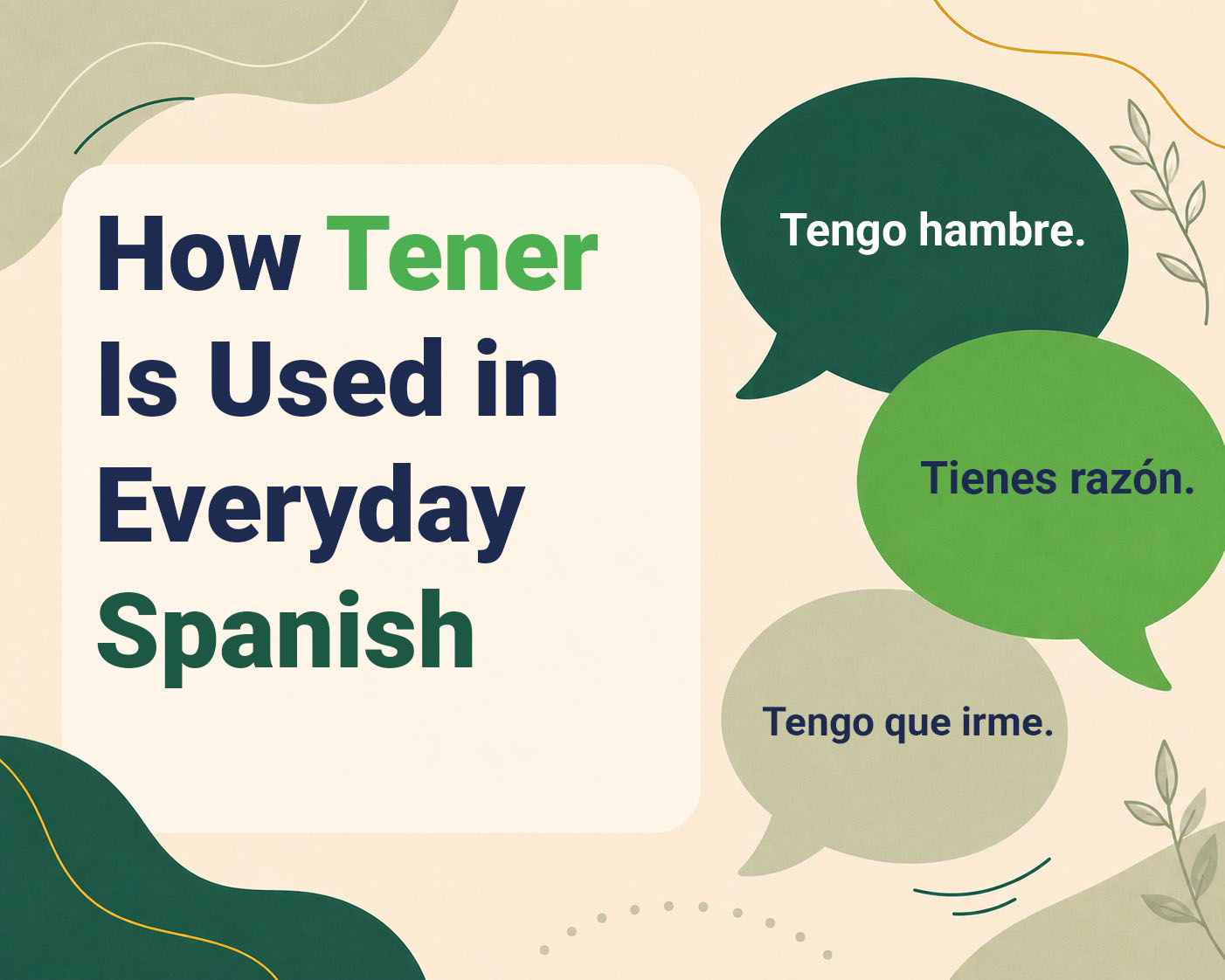
The Spanish verb tener is usually introduced as “to have,” and that’s certainly one of its main meanings. But everyday Spanish uses it in many situations where English would choose a completely different verb.
Spanish speakers use tener to talk about age, hunger, feelings, pain, obligation and what they feel like doing. Once you start noticing these expressions, you’ll hear forms such as tengo, tienes and tiene everywhere.
You can hear every main example spoken by a native Latin American Spanish speaker. The pronunciation guides are approximate, but they can help English speakers get close to the sound.
The most useful forms of tener
The form of tener changes according to who has or experiences something:
| Spanish | Meaning | Form of tener |
|---|---|---|
| yo | I | tengo |
| tú | you — informal, singular | tienes |
| él / ella / usted | he / she / you — formal | tiene |
| nosotros / nosotras | we | tenemos |
| ellos / ellas / ustedes | they / you — plural | tienen |
In Spain, you’ll also hear vosotros tenéis for the informal plural “you have.” Across most of Latin America, ustedes tienen is used when speaking to more than one person, whether the situation is formal or informal.
Spanish often leaves the subject pronoun out because the verb form already provides that information. Tengo normally means “I have” without needing to say yo.
Having or owning something
Tengo un perro.
Natural translation: I have a dog.
Pronunciation: TEN-goh oon PEH-rroh
Word for word: Tengo = I have · un = a · perro = dog
This is tener in its most direct sense: having or owning something. You can keep tengo and change what follows it:
- Tengo un gato. — I have a cat.
- Tengo dos gatos y un perro. — I have two cats and a dog.
- Tengo una gran familia. — I have a large family.
The double rr in perro is rolled more strongly than a single Spanish r. If you can’t produce the full roll yet, concentrate on making the sound clearly different from the softer r in a word such as pero (“but”).
¿Tienes hijos?
Natural translation: Do you have children?
Pronunciation: TYEH-nehs EE-hohs
Word for word: Tienes = you have · hijos = children
Spanish doesn’t need an extra verb equivalent to English “do” when forming this question. The statement Tienes hijos means “You have children,” while the question ¿Tienes hijos? uses the same words with question intonation.
This version is informal and addressed to one person. The formal version is:
¿Tiene hijos?
Natural translation: Do you have children? — formal
Pronunciation: TYEH-neh EE-hohs
Word for word: Tiene = you have (formal) · hijos = children
The h in hijos is silent. The j has a breathy sound similar to a strong English h.
Talking about age
¿Cuántos años tienes?
Natural translation: How old are you?
Pronunciation: KWAHN-tohs AH-nyohs TYEH-nehs
Word for word: Cuántos = how many · años = years · tienes = you have
English asks how old someone is, but Spanish asks how many years they have. The question literally means “How many years do you have?”
The letter ñ in años sounds similar to ny in the English word “canyon.” It’s a different letter from n, and leaving off the mark changes the word completely: años means “years,” while anos refers to anuses.
The formal question is ¿Cuántos años tiene? (“How old are you?”). The same words can also mean “How old is he?” or “How old is she?” when the person is clear from context.
Tengo cuarenta años.
Natural translation: I’m forty years old.
Pronunciation: TEN-goh kwah-REHN-tah AH-nyohs
Word for word: Tengo = I have · cuarenta = forty · años = years
The natural English translation uses “I am,” but the Spanish structure is literally “I have forty years.”
You can replace cuarenta with any age:
- Tengo veinte años. — I’m twenty years old.
- Tengo treinta y cinco años. — I’m thirty-five years old.
- Tengo sesenta años. — I’m sixty years old.
Don’t use soy or estoy to give your age. In Spanish, age belongs with tener.
Being hungry
Tengo hambre.
Natural translation: I’m hungry.
Pronunciation: TEN-goh AHM-breh
Word for word: Tengo = I have · hambre = hunger
Spanish treats hunger as something you have: tener hambre, literally “to have hunger.”
Thirst follows the same pattern:
Tengo sed. — I’m thirsty. Literally: “I have thirst.”
The h in hambre is silent, so the word begins directly with the a sound. Although hambre is a noun, the natural English translation uses the adjective “hungry.”
Saying someone is right
Tienes razón.
Natural translation: You are right.
Pronunciation: TYEH-nehs rrah-SOHN
Word for word: Tienes = you have · razón = reason
Spanish uses tener razón—literally, “to have reason”—where English uses “to be right.”
To disagree, you can say:
No tienes razón. — You are wrong. Literally: “You don’t have reason.”
The formal version is Tiene razón (“You are right”). This is also a useful polite response when someone has made a good point or corrected something accurately.
The final syllable of razón carries the stress. In most of Latin America, the z sounds like an English s.
Saying what you feel like doing
Tengo ganas de salir esta noche.
Natural translation: I feel like going out tonight.
Pronunciation: TEN-goh GAH-nahs deh sah-LEER EHS-tah NOH-cheh
Word for word: Tengo = I have · ganas = desire · de = to/of · salir = to go out · esta noche = tonight
The expression tener ganas de means to feel like doing something or to be in the mood for it. It’s followed by an infinitive—the unchanged verb form ending in -ar, -er or -ir.
For example:
- Tengo ganas de bañarme. — I feel like taking a bath.
- No tengo ganas de ir a casa. — I don’t feel like going home.
- Él tiene ganas de comer algo. — He feels like eating something.
The plural-looking ganas is part of the expression, even when one person is speaking. Don’t change it to singular gana here.
Expressing fear
¿De qué tienes miedo?
Natural translation: What are you scared of?
Pronunciation: deh keh TYEH-nehs MYEH-doh
Word for word: De = of · qué = what · tienes = you have · miedo = fear
The Spanish expression tener miedo means “to be afraid” or “to be scared.” Word for word, the question asks, “Of what do you have fear?”
The written accent in qué is important because this is a question word. Without the accent, que normally means “that” or “which.”
The formal version is ¿De qué tiene miedo? (“What are you scared of?”).
Tengo miedo de la oscuridad.
Natural translation: I’m scared of the dark.
Pronunciation: TEN-goh MYEH-doh deh lah ohs-koo-ree-DAHD
Word for word: Tengo = I have · miedo = fear · de = of · la = the · oscuridad = darkness
After tener miedo, Spanish commonly uses de before the thing or action causing the fear:
- miedo de la oscuridad — fear of the dark
- miedo de volar — fear of flying
- miedo de decir la verdad — fear of telling the truth
You’ll also hear miedo a in many regions and contexts, especially before nouns: miedo a las arañas (“fear of spiders”). Both patterns are common, and the exact preference can vary.
Talking about pain
Tengo dolor de cabeza.
Natural translation: I have a headache.
Pronunciation: TEN-goh doh-LOHR deh kah-BEH-sah
Word for word: Tengo = I have · dolor = pain · de = of · cabeza = head
Spanish describes many aches with tener dolor de, literally “to have pain of.” The body part follows de:
- dolor de espalda — back pain
- dolor de estómago — stomachache
- dolor de garganta — sore throat
In everyday speech, you may also hear Me duele la cabeza (“My head hurts”). The meaning is similar, but the structure is different.
In Latin American Spanish, the z in cabeza sounds like s. The stress falls on be: kah-BEH-sah.
Tener que: saying what you have to do
Tengo que irme. Mis hijos están esperando.
Natural translation: I have to go. My children are waiting.
Pronunciation: TEN-goh keh EER-meh. mees EE-hohs ehs-TAHN ehs-peh-RAHN-doh
Word for word: Tengo = I have · que = to · irme = leave/go myself · mis = my · hijos = children · están = are · esperando = waiting
Tener que + infinitive expresses obligation or necessity. It corresponds to “to have to” in English:
- Tengo que trabajar. — I have to work.
- Tienes que esperar. — You have to wait.
- Tenemos que hablar. — We have to talk.
In tengo que irme, the pronoun me is attached to ir. The phrase means that the speaker needs to leave, not simply that they need to go somewhere.
The h in hijos remains silent, while the j carries the strong breathy sound.
Talking about a past obligation
Tuve que ir a la farmacia hoy.
Natural translation: I had to go to the pharmacy today.
Pronunciation: TOO-beh keh eer ah lah fahr-MAH-syah oy
Word for word: Tuve = I had · que = to · ir = go · a = to · la = the · farmacia = pharmacy · hoy = today
Tuve is a past form of tener. Together with que, it describes something that became necessary and was completed: “I had to.”
The pattern remains the same even though the form of tener changes:
- Tengo que ir. — I have to go.
- Tuve que ir. — I had to go.
- Tendré que ir. — I’ll have to go.
The h in hoy is silent, so the word sounds approximately like “oy.” In farmacia, the cia ending sounds roughly like “syah” in Latin American Spanish.
Tener isn’t used for every English “have”
English uses “have” both for possession and as a helping verb: “I have a dog” and “I have eaten.” Spanish separates those uses.
Use tener for possession and the expressions covered in this article:
Tengo un perro. — I have a dog.
But Spanish normally uses haber as the helping verb before a past participle:
He comido. — I have eaten.
Using tengo comido as a direct translation of “I have eaten” would normally be incorrect. Recognizing the difference between tener and haber prevents one of the most common literal-translation mistakes.
Informal and formal forms
Here’s how some common expressions change when you address one person formally:
| Meaning | Informal | Formal |
|---|---|---|
| Do you have children? | ¿Tienes hijos? | ¿Tiene hijos? |
| How old are you? | ¿Cuántos años tienes? | ¿Cuántos años tiene? |
| You are right. | Tienes razón. | Tiene razón. |
| What are you scared of? | ¿De qué tienes miedo? | ¿De qué tiene miedo? |
| You have to wait. | Tienes que esperar. | Tiene que esperar. |
Use tú forms such as tienes with friends, relatives, children and people speaking in a relaxed setting. Use usted forms such as tiene when politeness or distance is appropriate.
How quickly people switch to informal language varies across Latin America. In some places usted is common even in fairly relaxed conversations; elsewhere, new acquaintances move to tú quickly.
A short everyday exchange
Person 1: ¿Tienes hambre?
Person 2: Sí, pero no tengo ganas de cocinar.
Person 1: Tienes razón. Es tarde.
Person 2: Tengo que irme pronto. ¿Comemos algo
ahora?
Natural translation:
Person 1: Are you hungry?
Person 2: Yes, but I don’t feel like cooking.
Person 1: You’re right. It’s late.
Person 2: I have to leave soon. Shall we eat something
now?
This short exchange brings together hunger, desire, agreement and obligation. English uses several different structures, while Spanish connects all four ideas with tener.
One verb, many everyday meanings
Once you recognize the expressions built with tener, many Spanish sentences become easier to understand. The verb can tell you what someone owns, how old they are, what they feel, whether something hurts and what they need to do.
Learning these expressions as complete phrases is more useful than translating tener as “to have” every time. Tengo hambre, Tienes razón and Tengo ganas de salir each work as a natural unit with its own conversational meaning.
The main examples in this article are taken from the LinguaBoost Spanish course and recorded by a native Spanish speaker.
Ready to speak more Spanish?
Build on the phrases in this article with structured practice, native-speaker audio and built-in review designed for everyday conversation.
Explore the Spanish course