
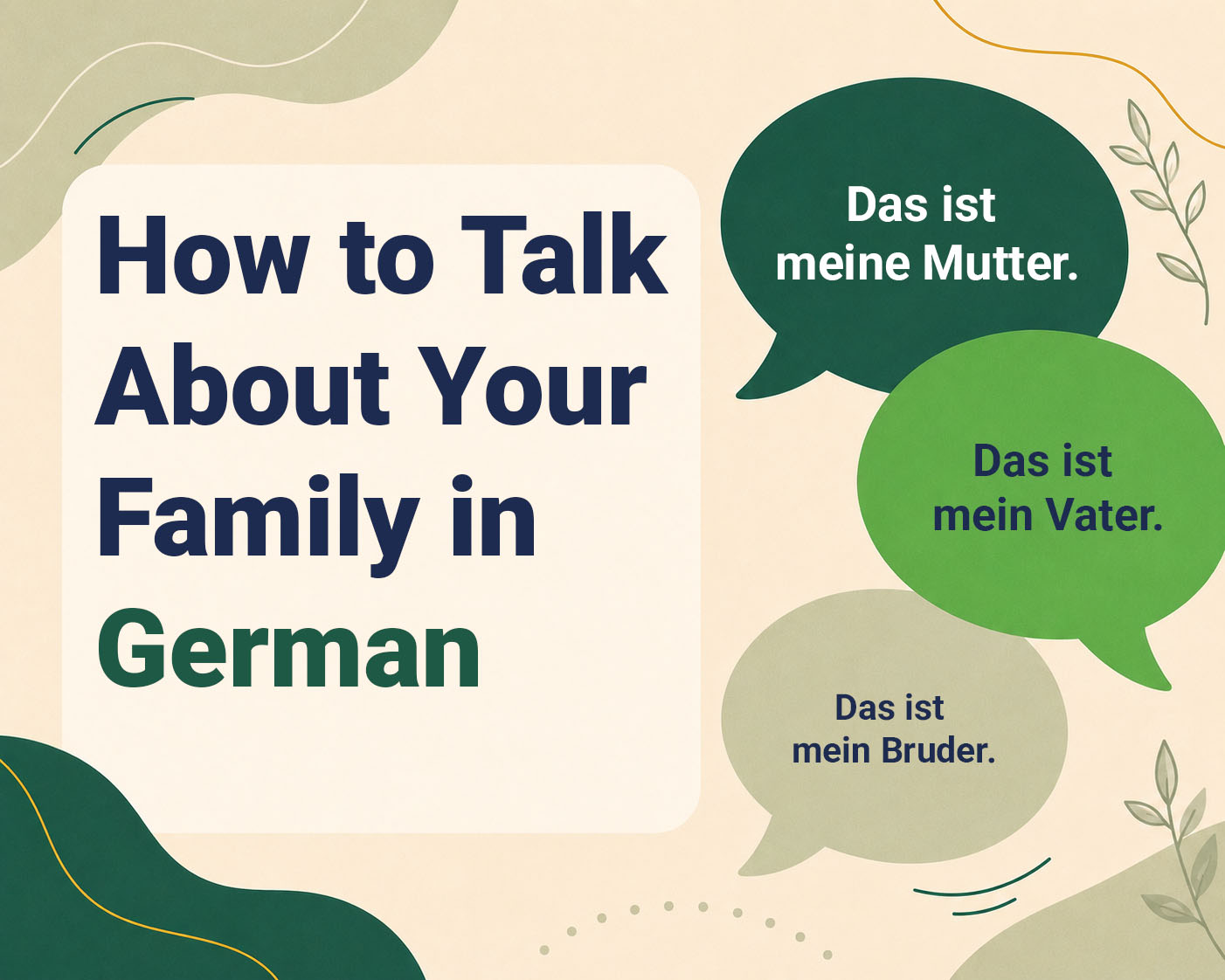
Talking about family in German quickly becomes more than a vocabulary exercise. Even a short introduction can show the difference between mein and meine, while questions about parents, marriage and children bring in informal du, formal Sie, German word order and case endings. Family resemblance introduces yet another useful pattern: jemandem ähnlich sehen, literally “to look similar to someone.”
The main examples below are complete phrases that German speakers can use in real conversations. Each one includes audio recorded by a native speaker. Supplementary expressions show how to change a relative, answer a question or choose the appropriate level of formality without repeating generic practice advice.
Introducing your parents
Das ist meine Mutter.
Natural translation: This is my mother.
Pronunciation: dahs ist MY-nuh MOOT-ter
Word for word: Das = this/that · ist = is · meine = my · Mutter = mother
Use Das ist… to identify or introduce a person. Mutter is feminine, so mein takes the ending -e: meine Mutter. The speaker’s gender does not affect the form; the ending agrees with the family noun.
German nouns begin with capital letters, which is why Mutter is capitalized in the middle of the sentence. The double t signals a short vowel in the first syllable.
Das ist mein Vater.
Natural translation: This is my father.
Pronunciation: dahs ist mine FAH-ter
Word for word: Das = this/that · ist = is · mein = my · Vater = father
Vater is masculine, so the basic nominative form is mein Vater without an added -e. Compare the pair mein Vater and meine Mutter. Learning them together makes the gender distinction visible inside a useful phrase.
The same pattern gives Das ist mein Onkel (“This is my uncle”) and Das ist meine Tante (“This is my aunt”). For grandparents, use mein Großvater and meine Großmutter, although the everyday forms mein Opa and meine Oma are common in families.
Talking about brothers and sisters
Das ist mein Bruder.
Natural translation: This is my brother.
Pronunciation: dahs ist mine BROO-der
Word for word: Das = this is · ist = is · mein = my · Bruder = brother
Bruder is masculine and follows the same pattern as Vater. To distinguish age, German says mein älterer Bruder (“my older brother”) and mein jüngerer Bruder (“my younger brother”). The adjective endings matter because the phrases stand in the nominative case.
Dies ist meine Schwester.
Natural translation: This is my sister.
Pronunciation: dees ist MY-nuh SHVES-ter
Word for word: Dies = this · ist = is · meine = my · Schwester = sister
Dies ist… is a little more explicit than Das ist…, but both can identify a person. Schwester begins with schw, pronounced approximately like English shv.
The age expressions are meine ältere Schwester and meine jüngere Schwester. German also has the convenient plural Geschwister, meaning “siblings”: Ich habe zwei Geschwister can mean that you have two brothers, two sisters or one of each.
Describing the family as a whole
Ich habe eine große Familie.
Natural translation: I have a large family.
Pronunciation: ikh HAH-buh EYE-nuh GROH-suh fah-MEE-lee-uh
Word for word: Ich = I · habe = have · eine = a · große = large · Familie = family
Familie is feminine. As the direct object of haben, it appears with accusative eine, which looks the same as the feminine nominative form. The adjective takes -e: eine große Familie.
The opposite is Ich habe eine kleine Familie—“I have a small family.” To be more specific, you can say Ich habe viele Cousins und Cousinen (“I have many male and female cousins”) or Ich bin Einzelkind (“I am an only child”).
German distinguishes die engste Familie (“immediate/closest family”) from die Großfamilie (“extended family” or a large family household, depending on context). The compound Familienmitglied means “family member.”
Asking where someone’s parents live
Wo leben deine Eltern?
Natural translation: Where do your parents live?
Pronunciation: voh LAY-ben DY-nuh EL-tern
Word for word: Wo = where · leben = live · deine = your · Eltern = parents
This is an informal question for one person. Eltern is plural, so the possessive is deine. With formal Sie, ask Wo leben Ihre Eltern? Formal possessive Ihre is capitalized.
German keeps the verb in second position in a question beginning with a question word: Wo occupies the first position, leben the second, and the subject deine Eltern follows.
Meine Eltern leben in Oslo.
Natural translation: My parents live in Oslo.
Pronunciation: MY-nuh EL-tern LAY-ben in OSS-loh
Word for word: Meine = my · Eltern = parents · leben = live · in Oslo = in Oslo
Use meine with plural nouns: meine Eltern, meine Kinder and meine Geschwister. A city usually follows in when you describe where someone lives: Meine Eltern leben in Berlin.
The course also provides useful singular patterns: Meine Schwester lebt in Paris and Mein Bruder lebt in Madrid. The verb changes from plural leben to singular lebt. This contrast is worth noticing because English “live” does not mark the difference in the same way for “my parents” and “my sister.”
Spending time with family
Ich verbringe gerne Zeit mit der Familie.
Natural translation: I like spending time with family.
Pronunciation: ikh fer-BRING-uh GEHR-nuh tsyt mit dair fah-MEE-lee-uh
Word for word: Ich = I · verbringe = spend · gerne = gladly/like to · Zeit = time · mit der Familie = with the family
German often uses gerne with a verb to express liking an activity. The structure is literally close to “I gladly spend time with the family.” Both gern and gerne are standard and have the same meaning.
The preposition mit always takes the dative case. Feminine die Familie therefore becomes mit der Familie. With plural relatives, use mit meinen Eltern, mit meinen Kindern or mit meinen Geschwistern. Notice the dative forms meinen and, in some plural nouns, an additional -n.
For a completed visit, Ich habe meine Eltern besucht means “I visited my parents.” The direct object meine Eltern is accusative, while the past participle besucht appears at the end of the clause.
Talking about marriage
Bist du verheiratet?
Natural translation: Are you married?
Pronunciation: bist doo fer-HY-rah-tet
Word for word: Bist = are · du = you · verheiratet = married
German yes-or-no questions place the conjugated verb first: Du bist verheiratet (“You are married”) becomes Bist du verheiratet? The formal version is Sind Sie verheiratet?
The adjective verheiratet does not change according to whether the person is a woman or a man. Possible answers include Ja, ich bin verheiratet (“Yes, I am married”) and Nein, ich bin nicht verheiratet (“No, I am not married”).
To introduce a spouse, say Das ist mein Ehemann (“This is my husband”) or Das ist meine Frau (“This is my wife”). Mann can mean “man” or “husband,” while Ehemann explicitly means husband. Partner and Partnerin are useful when “partner” is the preferred description.
Asking about children
Hast du Kinder?
Natural translation: Do you have children?
Pronunciation: hahst doo KIN-der
Word for word: Hast = have · du = you · Kinder = children
The verb comes first in this yes-or-no question. German does not use an extra equivalent of English “do.” The formal version is Haben Sie Kinder?
The phrase has no article before plural Kinder because it asks about children in general. A negative answer is Nein, ich habe keine Kinder. The plural negative article is keine.
Ich habe einen Sohn.
Natural translation: I have a son.
Pronunciation: ikh HAH-buh EYE-nen zohn
Word for word: Ich = I · habe = have · einen = a · Sohn = son
Sohn is masculine and functions as the direct object of haben, so nominative ein Sohn becomes accusative einen Sohn. This -en ending is a clear example of case marking inside a practical phrase.
Ich habe eine Tochter.
Natural translation: I have a daughter.
Pronunciation: ikh HAH-buh EYE-nuh TOKH-ter
Word for word: Ich = I · habe = have · eine = a · Tochter = daughter
Tochter is feminine, so the direct-object form remains eine Tochter. Compare the useful pair einen Sohn and eine Tochter. The ch after o is produced farther back in the mouth than the softer sound in ich.
Wie viele Kinder hast du?
Natural translation: How many children do you have?
Pronunciation: vee FEE-luh KIN-der hahst doo
Word for word: Wie viele = how many · Kinder = children · hast = have · du = you
The question phrase wie viele is followed directly by the plural noun. The verb remains in second position after the complete question phrase: Wie viele Kinder fills the first part, then comes hast.
Formally, ask Wie viele Kinder haben Sie? If the context is sensitive, speakers may simply let the other person volunteer the information rather than asking directly.
Ich habe zwei Kinder.
Natural translation: I have two children.
Pronunciation: ikh HAH-buh tsvy KIN-der
Word for word: Ich = I · habe = have · zwei = two · Kinder = children
German does not place an article between a number and the noun: ein Kind, zwei Kinder, drei Kinder. To specify, say Ich habe einen Sohn und eine Tochter—“I have a son and a daughter.”
Talking about family resemblance
Sieht er seiner Mutter oder seinem Vater ähnlich?
Natural translation: Does he look like his mother or his father?
Pronunciation: zeet air ZY-ner MOOT-ter OH-der ZY-nem FAH-ter AHN-likh
Word for word: Sieht = looks · er = he · seiner Mutter = similar to his mother · oder = or · seinem Vater = to his father · ähnlich = similar
The full pattern is jemandem ähnlich sehen—“to resemble someone.” The person being resembled appears in the dative case. That is why “his mother” becomes seiner Mutter and “his father” becomes seinem Vater.
The separable verb phrase places sieht near the beginning and ähnlich at the end. A straightforward statement is Er sieht seinem Vater ähnlich—“He looks like his father.” German also uses the more conversational comparison Er sieht aus wie sein Vater, literally “He looks like his father,” with a different structure and no dative after wie.
Useful family words in complete phrases
| English | German | Example in a complete phrase |
|---|---|---|
| parents | die Eltern | Meine Eltern leben in Berlin. |
| siblings | die Geschwister | Ich habe zwei Geschwister. |
| grandparents | die Großeltern | Ich besuche meine Großeltern. |
| grandfather | der Großvater / Opa | Mein Opa wohnt auf dem Land. |
| grandmother | die Großmutter / Oma | Meine Oma kocht sehr gern. |
| uncle | der Onkel | Das ist mein Onkel. |
| aunt | die Tante | Meine Tante hat eine Tochter. |
| male cousin | der Cousin | Mein Cousin lebt in Hamburg. |
| female cousin | die Cousine | Meine Cousine spricht Deutsch. |
German family compounds are often transparent once their parts are recognized: Großeltern combines “grand” and “parents,” while Enkelkind means “grandchild.” Schwiegermutter and Schwiegervater mean mother-in-law and father-in-law; Stiefmutter and Stiefvater mean stepmother and stepfather.
Informal and formal questions
| Meaning | Informal singular | Formal singular or plural |
|---|---|---|
| Where do your parents live? | Wo leben deine Eltern? | Wo leben Ihre Eltern? |
| Are you married? | Bist du verheiratet? | Sind Sie verheiratet? |
| Do you have children? | Hast du Kinder? | Haben Sie Kinder? |
| How many children do you have? | Wie viele Kinder hast du? | Wie viele Kinder haben Sie? |
Use du, dein and their inflected forms with friends, relatives, children and people with whom you have agreed to speak informally. Use capitalized Sie and Ihr- forms when addressing one person politely. The same Sie forms also address several people formally.
A short family conversation
Person 1: Hast du eine große Familie?
Person 2: Ja. Ich habe einen Bruder und eine Schwester.
Person 1: Wo leben deine Eltern?
Person 2: Meine Eltern leben in Oslo.
Person 1: Hast du Kinder?
Person 2: Ja, ich habe zwei Kinder.
Natural translation:
Person 1: Do you have a large family?
Person 2: Yes. I have a brother and a sister.
Person 1: Where do your parents live?
Person 2: My parents live in Oslo.
Person 1: Do you have children?
Person 2: Yes, I have two children.
The exchange keeps the vocabulary inside structures that German requires: mein Bruder versus meine Schwester, singular lebt versus plural leben, and informal questions with the verb before du. Those details are what turn a family-word list into language that can be used in conversation.
The main examples in this article are taken from the LinguaBoost German course and recorded by a native German speaker.
Speak About the People Who Matter in German
Continue with practical complete phrases, native-speaker audio and structured review that helps German word order, endings and everyday expressions become more familiar.
Explore the German course