
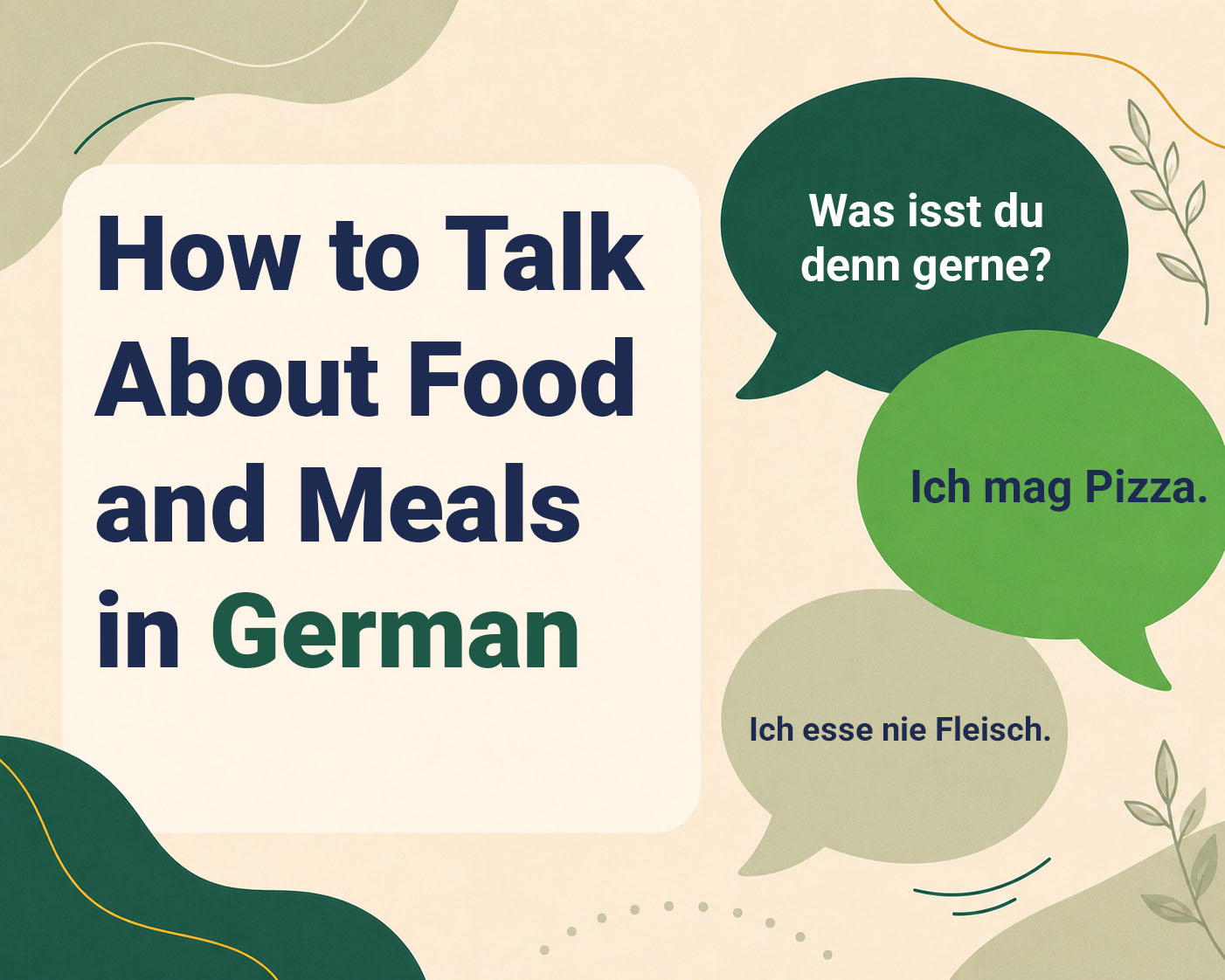
Food is an easy subject to bring into an everyday German conversation. You can ask what someone enjoys eating, compare tea and coffee, talk about your usual meals or simply say that you are hungry.
These conversations also reveal several useful features of German. The language has different ways to express liking and preference, nouns change form after certain words, and common meals appear inside compounds such as Frühstück, Mittagessen and Abendessen.
Asking what someone likes to eat
Was isst du denn gerne?
Natural translation: What do you like to eat?
Pronunciation: vahs ist doo den GEHR-nuh
Word for word: Was = what · isst = eat · du = you · denn = then/so · gerne = gladly
German often uses gern or gerne with a verb to say that someone likes doing something. The sentence is therefore structured more like “What do you gladly eat?” than English “What do you like to eat?”
The word denn does not need a direct English translation here. It makes the question sound more natural and conversational, rather like “So, what do you like to eat?”
This version uses informal singular du. When speaking formally to one person—or to more than one person—you can ask:
Was essen Sie denn gerne?
Natural translation: What do you like to eat? — formal or plural
Pronunciation: vahs ES-sen zee den GEHR-nuh
Notice that both the pronoun and the verb change: isst du becomes essen Sie. Formal Sie is always written with a capital letter.
Saying that you like a food
Ich mag Pizza.
Natural translation: I like pizza.
Pronunciation: ikh mahk PEET-sah
Word for word: Ich = I · mag = like · Pizza = pizza
The verb mögen expresses liking. Its form changes to mag with ich:
- Ich mag Pizza. — I like pizza.
- Du magst Pizza. — You like pizza.
- Er mag Pizza. — He likes pizza.
German nouns begin with capital letters, so Pizza is capitalised even in the middle of a sentence.
The sound at the end of ich does not have an exact English equivalent. It is a soft sound made by bringing the middle of the tongue close to the roof of the mouth. Avoid turning it into a hard k if possible, but an approximate sound will still be understood.
Gern and mögen express liking differently
German can talk about likes with both gern and mögen, but they are used in different structures.
Use mögen directly before a person or thing:
- Ich mag Pizza. — I like pizza.
- Ich mag Kaffee. — I like coffee.
- Ich mag dieses Restaurant. — I like this restaurant.
Use gern or gerne with another verb to say that you enjoy the activity:
- Ich esse gerne Pizza. — I like eating pizza.
- Ich trinke gerne Tee. — I like drinking tea.
- Ich koche gerne. — I like cooking.
The difference becomes clearer if you compare Ich mag Pizza with Ich esse gerne Pizza. The first focuses on pizza as something you like; the second focuses on the activity of eating it.
Both gern and gerne are standard. The additional e does not change the meaning, and speakers choose between them according to habit, rhythm and region.
Saying that you never eat something
Ich esse nie Fleisch.
Natural translation: I never eat meat.
Pronunciation: ikh ES-suh nee flysh
Word for word: Ich = I · esse = eat · nie = never · Fleisch = meat
The word nie means “never.” It is useful for dietary habits and personal choices:
- Ich esse nie Fleisch. — I never eat meat.
- Ich trinke nie Kaffee. — I never drink coffee.
- Ich frühstücke nie. — I never eat breakfast.
The combination ei in Fleisch sounds similar to English “eye.” The final sch sounds like English sh.
If you need to say that you are vegetarian, a useful additional phrase is Ich bin Vegetarier for a man or Ich bin Vegetarierin for a woman. Ich esse kein Fleisch (“I don’t eat meat”) is often the most direct way to communicate the practical point.
Saying that you do not like a drink
Ich mag keinen Kaffee.
Natural translation: I don’t like coffee.
Pronunciation: ikh mahk KAI-nen kah-FEH
Word for word: Ich = I · mag = like · keinen = no/not any · Kaffee = coffee
German often negates a noun with kein rather than placing nicht before it. Here, Kaffee is masculine and functions as the direct object, so kein takes the form keinen.
Compare:
- Ich mag Kaffee. — I like coffee.
- Ich mag keinen Kaffee. — I don’t like coffee.
You may also hear Ich mag Kaffee nicht, especially when contrasting coffee with something else. Ich mag keinen Kaffee is a natural general statement that coffee is not something you like.
For a milder reaction, Ich mag Kaffee nicht so gern means “I don’t like coffee very much.”
Asking someone to choose between tea and coffee
Bevorzugen Sie Tee oder Kaffee?
Natural translation: Do you prefer tea or coffee?
Pronunciation: beh-FOR-tsoo-gen zee tay OH-der kah-FEH
Word for word: Bevorzugen = prefer · Sie = you · Tee = tea · oder = or · Kaffee = coffee
This question uses formal Sie, making it appropriate with a customer, guest, stranger or anyone you are addressing politely.
The informal singular version is:
Bevorzugst du Tee oder Kaffee?
In relaxed conversation, Germans may also ask Trinkst du lieber Tee oder Kaffee?—literally, “Do you rather drink tea or coffee?” The word lieber is extremely common when comparing two activities or choices.
The letter z in bevorzugen has the sound ts, while the initial v is pronounced like f.
Ich bevorzuge schwarzen Kaffee.
Natural translation: I prefer black coffee.
Pronunciation: ikh beh-FOR-tsoo-guh SHVART-sen kah-FEH
Word for word: Ich = I · bevorzuge = prefer · schwarzen = black · Kaffee = coffee
The adjective appears as schwarzen because Kaffee is masculine and is the direct object of bevorzuge. This ending carries grammatical information that English does not show in “black coffee.”
A more conversational alternative is Ich trinke lieber schwarzen Kaffee—“I prefer drinking black coffee.” Both versions are natural, although bevorzugen can sound slightly more deliberate or formal.
Asking whether someone has eaten lunch
Hast du schon zu Mittag gegessen?
Natural translation: Have you eaten lunch yet?
Pronunciation: hahst doo shohn tsoo MIT-tahk guh-GES-sen
Word for word: Hast = have · du = you · schon = already/yet · zu Mittag = at midday · gegessen = eaten
The phrase zu Mittag essen means “to eat lunch.” German can refer to the meal with the noun das Mittagessen, but this common expression uses zu Mittag with the verb essen.
The question uses the conversational past tense called the Perfekt: hast ... gegessen. The helping verb moves to the first position in the question, while gegessen appears at the end.
The formal version is:
Haben Sie schon zu Mittag gegessen?
The word schon literally means “already,” but in this question it often corresponds naturally to English “yet.”
Ich habe Fisch gegessen.
Natural translation: I ate fish. / I have eaten fish.
Pronunciation: ikh HAH-buh fish guh-GES-sen
Word for word: Ich = I · habe = have · Fisch = fish · gegessen = eaten
German uses the Perfekt very frequently when talking about completed past actions in conversation. The word-for-word structure resembles English “I have eaten fish,” but Ich habe Fisch gegessen can naturally answer the question “What did you eat?”
That question is:
Was hast du gegessen? — What did you eat?
The helping verb hast appears near the beginning, while the past participle gegessen closes the sentence.
Talking about breakfast
Frühstückst du jeden Tag?
Natural translation: Do you eat breakfast every day?
Pronunciation: FRUE-shtuekst doo YAY-den tahk
Word for word: Frühstückst = eat breakfast · du = you · jeden Tag = every day
German can turn the noun Frühstück (“breakfast”) into the verb frühstücken (“to eat breakfast”). Frühstückst is the informal singular “you” form.
The letter ü is produced with the tongue positioned roughly as for English ee, while the lips are rounded. The written pronunciation ue is only an approximation; hearing the native recording is especially helpful for this sound.
The answer from the course is:
Ja, ich frühstücke jeden Tag. — Yes, I eat breakfast every day.
Formally, the question becomes Frühstücken Sie jeden Tag?
Zum Frühstück trinke ich immer Saft.
Natural translation: For breakfast, I always drink juice.
Pronunciation: tsoom FRUE-shtuek TRINK-uh ikh IM-mer zahft
Word for word: Zum Frühstück = for breakfast · trinke = drink · ich = I · immer = always · Saft = juice
When Zum Frühstück occupies the first position, the conjugated verb trinke still comes second. The subject ich therefore follows the verb.
You can change the drink while preserving the structure:
- Zum Frühstück trinke ich Kaffee. — I drink coffee for breakfast.
- Zum Frühstück trinke ich Tee. — I drink tea for breakfast.
- Zum Frühstück trinke ich Wasser. — I drink water for breakfast.
The word zum is a contraction of zu dem.
Talking about a regular lunch
Ich esse immer um zwölf Uhr zu Mittag.
Natural translation: I always eat lunch at twelve o’clock.
Pronunciation: ikh ES-suh IM-mer oom tsvoelf oor tsoo MIT-tahk
Word for word: Ich = I · esse = eat · immer = always · um zwölf Uhr = at twelve o’clock · zu Mittag = at midday/for lunch
German uses um before clock times. The phrase um zwölf Uhr means “at twelve o’clock.”
The word order allows several time expressions to appear in one sentence. Immer gives the frequency, um zwölf Uhr gives the exact time and zu Mittag identifies the meal.
Another course phrase is:
Ich esse oft Fisch zum Mittagessen. — I often eat fish for lunch.
Here German uses the compound noun Mittagessen, literally “midday food/meal.” Like all German nouns, it begins with a capital letter.
Asking what is for dinner
Was gibt es zum Abendessen?
Natural translation: What’s for dinner?
Pronunciation: vahs gipt es tsoom AH-bent-es-sen
Word for word: Was = what · gibt es = is there · zum Abendessen = for dinner
The expression es gibt means “there is” or “there are.” In a question, the verb comes before es: Was gibt es...?
Abendessen combines Abend (“evening”) and Essen (“food” or “meal”). The course also contains Meine Frau macht das Abendessen—“My wife is making dinner.”
Additional unrecorded example.
German compounds can look long, but their parts often make the meaning transparent once you recognise them: Frühstück, Mittagessen and Abendessen correspond to breakfast, lunch and dinner.
Saying that something smells delicious
Es riecht köstlich!
Natural translation: It smells delicious!
Pronunciation: es reekht KOEST-likh
Word for word: Es = it · riecht = smells · köstlich = delicious
Additional unrecorded example.
This is a natural reaction when food is being prepared. The vowel ö in köstlich has no exact English equivalent. Form it with the tongue roughly in the position for e while rounding the lips.
The two ch sounds are not identical. In riecht, the sound follows a front vowel and is relatively soft. Köstlich ends with the same soft sound heard in ich.
To say that the food tastes delicious, you can use Es schmeckt köstlich or the very common Es schmeckt sehr gut (“It tastes very good”).
Saying that you are hungry or thirsty
Ich bin hungrig.
Natural translation: I’m hungry.
Pronunciation: ikh bin HOONG-rikh
Word for word: Ich = I · bin = am · hungrig = hungry
Additional unrecorded example.
Ich bin hungrig is correct and easy to understand. In everyday conversation, you will also very often hear Ich habe Hunger, literally “I have hunger.”
Both expressions work, but Ich habe Hunger is especially common as a direct statement that you want something to eat.
Ich habe Durst.
Natural translation: I’m thirsty.
Pronunciation: ikh HAH-buh doorst
Word for word: Ich = I · habe = have · Durst = thirst
Additional unrecorded example.
German normally describes thirst with haben: Ich habe Durst. The literal structure is “I have thirst.”
You can ask informally Hast du Hunger? or Hast du Durst? Formally, use Haben Sie Hunger? and Haben Sie Durst?
Useful language when eating out
The course phrases in this article focus on food, drinks and meals rather than a complete restaurant exchange. A few additional expressions connect this vocabulary to eating out:
- Ich hätte gern einen Kaffee, bitte. — I’d like a coffee, please.
- Ich nehme die Suppe. — I’ll have the soup.
- Für mich den Fisch, bitte. — The fish for me, please.
- Die Rechnung, bitte. — The bill, please.
- Kann ich mit Karte bezahlen? — Can I pay by card?
Ich hätte gern... is polite and widely useful when requesting food, drinks or other items. The phrase Die Rechnung, bitte is short but normal in a restaurant when the context is already clear.
Informal and formal forms
German makes a clear distinction between informal singular du and formal Sie:
| Meaning | Informal singular | Formal or plural |
|---|---|---|
| What do you like to eat? | Was isst du denn gerne? | Was essen Sie denn gerne? |
| Do you prefer tea or coffee? | Bevorzugst du Tee oder Kaffee? | Bevorzugen Sie Tee oder Kaffee? |
| Have you eaten lunch yet? | Hast du schon zu Mittag gegessen? | Haben Sie schon zu Mittag gegessen? |
| Do you eat breakfast every day? | Frühstückst du jeden Tag? | Frühstücken Sie jeden Tag? |
| Are you hungry? | Hast du Hunger? | Haben Sie Hunger? |
Use du with friends, relatives, children and people with whom you have agreed to speak informally. Use Sie with strangers, customers and in more formal situations.
When Sie means formal “you,” it is capitalised. Lowercase sie can mean “she” or “they,” so the capital letter is meaningful in writing.
A short everyday exchange
Person 1: Was isst du denn gerne?
Person 2: Ich esse gerne Fisch. Ich esse nie Fleisch.
Person 1: Bevorzugst du Tee oder Kaffee?
Person 2: Ich bevorzuge schwarzen Kaffee. Und du?
Natural translation:
Person 1: What do you like to eat?
Person 2: I like eating fish. I never eat meat.
Person 1: Do you prefer tea or coffee?
Person 2: I prefer black coffee. And you?
This exchange combines a general question, a preference and a dietary habit. The phrases are useful in their original forms, but they also provide patterns that can be adapted to different foods and drinks.
Food as an everyday conversation topic
Talking about food in German involves more than memorising the names of dishes. Expressions such as Ich mag..., Ich esse gerne... and Ich bevorzuge... show different kinds of preference. Phrases with Frühstück, Mittagessen and Abendessen connect food with daily routines.
Learning these ideas inside complete phrases also preserves the details that isolated vocabulary leaves out: verb position, case endings, articles and the forms used with du and Sie.
Hear Food and Meals in Complete German Phrases
The main examples in this article are taken from the LinguaBoost German course and recorded by a native German speaker.
Ready to speak more German?
Build on the phrases in this article with structured practice, native-speaker audio and built-in review designed for everyday conversation.
Explore the German course