
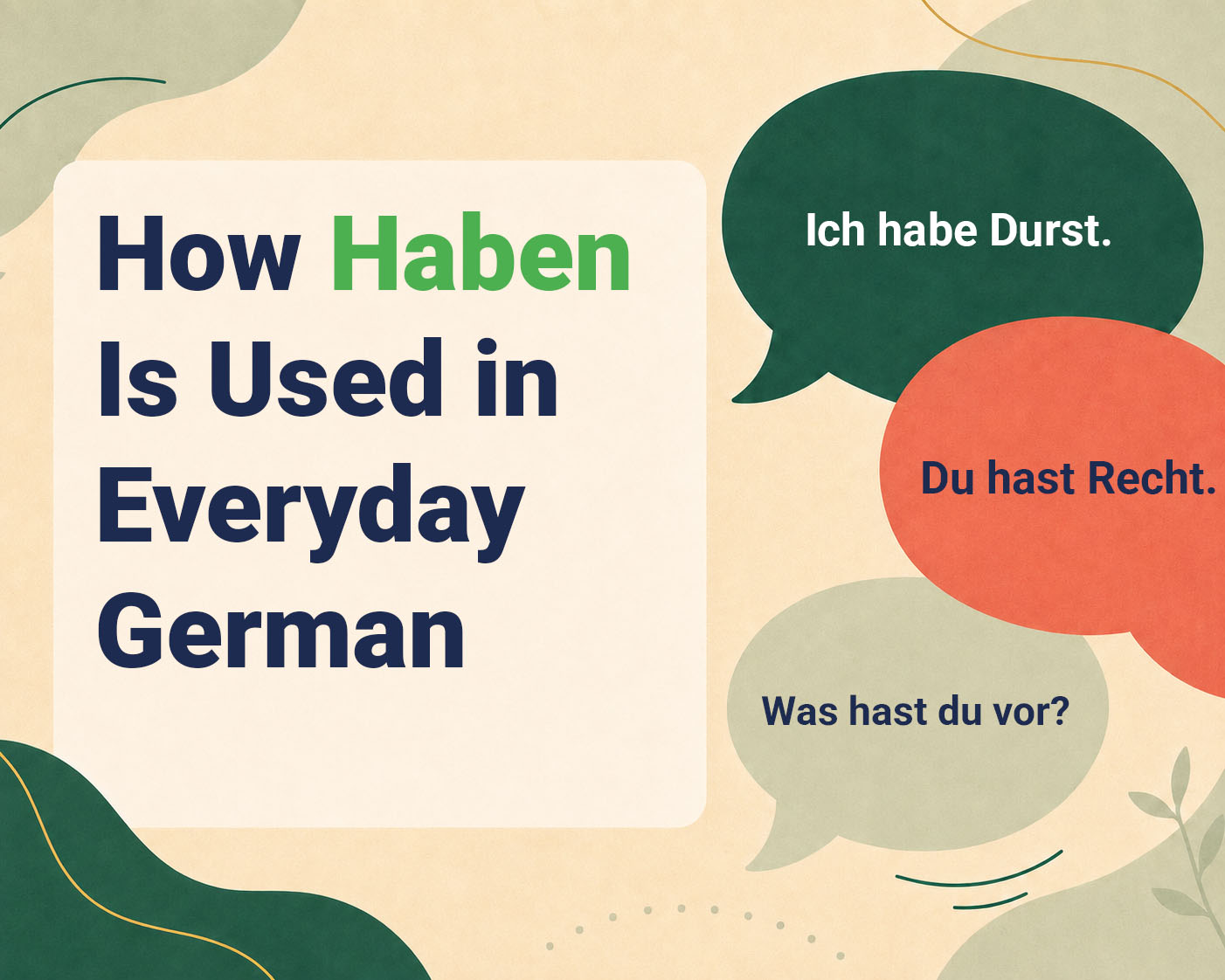
The German verb haben is usually introduced as the equivalent of “to have.” That’s an important use, but it’s only part of the story.
German speakers also use haben in expressions about thirst, feelings, plans and available time. It can even work as a helping verb when talking about the past. That makes it one of the most useful verbs to recognize in everyday German.
You can hear every main example spoken by a native German speaker. The pronunciation guides are approximate, but they can help English speakers get close to the sound.
The basic forms of haben
The form of haben changes depending on who has something:
| German | Meaning | Form of haben |
|---|---|---|
| ich | I | habe |
| du | you — informal, singular | hast |
| er / sie / es | he / she / it | hat |
| wir | we | haben |
| ihr | you — informal, plural | habt |
| sie / Sie | they / you — formal | haben |
In everyday speech, ich habe, du hast and er oder sie hat are especially common. The following examples show that these forms appear in more situations than straightforward possession.
Having or owning something
Ich habe einen Hund.
Natural translation: I have a dog.
Pronunciation: ikh HAH-buh EYE-nen hoont
Word for word: Ich = I · habe = have · einen = a · Hund = dog
This is haben in its most direct sense: someone has or owns something. You can keep the same beginning and change what comes afterwards:
- Ich habe eine Katze. — I have a cat.
- Ich habe zwei Kinder. — I have two children.
- Ich habe eine große Familie. — I have a large family.
The German ch in ich doesn’t have an exact English equivalent. It’s a soft sound made near the front of the mouth—not a hard k sound. The u in Hund is also shorter than the English oo suggested by the guide.
Hast du Kinder?
Natural translation: Do you have children?
Pronunciation: hahst doo KIN-der
Word for word: Hast = have · du = you · Kinder = children
German forms many questions by placing the verb first. Instead of adding a separate word like English “do,” German simply changes du hast (“you have”) to hast du? (“do you have?”).
This version is informal and addressed to one person. With someone you address formally, you would say:
Haben Sie Kinder?
Natural translation: Do you have children? — formal
Pronunciation: HAH-ben zee KIN-der
Word for word: Haben = have · Sie = you (formal) · Kinder = children
The capital letter in Sie matters: lowercase sie can mean “she” or “they,” while capitalized Sie is the formal “you.”
Having thirst, not being thirsty
Ich habe Durst.
Natural translation: I’m thirsty.
Pronunciation: ikh HAH-buh doorst
Word for word: Ich = I · habe = have · Durst = thirst
English describes thirst with “to be,” but German treats it as something you have: Ich habe Durst, literally “I have thirst.”
You’ll see the same structure with hunger:
Ich habe Hunger. — I’m hungry. Literally: “I have hunger.”
These expressions are a good reminder that a natural translation isn’t always a word-for-word translation.
Saying that someone is right
Du hast Recht.
Natural translation: You are right.
Pronunciation: doo hahst rekht
Word for word: Du = you · hast = have · Recht = right
German once again uses haben where English uses “to be.” Du hast Recht literally means “You have right,” but the natural English translation is “You are right.”
The opposite is:
Du hast Unrecht. — You are wrong.
When speaking formally, use Sie haben Recht (“You are right”).
The ch in Recht is stronger than the sound in ich. It’s made farther back in the mouth, a little like the sound in the Scottish pronunciation of “loch.”
Talking about what you feel like doing
Ich habe Lust, heute Abend auszugehen.
Natural translation: I feel like going out tonight.
Pronunciation: ikh HAH-buh loost HOY-tuh AH-bent OWS-tsoo-gay-en
Word for word: Ich = I · habe = have · Lust = desire/inclination · heute = today · Abend = evening · auszugehen = to go out
The expression Lust haben means to feel like doing something or to be in the mood for it. Here, heute Abend means “this evening” or “tonight.”
You can also use Lust auf before a noun:
Ich habe Lust auf ein Bad. — I feel like taking a bath.
To say you don’t feel like doing something, add keine:
Ich habe keine Lust, nach Hause zu gehen. — I don’t feel like going home.
In heute, the letters eu sound approximately like “oy.” In auszugehen, the first part sounds like English “ows,” followed by tsoo-GAY-en.
Talking about plans
Was hast du vor?
Natural translation: What are you planning to do?
Pronunciation: vahs hahst doo fohr
Word for word: Was = what · hast = have · du = you · vor = planned/intended
Etwas vorhaben means to have something planned or to intend to do something. In a statement, vor is joined to the verb: vorhaben. In this question, it moves to the end: Was hast du vor?
A possible answer is:
Ich habe vor, angeln zu gehen. — I’m planning to go fishing.
The formal question is Was haben Sie vor? (“What are you planning to do?”).
German w normally sounds like an English v, which is why was begins approximately like “vahs.”
Expressing fear
Ich habe Angst vor der Dunkelheit.
Natural translation: I’m scared of the dark.
Pronunciation: ikh HAH-buh ahngst fohr dair DOON-kel-hite
Word for word: Ich = I · habe = have · Angst = fear · vor = of/before · der = the · Dunkelheit = darkness
German uses Angst haben—literally, “to have fear”—where English normally says “to be afraid” or “to be scared.”
The thing causing the fear follows vor:
- Angst vor Spinnen — fear of spiders
- Angst vor Clowns — fear of clowns
- Angst vorm Fliegen — fear of flying
Vorm is a common contraction of vor dem. It’s similar to the way English contracts “do not” to “don’t,” although the grammar behind it is different.
Describing pain
Ich habe Kopfschmerzen.
Natural translation: I have a headache.
Pronunciation: ikh HAH-buh KOPF-shmair-tsen
Word for word: Ich = I · habe = have · Kopfschmerzen = headache/head pain
Kopfschmerzen combines Kopf (“head”) and Schmerzen (“pains”). German often builds precise words by joining shorter words together.
Although English normally says “a headache,” German usually uses the plural-looking Kopfschmerzen without an article. You wouldn’t normally translate it as “headaches” in this sentence.
The z in German sounds like ts, as in the end of “cats.”
Having time—or not having it
Ich habe keine Zeit, um fernzusehen.
Natural translation: I don’t have time to watch TV.
Pronunciation: ikh HAH-buh KYE-nuh tsite oom fairn-tsoo-zay-en
Word for word: Ich = I · habe = have · keine = no · Zeit = time · um = in order to · fernzusehen = to watch television
Zeit haben means “to have time.” To make it negative, German uses keine Zeit, literally “no time.”
The positive version is simply Ich habe Zeit (“I have time” or “I’m free”). You may also hear Ich glaube, ich habe morgen Zeit: “I think I’m free tomorrow.”
The German z in Zeit sounds like ts, and ei sounds like English “eye.”
Haben as a helping verb
Hast du schon zu Mittag gegessen?
Natural translation: Have you eaten lunch yet?
Pronunciation: hahst doo shohn tsoo MIT-tahk guh-GESS-en
Word for word: Hast = have · du = you · schon = already/yet · zu Mittag = at midday/for lunch · gegessen = eaten
Here, haben doesn’t mean possession. It helps form the German conversational past together with gegessen (“eaten”). This construction is called the perfect tense, and it’s extremely common when German speakers talk about completed events.
As in the English question “Have you eaten?”, the form of haben comes before the subject. German places the other part of the verb—gegessen—at the end.
Ich habe Musik gehört.
Natural translation: I listened to music.
Pronunciation: ikh HAH-buh moo-ZEEK guh-HURT
Word for word: Ich = I · habe = have · Musik = music · gehört = listened/heard
The word-for-word translation resembles “I have heard music,” but in an ordinary account of what someone did, natural English uses the simple past: “I listened to music.”
Many German verbs form the conversational past with haben, including machen (“to do”), kaufen (“to buy”) and sehen (“to see”). Some verbs use sein (“to be”) instead, particularly verbs involving movement or a change of state.
One place German doesn’t use haben
English speakers sometimes try to use haben when stating their age. German uses sein (“to be”) instead:
Ich bin vierzig Jahre alt.
Natural translation: I am forty years old.
Pronunciation: ikh bin FEER-tsikh YAH-ruh ahlt
Word for word: Ich = I · bin = am · vierzig = forty · Jahre = years · alt = old
So German follows the same basic idea as English here. You are forty years old; you don’t “have forty years,” as you would say in some other European languages.
Informal and formal forms
Here’s how some of the article’s questions and statements change:
| Meaning | Informal | Formal |
|---|---|---|
| Do you have children? | Hast du Kinder? | Haben Sie Kinder? |
| What are you planning to do? | Was hast du vor? | Was haben Sie vor? |
| You are right. | Du hast Recht. | Sie haben Recht. |
| Have you eaten lunch yet? | Hast du schon zu Mittag gegessen? | Haben Sie schon zu Mittag gegessen? |
Use du with friends, relatives, children and people who have agreed to speak informally. Sie is the safer choice with strangers in formal situations, customers and people you’re addressing professionally.
German-speaking countries and individuals differ in how quickly they switch to du. If someone says Wir können uns duzen (“We can use du with each other”), they’re inviting you to use the informal form.
A short everyday exchange
Person 1: Hast du heute Abend Zeit?
Person 2: Ja. Was hast du vor?
Person 1: Ich habe Lust, auszugehen.
Person 2: Gute Idee!
Natural translation:
Person 1: Are you free tonight?
Person 2: Yes. What are you planning to do?
Person 1: I feel like going out.
Person 2: Good idea!
This exchange brings together three common uses of haben: having time, having a plan and feeling like doing something. None of them is really about owning an object.
A small verb with many everyday uses
Once you start noticing haben, you’ll hear it everywhere. It can tell you what someone owns, how they feel, whether they have time and what they intend to do. It also helps German speakers describe completed events.
Learning these uses as complete phrases makes the differences easier to recognize. Instead of translating every word separately, you begin to connect Ich habe Durst, Du hast Recht and Was hast du vor? directly with what they mean in conversation.
The main examples in this article are taken from the LinguaBoost German course and recorded by a native German speaker.
Ready to speak more German?
Build on the phrases in this article with structured practice, native-speaker audio and built-in review designed for everyday conversation.
Explore the German course