
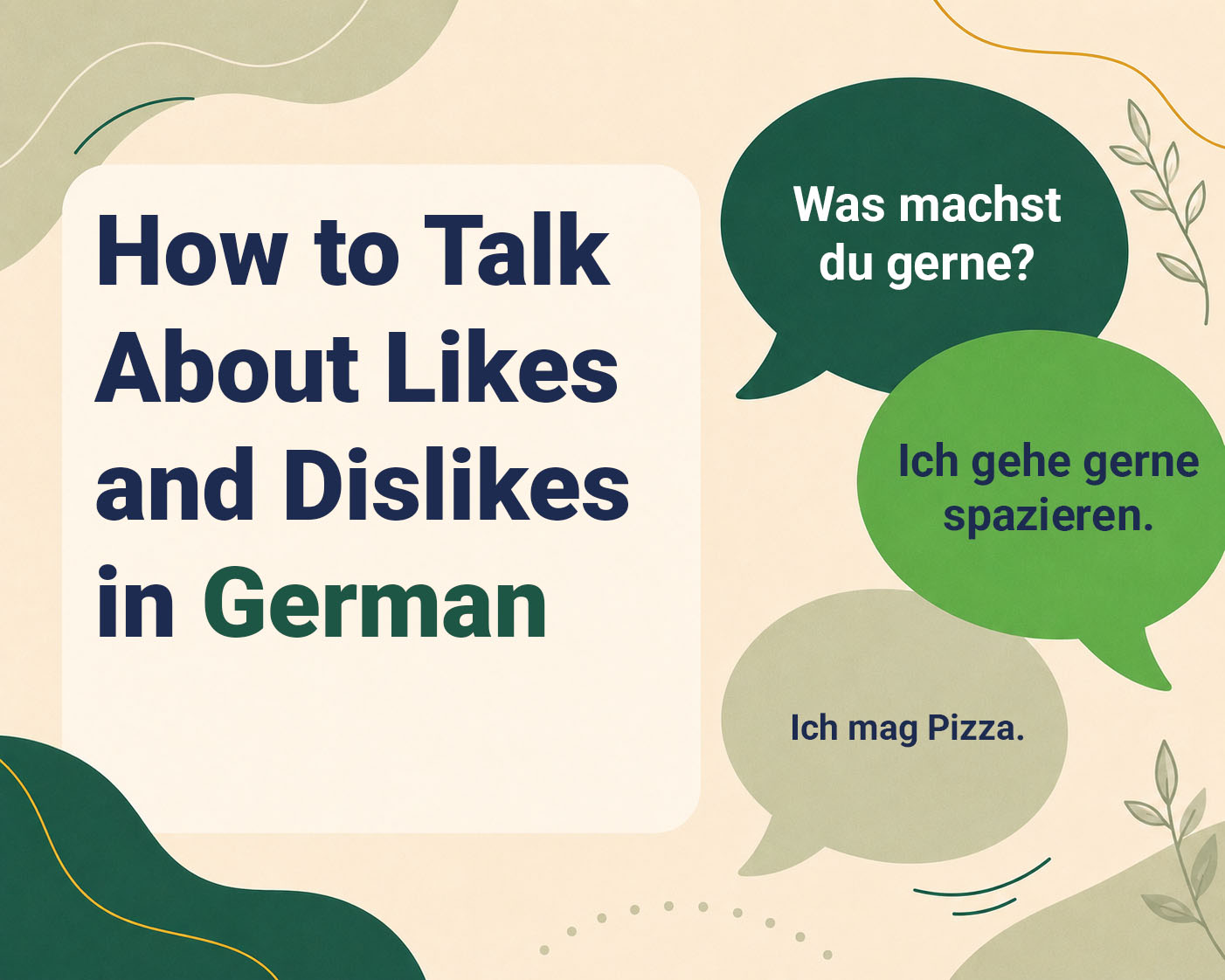
German uses several patterns for preferences. Mögen is common with things, gern describes activities you like doing, and bevorzugen makes a deliberate comparison. These recorded phrases show the patterns in complete sentences.
Asking about favourite activities
Was machst du gerne?
Natural translation: What do you like to do? Pronunciation: vahs mahkhst doo GEHR-nuh
Playback: Normal speed and 0.5× slow speed
Gerne—often shortened to gern—describes doing something willingly or with pleasure. The formal question is Was machen Sie gerne?
Ich gehe gerne spazieren.
Natural translation: I like going for walks. Pronunciation: ikh GAY-uh GEHR-nuh shpah-TSEE-ren
Playback: Normal speed and 0.5× slow speed
The activity appears around the adverb: Ich gehe gern…. Learn spazieren gehen as one unit even though the two parts separate in the sentence.
Liking and disliking things
Ich mag Pizza.
Natural translation: I like pizza. Pronunciation: ikh mahk PIT-sah
Playback: Normal speed and 0.5× slow speed
Mag is the first-person form of mögen. With an activity, German often prefers gern: Ich koche gern means “I like cooking.”
Ich mag keinen Kaffee.
Natural translation: I don’t like coffee. Pronunciation: ikh mahk KAI-nen kah-FEH
Playback: Normal speed and 0.5× slow speed
German often negates a noun with kein. Here masculine Kaffee is a direct object, so the form is keinen.
Ich hasse Käse.
Natural translation: I hate cheese. Pronunciation: ikh HAH-suh KAY-zuh
Playback: Normal speed and 0.5× slow speed
Hassen is much stronger than nicht mögen. Use it when you really mean “hate”; otherwise Ich mag Käse nicht is softer.
Comparing two choices
Bevorzugen Sie Tee oder Kaffee?
Natural translation: Do you prefer tea or coffee? Pronunciation: beh-FOR-tsoo-gen zee tay OH-der kah-FEH
Playback: Normal speed and 0.5× slow speed
This phrase uses formal Sie. Informally, say Bevorzugst du Tee oder Kaffee? In relaxed conversation, Trinkst du lieber Tee oder Kaffee? is also common.
Ich bevorzuge schwarzen Kaffee.
Natural translation: I prefer black coffee. Pronunciation: ikh beh-FOR-tsoo-guh SHVART-sen kah-FEH
Playback: Normal speed and 0.5× slow speed
The ending in schwarzen agrees with masculine Kaffee in the accusative. Remembering schwarzen Kaffee as a chunk is easier than rebuilding the ending each time.
A short preference exchange
Person 1: Was machst du gerne? Person 2: Ich gehe gerne spazieren und ich koche gern. Person 1: Magst du Kaffee? Person 2: Nein, ich mag keinen Kaffee. Ich trinke lieber Tee.
The recorded phrases give you reusable frames. Replace the activity after gern, or the noun after Ich mag, to make the conversation personal.
Practise Complete German Phrases
Three useful ways to express a preference in German
German does not rely on one direct equivalent of English “like.” The most useful distinction is between gern, mögen and bevorzugen. Use gern with an activity: Ich gehe gern spazieren means that walking is something you enjoy doing. Use mögen mainly with people or things: Ich mag Pizza, Ich mag diesen Film or Ich mag Anna. Use bevorzugen when comparing options or stating a more deliberate preference. It is slightly more formal than mögen and is common in questions such as Bevorzugen Sie Tee oder Kaffee?
| German pattern | Natural meaning | Complete example |
|---|---|---|
| gern + verb | like doing something | Ich koche gern. — I like cooking. |
| mögen + noun | like someone or something | Ich mag italienisches Essen. — I like Italian food. |
| lieber + verb | prefer doing one thing | Ich trinke lieber Tee. — I prefer drinking tea. |
| am liebsten + verb | like doing something best | Am liebsten bleibe ich zu Hause. — I like staying home best. |
| bevorzugen + noun | prefer an option | Ich bevorzuge schwarzen Kaffee. — I prefer black coffee. |
From liking to disliking: choosing the right strength
Ich mag … is a neutral positive statement. To make it stronger, German can use sehr: Ich mag dieses Restaurant sehr. With activities, sehr gern serves the same purpose: Ich lese sehr gern. Ich liebe … is stronger and corresponds to “I love …,” while Ich hasse … expresses a strong dislike and can sound forceful in casual conversation.
For a softer negative, use nicht so gern with activities: Ich tanze nicht so gern means “I don’t particularly like dancing.” With nouns, use nicht or the negative article kein. Compare Ich mag den Kaffee nicht, which rejects a particular coffee, with Ich mag keinen Kaffee, which means that you do not like coffee generally. Kaffee is masculine, and it is the direct object of mögen, so kein takes the accusative form keinen.
Informal and formal questions about preferences
| Informal | Formal | Use |
|---|---|---|
| Was machst du gern? | Was machen Sie gern? | Ask what someone likes doing. |
| Magst du Kaffee? | Mögen Sie Kaffee? | Ask whether someone likes a thing. |
| Was trinkst du lieber? | Was trinken Sie lieber? | Ask which option someone prefers. |
| Was machst du am liebsten? | Was machen Sie am liebsten? | Ask for a favourite activity. |
German formal Sie always takes the same verb form as plural sie, but it is capitalized. A natural answer can be short—Ich trinke lieber Tee—or can give a reason: Ich trinke lieber Tee, weil ich Kaffee zu bitter finde (“I prefer tea because I find coffee too bitter”). Another useful follow-up is Warum? or the softer Warum magst du das? A disagreement often sounds friendlier with nicht so or eigentlich: Ich mag Käse eigentlich nicht so gern.
Using gern, lieber and am liebsten as a scale
These three forms create a useful comparison. Gern says that an activity is enjoyable: Ich höre gern Musik. Lieber compares it with another possibility: Ich höre lieber Musik als Podcasts. The item after als is the less preferred option. Am liebsten identifies the favourite among several possibilities: Am liebsten höre ich Jazz. Because these words modify the activity, they are used with a verb rather than directly before a noun.
| Question | Natural answer | Meaning |
|---|---|---|
| Hörst du gern Musik? | Ja, ich höre sehr gern Musik. | Do you enjoy listening to music? — Yes, very much. |
| Hörst du lieber Rock oder Jazz? | Ich höre lieber Jazz. | Do you prefer rock or jazz? — I prefer jazz. |
| Welche Musik hörst du am liebsten? | Am liebsten höre ich klassische Musik. | Which music do you like best? — Classical music. |
Word order can change without changing the central preference. Ich spiele am Wochenende gern Tennis begins with the person, while Am Wochenende spiele ich gern Tennis highlights the weekend. When an element other than the subject occupies the first position, the conjugated verb remains second and the subject follows it. This is why German says Am Wochenende spiele ich, not Am Wochenende ich spiele.
The main examples in this article are taken from the LinguaBoost German course and recorded by a native German speaker.
Ready to speak more German?
Build on the phrases in this article with structured practice, native-speaker audio and built-in review designed for everyday conversation.