
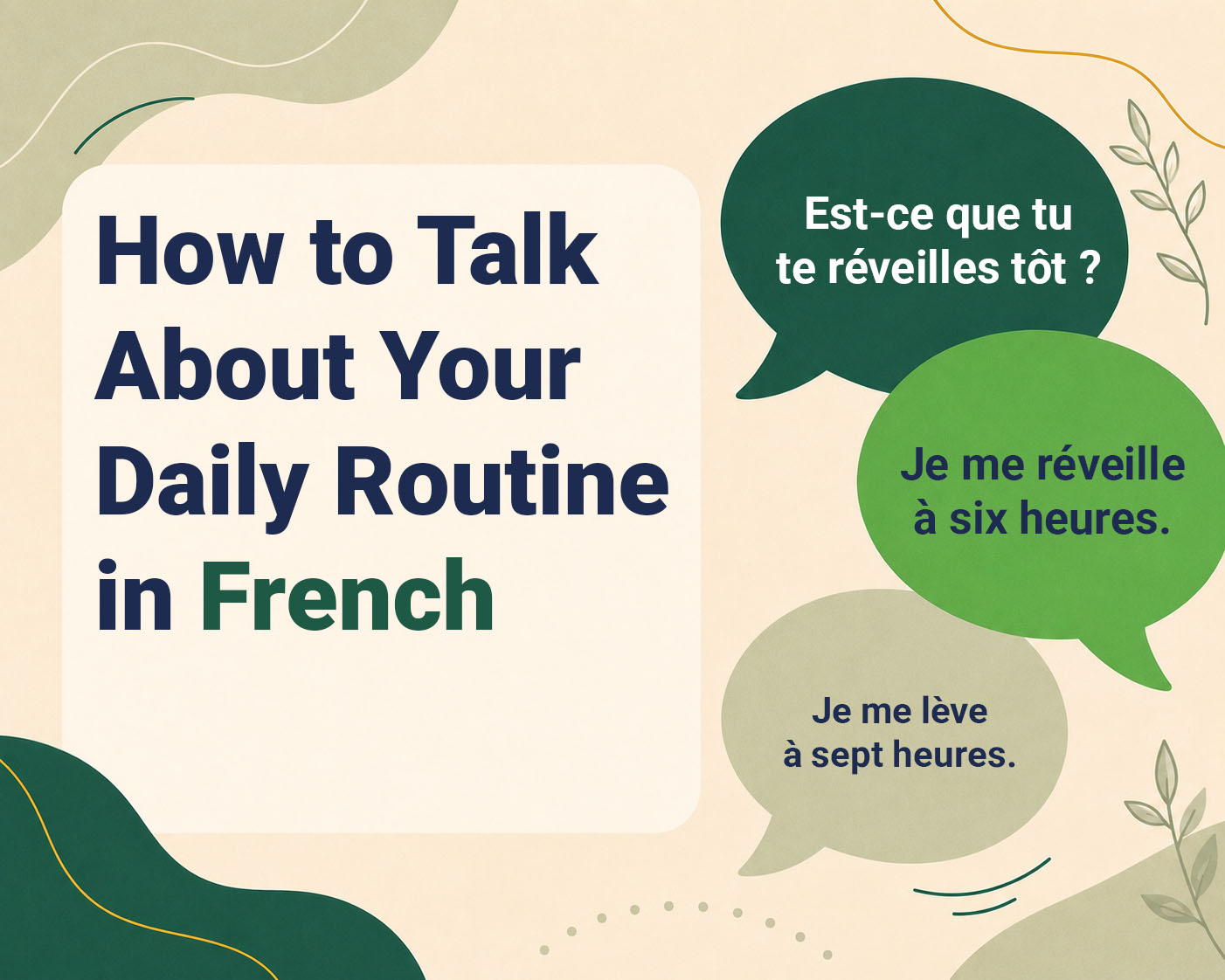
Daily routines are ideal for practising French because the same useful structures return every day: waking up, getting ready, travelling to work, eating and going to bed. The phrases below are recorded by a native French speaker.
Waking up and getting out of bed
Est-ce que tu te réveilles tôt ?
Natural translation: Do you wake up early? Pronunciation: ess-kuh tyuh tuh ray-VAY toh
Playback: Normal speed and 0.5× slow speed
Se réveiller is reflexive, so the pronoun changes with the subject: je me réveille, tu te réveilles, vous vous réveillez. A formal version is Est-ce que vous vous réveillez tôt ?
Je me réveille à six heures.
Natural translation: I wake up at six o’clock. Pronunciation: zhuh muh ray-VAY ah seez-uhr
Playback: Normal speed and 0.5× slow speed
Use à before a clock time. The liaison between six and heures makes the words flow together.
Je me lève à sept heures.
Natural translation: I get up at seven o’clock. Pronunciation: zhuh muh lev ah set-uhr
Playback: Normal speed and 0.5× slow speed
French distinguishes waking up, se réveiller, from physically getting up, se lever.
Breakfast and leaving home
Pour le petit déjeuner, je bois toujours du jus.
Natural translation: For breakfast, I always drink juice. Pronunciation: poor luh puh-TEE day-zhuh-NAY zhuh bwah too-ZHOOR dyoo zhyoo
Playback: Normal speed and 0.5× slow speed
Toujours normally sits after the conjugated verb: je bois toujours. Replace du jus with du café, du thé or de l’eau.
Après le petit déjeuner, je vais travailler.
Natural translation: After breakfast, I go to work. Pronunciation: ah-PRAY luh puh-TEE day-zhuh-NAY zhuh vay trah-vah-YAY
Playback: Normal speed and 0.5× slow speed
Aller + infinitive often expresses a near-future action, but in a routine it can also describe the next regular step.
Je quitte ma maison à huit heures.
Natural translation: I leave my house at eight o’clock. Pronunciation: zhuh keet mah may-ZOHN ah wee-tuhr
Playback: Normal speed and 0.5× slow speed
Quitter takes a direct object: quitter la maison, not quitter de la maison.
The working day
J’arrive au travail à neuf heures et demie.
Natural translation: I arrive at work at half past nine. Pronunciation: zhah-REEV oh trah-VY ah nuh-vuhr ay duh-MEE
Playback: Normal speed and 0.5× slow speed
French uses et demie after the hour for “half past.” With midi and minuit, the form is et demi.
Je déjeune toujours à midi.
Natural translation: I always eat lunch at twelve o’clock. Pronunciation: zhuh day-ZHUHN too-ZHOOR ah mee-DEE
Playback: Normal speed and 0.5× slow speed
In France, déjeuner usually means “to eat lunch.” Usage differs in parts of the French-speaking world, so context matters.
Coming home and going to bed
Je rentre chez moi à six heures et quart.
Natural translation: I return home at quarter past six. Pronunciation: zhuh rahntr shay mwah ah seez-uhr ay kar
Playback: Normal speed and 0.5× slow speed
Chez moi means “at/to my home.” The phrase rentrer chez moi is a natural way to say “go back home.”
Je me couche à onze heures du soir.
Natural translation: I go to bed at eleven o’clock at night. Pronunciation: zhuh muh koosh ah ohnz-uhr dyoo swahr
Playback: Normal speed and 0.5× slow speed
Se coucher means to go to bed, while dormir means to sleep. Keeping the whole phrase makes the reflexive form easier to remember.
Build your own routine
Keep the sentence frame and replace one detail at a time: Je me lève à…, Je quitte ma maison à…, Je déjeune à…. Then link two actions with après, ensuite or le soir. This turns a short list of phrases into a description of your real day.
Hear practical French phrases in context and review them until they become easier to recall.
Time expressions that organize a French routine
A clear routine description needs more than a list of verbs. French speakers connect events with expressions such as d’abord (first), ensuite (next), puis (then), après (afterwards) and enfin (finally). These words make the order explicit: D’abord, je me réveille. Ensuite, je me lève et je prends mon petit déjeuner. When après is followed by a noun, it normally takes no article before a named meal in expressions such as après le petit déjeuner.
| Function | French expression | Example |
|---|---|---|
| Start the sequence | d’abord | D’abord, je prends une douche. |
| Add the next action | ensuite / puis | Ensuite, je m’habille. |
| Place one event after another | après | Après le travail, je rentre chez moi. |
| Close the sequence | enfin | Enfin, je me couche. |
| Contrast weekdays and weekends | en semaine / le week-end | En semaine, je me lève tôt. |
Why so many routine verbs begin with me?
Se réveiller, se lever and se coucher are pronominal verbs. With je, the reflexive pronoun becomes me: je me réveille, je me lève, je me couche. Before a vowel sound, me contracts to m’, as in je m’habille. If the subject changes, both parts must change: tu te lèves, elle se lève, nous nous levons and vous vous levez.
Not every daily action is reflexive. French says je prends mon petit déjeuner (“I have breakfast”), je vais travailler, je déjeune and je rentre chez moi. Notice that chez moi means “to my place/home”; French does not normally say à ma maison for the everyday idea of going home.
Changing the time without breaking the sentence
| Base statement | Natural variation | What changed |
|---|---|---|
| Je me réveille à six heures. | Je me réveille vers six heures et demie. | vers makes the time approximate; et demie adds half an hour. |
| Je me lève à sept heures. | Le week-end, je me lève à neuf heures. | The opening phrase limits the statement to weekends. |
| Je déjeune à midi. | Je déjeune généralement vers midi et demi. | généralement marks a usual habit rather than an absolute rule. |
| Je rentre à six heures et quart. | Je ne rentre pas avant sept heures. | ne … pas avant means “not before.” |
| Je me couche à onze heures. | Je me couche rarement avant minuit. | rarement means “rarely”; minuit needs no article. |
Questions that turn a routine into a conversation
With friends, Tu te lèves à quelle heure ? is a natural conversational alternative to À quelle heure est-ce que tu te lèves ? In a formal situation, change both the subject and reflexive pronoun: À quelle heure est-ce que vous vous levez ? Useful follow-ups include Et le week-end ?, Tu travailles loin de chez toi ?, Combien de temps dure ton trajet ? and Qu’est-ce que tu fais après le travail ?
A connected answer can combine time, frequency and contrast: En semaine, je me lève à sept heures, mais le week-end, je dors plus longtemps. Après le travail, je rentre chez moi vers six heures et je prépare le dîner. This sounds more natural than presenting every action as an unrelated sentence.
The main examples in this article are taken from the LinguaBoost French course and recorded by a native French speaker.
Ready to speak more French?
Build on the phrases in this article with structured practice, native-speaker audio and built-in review designed for everyday conversation.