
Talking about food in French means more than memorising names for ingredients. In an ordinary conversation, you may need to say that you are hungry or thirsty, ask what someone likes to eat, compare drinks, describe breakfast or lunch, and make a preference sound polite. The recorded phrases below give you complete sentence patterns, while the explanations show how French articles, negation and meal verbs work in context.
Several everyday structures differ from English. French says avoir faim and avoir soif, literally “to have hunger” and “to have thirst.” It commonly uses a definite article when describing a general preference—J’aime la pizza—but often uses a partitive article when referring to an unspecified amount—Je mange du pain. These small choices become much easier when attached to phrases you can hear and reuse.
Saying that you are hungry
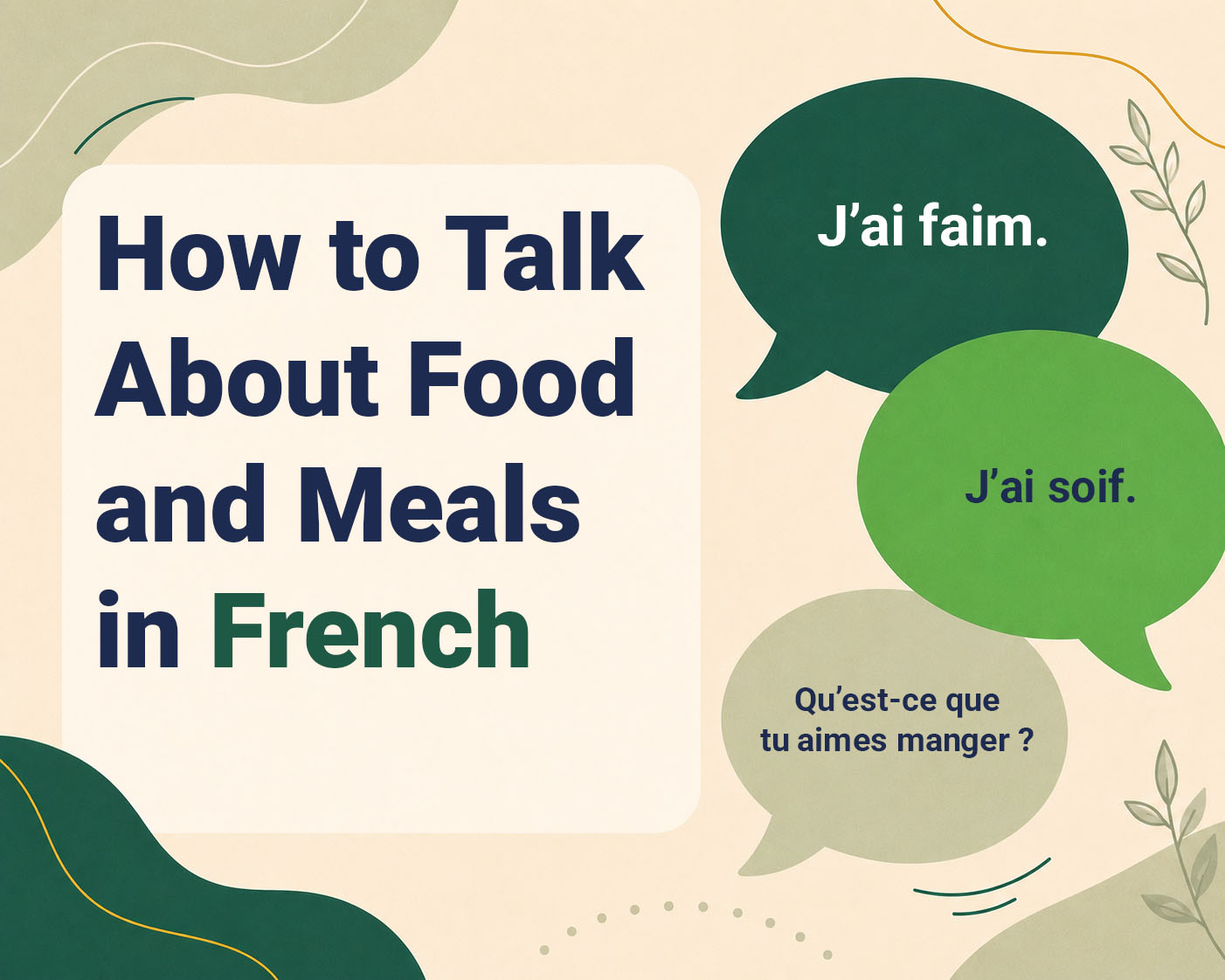
J’ai faim.
Natural translation: I’m hungry.
Pronunciation: zhay fan — with a nasal vowel and no separate final n
Word for word: j’ai = I have · faim = hunger
French uses avoir, “to have,” rather than être, “to be.” Je suis faim is not standard French. Keep j’ai faim as one expression, then change only the form of avoir when the person changes:
| Meaning | French |
|---|---|
| I’m hungry | J’ai faim. |
| Are you hungry? — informal | Tu as faim ? |
| Are you hungry? — formal or plural | Vous avez faim ? |
| He/She is hungry | Il/Elle a faim. |
| We’re hungry | Nous avons faim. / On a faim. |
On a faim is extremely common for “we’re hungry” in conversation. To intensify the feeling, say J’ai très faim (“I’m very hungry”). To negate it, place ne… pas around the verb: Je n’ai pas faim. In relaxed speech, the ne is often dropped, but it remains useful in careful writing.
Saying that you are thirsty
J’ai soif.
Natural translation: I’m thirsty.
Pronunciation: zhay swahf
Word for word: j’ai = I have · soif = thirst
Avoir soif follows the same pattern as avoir faim: Tu as soif ?, Elle a soif, Nous avons soif. Unlike many final consonants in French, the final f in soif is pronounced.
To connect the feeling with a request, you can say J’ai soif. Je voudrais de l’eau, s’il vous plaît—“I’m thirsty. I’d like some water, please.” The second sentence uses de l’ before a vowel sound. Je veux de l’eau is grammatically correct but more direct; je voudrais is generally more courteous when ordering or asking someone to bring something.
Asking what someone likes to eat
Qu’est-ce que tu aimes manger ?
Natural translation: What do you like to eat?
Pronunciation: kess kuh tyoo em mahn-ZHAY
Word for word: qu’est-ce que = what · tu = you · aimes = like · manger = to eat
This is an informal question to one person. The formal or plural version is Qu’est-ce que vous aimez manger ? Only the subject and verb change: tu aimes becomes vous aimez.
In casual French, Tu aimes manger quoi ? is also possible, with quoi at the end. The qu’est-ce que version is neutral and widely useful. After aimer, the next verb stays in the infinitive: aimer manger, aimer cuisiner, aimer goûter de nouveaux plats.
To ask about an immediate choice, use Qu’est-ce que tu veux manger ?—“What do you want to eat?” Preference and present desire are not the same. Someone may like pizza in general but want soup today.
Saying that you like pizza
J’aime la pizza.
Natural translation: I like pizza.
Pronunciation: zhem lah peet-SAH
Word for word: j’aime = I like · la pizza = pizza
French normally uses the definite article when stating a general preference: J’aime la pizza, J’aime le fromage, J’aime les légumes. English often omits “the,” but French keeps le, la or les because the statement concerns the whole category.
That differs from eating an unspecified amount:
- J’aime le fromage. — I like cheese in general.
- Je mange du fromage. — I eat/am eating some cheese.
- Je voudrais un fromage local. — I’d like a local cheese.
J’aime is the contraction of je aime. The apostrophe removes the final vowel of je before the vowel sound in aime, so the words flow together as one syllable at the start.
Expressing a strong dislike
Je déteste le fromage.
Natural translation: I hate cheese.
Pronunciation: zhuh day-TEST luh froh-MAHZH
Word for word: je = I · déteste = hate · le fromage = cheese
Détester is much stronger than simply not liking something. For a milder statement, use Je n’aime pas le fromage. If the issue is dietary rather than a preference, be precise: Je ne mange pas de fromage means “I don’t eat cheese,” and Je suis allergique aux produits laitiers means “I’m allergic to dairy products.”
The definite article remains after verbs of preference and dislike: aimer le fromage, adorer la cuisine française, détester les olives. This is different from the article change that follows a negative statement about consumption, where du/de la/des usually becomes de: Je mange du fromage, but Je ne mange pas de fromage.
Saying that you do not like coffee
Je n’aime pas le café.
Natural translation: I don’t like coffee.
Pronunciation: zhuh nem pah luh kah-FAY
Word for word: je n’aime pas = I do not like · le café = coffee
The negative surrounds the conjugated verb: n’ + aime + pas. Elision changes ne to n’ because aime begins with a vowel. The definite article le does not change after a verb of preference, even in the negative.
Compare these two meanings:
| French | Natural meaning | Why the article differs |
|---|---|---|
| Je n’aime pas le café. | I don’t like coffee. | General preference keeps le. |
| Je ne bois pas de café. | I don’t drink coffee. | Negative consumption normally uses de. |
To soften the opinion, Je n’aime pas beaucoup le café means “I don’t like coffee very much.” Je préfère le thé gives a positive alternative and often sounds more conversational than ending with a negative statement.
Asking someone to choose between drinks
Vous préférez le thé ou le café ?
Natural translation: Do you prefer tea or coffee?
Pronunciation: voo pray-fay-RAY luh tay oo luh kah-FAY
Word for word: vous préférez = you prefer · le thé = tea · ou = or · le café = coffee
Vous makes the question suitable for a polite conversation or for more than one person. With a friend, use Tu préfères le thé ou le café ? The spoken question can keep statement word order and rely on rising intonation.
The word ou means “or.” Do not confuse it in writing with où, “where.” The accent changes the meaning, although the two words sound the same.
Je préfère le café noir.
Natural translation: I prefer black coffee.
Pronunciation: zhuh pray-FEHR luh kah-FAY nwahr
Word for word: je préfère = I prefer · le café noir = black coffee
French places most colour adjectives after the noun: café noir, vin blanc, thé vert. The adjective agrees where the form changes: une sauce blanche, “a white sauce,” uses feminine blanche.
For an actual order, Je voudrais un café noir, s’il vous plaît is more natural than simply announcing a preference. Un café in France often means an espresso unless you specify another style. Un café allongé, un café crème and un décaféiné are different choices, and café terminology can vary by region and establishment.
Talking about breakfast
Pour le petit déjeuner, je bois toujours du jus.
Natural translation: For breakfast, I always drink juice.
Pronunciation: poor luh puh-TEE day-zhuh-NAY zhuh bwah too-ZHOOR dyoo zhyoo
Word for word: pour le petit déjeuner = for breakfast · je bois = I drink · toujours = always · du jus = some juice
The phrase introduces the meal with pour le petit déjeuner. You may also hear au petit déjeuner, especially for “at breakfast.” Du jus is a partitive expression for an unspecified amount of juice. Other natural substitutions are du café, du thé and de l’eau.
The adverb toujours normally follows the conjugated verb: je bois toujours, je mange toujours, je prends toujours. If you change the drink, keep the article that fits the noun: du café and du thé are masculine, while de l’eau appears before a vowel sound.
French commonly uses prendre le petit déjeuner for “to have breakfast.” In informal speech, petit déjeuner may lose the hyphen in some writing, but the standard noun is often written petit-déjeuner. A useful supplementary question is Tu prends quoi au petit-déjeuner ?—“What do you have for breakfast?”
Talking about lunch
Je déjeune toujours à midi.
Natural translation: I always have lunch at noon.
Pronunciation: zhuh day-ZHUHN too-ZHOOR ah mee-DEE
Word for word: je déjeune = I have lunch · toujours = always · à midi = at noon
Déjeuner is both a verb and a noun. Je déjeune means “I have lunch,” while le déjeuner means “lunch.” In France, this is the usual distinction, but meal vocabulary varies across the French-speaking world. In parts of Belgium, Switzerland and Canada, déjeuner may refer to breakfast, dîner to lunch and souper to the evening meal. Context and region therefore matter.
The phrase à midi means “at noon.” For a clock time, use à: Je déjeune à midi et demi (“I have lunch at half past twelve”). To ask about routine, Tu déjeunes à quelle heure ? means “What time do you have lunch?” The polite form is Vous déjeunez à quelle heure ?
The main meal words
| Common usage in France | Meaning | Useful phrase |
|---|---|---|
| le petit-déjeuner | breakfast | Je prends le petit-déjeuner à sept heures. |
| le déjeuner | lunch | Le déjeuner est prêt. |
| le dîner | dinner | Qu’est-ce qu’on mange pour le dîner ? |
| le goûter | afternoon snack, especially for children | Les enfants prennent leur goûter. |
These examples are supplementary and do not have separate playable audio. Prendre is common with meals: prendre le petit-déjeuner, prendre le déjeuner and prendre le dîner. The dedicated verbs déjeuner and dîner are concise alternatives for lunch and dinner.
For “What are we having for dinner?”, Qu’est-ce qu’on mange ce soir ? is often more natural in conversation than a literal construction with “have.” On commonly means “we” in everyday speech, while the verb stays in the third-person singular form.
Articles with food: a practical contrast
French food sentences often reveal whether you mean a category, an amount or a countable item:
| Intended meaning | French | Article choice |
|---|---|---|
| I like bread. | J’aime le pain. | le for the category |
| I eat bread. | Je mange du pain. | du for an unspecified amount |
| I want a bread roll. | Je voudrais un petit pain. | un for one countable item |
| I don’t eat bread. | Je ne mange pas de pain. | de after negative consumption |
| I’m buying the bread. | J’achète le pain. | le for specific known bread |
This is why replacing one noun mechanically can produce the wrong article. First decide whether the sentence describes a general preference, an unspecified quantity or a particular item. The verb and meaning determine the article as much as the noun does.
A short conversation at mealtime
Tu as faim ?
Are you hungry?Oui. Qu’est-ce qu’on mange ce soir ?
Yes. What are we eating tonight?Du poisson avec des légumes. Tu aimes le poisson ?
Fish with vegetables. Do you like fish?Oui, mais je préfère les légumes.
Yes, but I prefer the vegetables.
This supplementary exchange moves from a physical feeling to the meal and then to a preference. Du poisson presents an unspecified amount of fish as food. Le poisson in the question treats fish as a general category. Les légumes in the final answer can refer to the vegetables in this particular meal or vegetables as a category, depending on context.
The main examples in this article are taken from the LinguaBoost French course and recorded by a native French speaker.
Bring French Food Conversations to the Table
Continue with practical meal phrases, native-speaker audio and structured review that helps everyday French become easier to recall.