
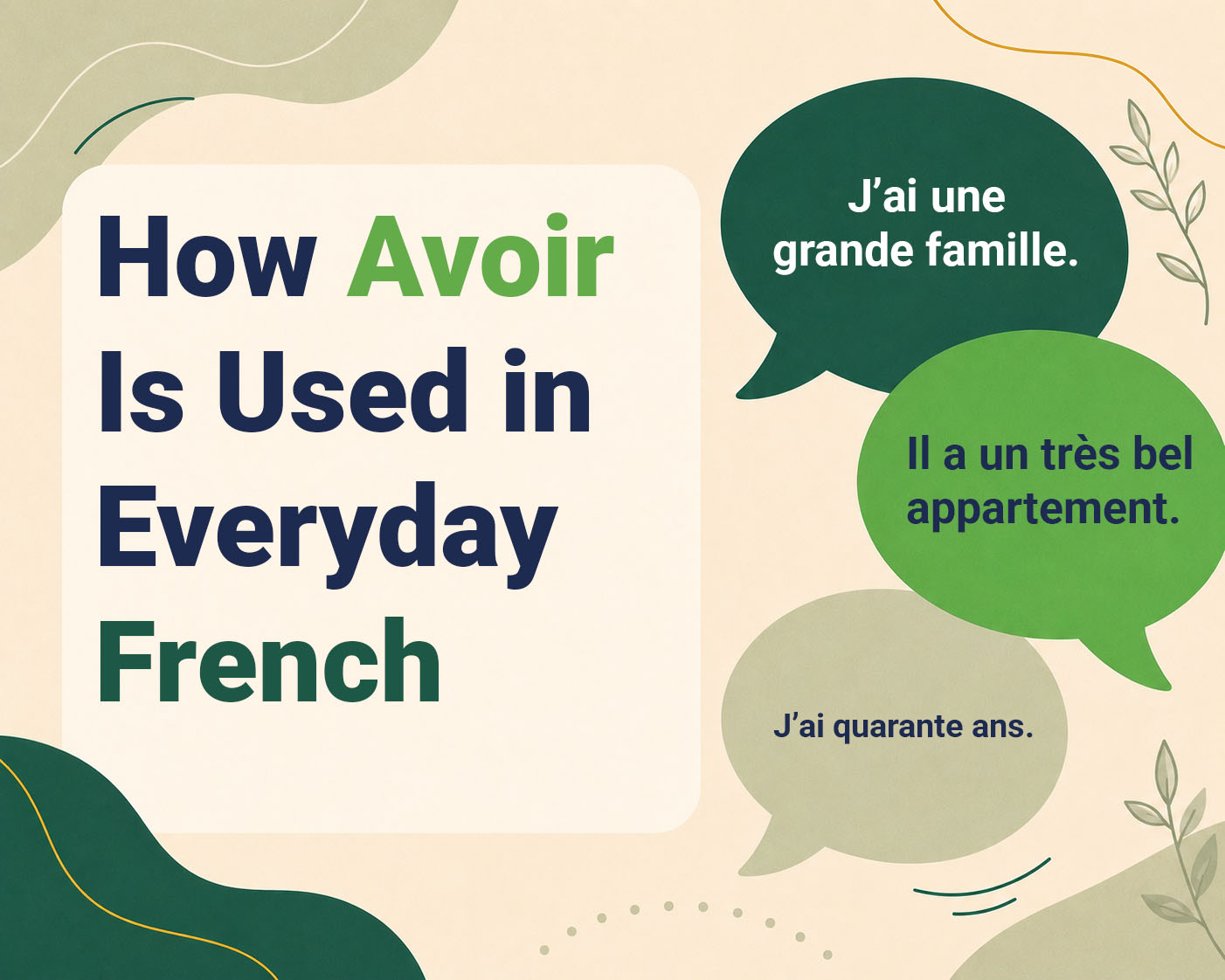
The French verb avoir is usually introduced as “to have.” That translation works when you are talking about possessions, family or pets, but avoir appears in many other everyday expressions too.
French speakers use it to give their age, say they are hungry or thirsty, describe fear and pain, express what they need or feel like doing, and say that someone looks a certain way. It is also one of the two main helping verbs used to form the French past tense.
Once you start noticing expressions built with avoir, forms such as j’ai, tu as, il a and vous avez become much easier to recognize. You can hear every main example below spoken by a native French speaker. The pronunciation guides are approximate, but they can help English speakers get closer to the sound.
The most useful forms of avoir
The present-tense form changes according to who has or experiences something:
| French | Meaning | Form of avoir |
|---|---|---|
| j’ | I | ai |
| tu | you — informal, singular | as |
| il / elle / on | he / she / we or one | a |
| nous | we | avons |
| vous | you — formal singular or plural | avez |
| ils / elles | they | ont |
French normally writes je ai as j’ai because ai begins with a vowel. Although several of these forms contain final consonants, those consonants are usually silent. As and a, for example, sound the same even though they are written differently.
Before a word beginning with a vowel, a normally silent final consonant may link to the next word. This is called liaison. You can hear it in expressions such as vous avez, pronounced approximately “voo zah-VAY,” and ils ont, approximately “eel zon.”
Having something or describing what belongs to someone
J’ai une grande famille.
Natural translation: I have a large family.
Pronunciation: zhay oon grahnd fah-MEE
Word for word: J’ai = I have · une = a · grande = large · famille = family
This is avoir in its most direct sense. French uses the verb to connect a person with something they have, whether that is a possession, a relationship or part of their life.
The final letters in grande are heard because the adjective is in its feminine form. In famille, the letters ill create a sound similar to the y in “yes”; the word does not rhyme with English “mile.”
Il a un très bel appartement.
Natural translation: He has a very nice apartment.
Pronunciation: eel ah uhn treh bell ah-par-tuh-MAHN
Word for word: Il = he · a = has · un = a · très = very · bel = nice/beautiful · appartement = apartment
The form a means “has” with il, elle or on. It is written without an accent. This distinguishes it from à, which is a preposition often meaning “to,” “at” or “in.” The two words sound alike, so the difference is visible in writing rather than speech.
French normally uses beau before a masculine singular noun, but bel appears before a masculine noun beginning with a vowel or silent h. That is why the phrase has un bel appartement, not un beau appartement.
Talking about age
J’ai quarante ans.
Natural translation: I’m forty years old.
Pronunciation: zhay kah-RAHNT ahn
Word for word: J’ai = I have · quarante = forty · ans = years
English says that someone is a certain age, but French says that the person has a certain number of years. The literal structure is “I have forty years.”
You can keep j’ai and replace the number:
- J’ai vingt ans. — I’m twenty years old.
- J’ai trente-cinq ans. — I’m thirty-five years old.
- J’ai soixante ans. — I’m sixty years old.
The final s in ans is silent, and the vowel is nasal. In quarante ans, the final t of quarante links smoothly to ans.
Don’t use je suis to give your age. French uses avoir, so “I’m forty” is J’ai quarante ans.
Asking whether someone has children
Tu as des enfants ?
Natural translation: Do you have children?
Pronunciation: tew ah dayz ahn-FAHN
Word for word: Tu = you · as = have · des = some · enfants = children
This is a common conversational question. French can form an informal question simply by using statement word order with rising intonation: Tu as des enfants ?
When addressing someone formally—or more than one person—you can say:
Vous avez des enfants ?
Natural translation: Do you have children? — formal singular or plural
Pronunciation: voo zah-VAY dayz ahn-FAHN
The z sound between vous and avez is a liaison. Another more structured version is Est-ce que vous avez des enfants ? All three patterns are natural, but the shorter version is especially common in conversation.
Being hungry or thirsty
J’ai faim.
Natural translation: I’m hungry.
Pronunciation: zhay fan — the vowel is nasal; don’t pronounce a separate final n
Word for word: J’ai = I have · faim = hunger
French treats hunger as something you have rather than something you are. Avoir faim literally means “to have hunger.”
Thirst follows the same pattern:
J’ai soif.
Natural translation: I’m thirsty.
Pronunciation: zhay swahf
Word for word: J’ai = I have · soif = thirst
Using je suis faim or je suis soif would be a direct translation from English and is not standard French. The complete expressions to remember are avoir faim and avoir soif.
Saying someone is right or wrong
Tu as raison.
Natural translation: You are right.
Pronunciation: tew ah ray-ZOHN — the final vowel is nasal
Word for word: Tu = you · as = have · raison = reason
French uses avoir raison, literally “to have reason,” where English says “to be right.” The opposite expression also uses avoir:
Tu as tort.
Natural translation: You are wrong.
Pronunciation: tew ah tor
Word for word: Tu = you · as = have · tort = wrong
The final t in tort is normally silent. In a formal situation, change tu as to vous avez:
- Vous avez raison. — You are right.
- Vous avez tort. — You are wrong.
The second expression can sound quite direct. Depending on the situation, a softer disagreement such as Je ne suis pas sûr (“I’m not sure”) may be more diplomatic.
Expressing what you need
J’ai besoin d’un taxi.
Natural translation: I need a taxi.
Pronunciation: zhay buh-ZWAN duhn tak-SEE
Word for word: J’ai = I have · besoin = need · d’un = of a · taxi = taxi
The expression avoir besoin de means “to need.” Word for word, it is closer to “to have need of.” The de changes according to what follows:
- J’ai besoin d’aide. — I need help.
- J’ai besoin de vacances. — I need a vacation.
- Il a besoin d’aide. — He needs help.
- Ils ont besoin de fleurs. — They need flowers.
Before a vowel, de contracts to d’, as in d’aide and d’un taxi. Unlike English “need,” besoin is a noun and remains unchanged when the subject changes; only the form of avoir changes.
The informal question is De quoi est-ce que tu as besoin ? (“What do you need?”). Formally, it becomes De quoi est-ce que vous avez besoin ?
Saying what you feel like doing
J’ai envie de sortir ce soir.
Natural translation: I feel like going out tonight.
Pronunciation: zhay ahn-VEE duh sor-TEER suh SWAHR
Word for word: J’ai = I have · envie = desire · de = to/of · sortir = go out · ce soir = tonight
Avoir envie de expresses a desire or what someone feels like doing. When it is followed by an action, the next verb stays in the infinitive:
- J’ai envie de prendre un bain. — I feel like taking a bath.
- Il a envie de manger quelque chose. — He feels like eating something.
- Qu’est-ce que tu as envie de faire ? — What do you feel like doing?
The expression can also be followed by a noun: J’ai envie d’un café means “I feel like a coffee” or “I’d like a coffee.” As with avoir besoin de, de becomes d’ before a vowel.
Expressing fear
J’ai peur du noir.
Natural translation: I’m scared of the dark.
Pronunciation: zhay puhr dew NWAHR
Word for word: J’ai = I have · peur = fear · du = of the · noir = dark
French uses avoir peur, literally “to have fear,” where English normally uses “to be afraid” or “to be scared.” The cause of the fear follows de:
- Elle a peur des araignées. — She is scared of spiders.
- Ils ont peur des clowns. — They are scared of clowns.
- J’ai peur de l’avion. — I’m scared of flying.
The words following de determine whether you see du, de la, de l’ or des. These combinations all preserve the same basic pattern: avoir peur de something.
Talking about pain
J’ai mal à la tête.
Natural translation: I have a headache. / My head hurts.
Pronunciation: zhay mahl ah lah tet
Word for word: J’ai = I have · mal = pain/badly · à = in/to · la tête = the head
The expression avoir mal à is used when a part of the body hurts. The article changes with the body part:
- J’ai mal aux yeux. — My eyes hurt.
- J’ai mal au dos. — My back hurts.
- J’ai mal à la gorge. — I have a sore throat.
In this construction, au combines à + le, while aux combines à + les. French normally includes the definite article before the body part rather than using a possessive such as “my.”
Describing how someone looks
Il a l’air fatigué.
Natural translation: He looks tired.
Pronunciation: eel ah LEHR fah-tee-GAY
Word for word: Il = he · a = has · l’air = the appearance · fatigué = tired
Avoir l’air means “to look,” “to seem” or “to appear.” It is useful for observations about people and situations:
- Elle a l’air contente. — She looks happy.
- Vous avez l’air fatigué. — You look tired.
- Ça a l’air intéressant. — That looks interesting.
The adjective usually agrees with the person being described. A woman who looks tired is Elle a l’air fatiguée. The additional e changes the spelling, although fatigué and fatiguée sound the same.
Avoir as a helping verb in the past
J’ai acheté une nouvelle voiture.
Natural translation: I bought a new car.
Pronunciation: zhay ash-TAY oon noo-VELL vwah-TUR
Word for word: J’ai = I have · acheté = bought · une = a · nouvelle = new · voiture = car
Here, avoir does not express possession. It is a helping verb used with acheté, the past participle of acheter. Together, j’ai acheté forms the passé composé, the tense commonly used for completed past actions.
Many everyday French verbs form the past this way:
- J’ai écouté de la musique. — I listened to music.
- J’ai appelé mon ami. — I phoned my friend.
- Nous avons dansé. — We danced.
- Tu as déjà déjeuné ? — Have you eaten lunch yet?
English sometimes also uses “have” as a helping verb, but the tense meanings do not line up perfectly. French J’ai acheté une voiture can naturally mean “I bought a car,” even though its word-for-word structure resembles “I have bought a car.”
Not every French verb uses avoir in the passé composé. A smaller group—including many verbs of movement and all reflexive verbs—uses être instead. For example, Je suis allé au cinéma means “I went to the cinema.”
Avoir isn’t used for every English “have”
English “have” appears in expressions that French builds differently. For example:
- prendre le petit-déjeuner — to have breakfast
- prendre un café — to have a coffee
- passer un bon moment — to have a good time
French does sometimes combine these ideas with avoir in the past because avoir acts as the helping verb: Nous avons passé un bon moment means “We had a good time.” The main verb, however, is passer, not avoir.
This is why it is more useful to learn complete expressions than to replace every English “have” mechanically with avoir.
Informal and formal forms
The distinction between tu and vous affects the form of avoir:
| Meaning | Informal | Formal or plural |
|---|---|---|
| Do you have children? | Tu as des enfants ? | Vous avez des enfants ? |
| You are right. | Tu as raison. | Vous avez raison. |
| You are wrong. | Tu as tort. | Vous avez tort. |
| What do you need? | De quoi est-ce que tu as besoin ? | De quoi est-ce que vous avez besoin ? |
| What do you feel like doing? | Qu’est-ce que tu as envie de faire ? | Qu’est-ce que vous avez envie de faire ? |
Use tu with friends, relatives, children and people who have agreed to speak informally. Use vous with more than one person and when politeness or social distance calls for the formal singular.
Usage varies with age, region and setting. French speakers may switch to tu quickly in some relaxed environments, while vous can remain standard between strangers, with customers or in more formal professional situations.
A short everyday exchange
Person 1: Tu as faim ?
Person 2: Oui, et j’ai envie de sortir ce soir.
Person 1: Tu as raison. On a besoin d’une pause.
Person 2: J’ai une idée. On peut aller au restaurant.
Natural translation:
Person 1: Are you hungry?
Person 2: Yes, and I feel like going out tonight.
Person 1: You’re right. We need a break.
Person 2: I have an idea. We can go to a restaurant.
This exchange brings together hunger, desire, agreement, need and possession. English uses several different structures, while French connects all of them through avoir.
One verb, many everyday meanings
Once you recognize the expressions built with avoir, many common French sentences become easier to understand. The verb can tell you what someone has, how old they are, what they need, how they feel and whether something hurts. It can also help place an action in the past.
Learning these combinations as complete phrases is more useful than translating avoir as “to have” every time. J’ai faim, Tu as raison, J’ai besoin d’aide and Il a l’air fatigué each work as a natural unit with its own conversational meaning.
Hear Avoir in Complete French Phrases
The main examples in this article are taken from the LinguaBoost French course and recorded by a native French speaker.
Ready to speak more French?
Build on the phrases in this article with structured practice, native-speaker audio and built-in review designed for everyday conversation.
Explore the French course