
Family often comes up when French speakers are getting to know one another. You may introduce a parent or sibling, explain where your relatives live, say whether you have children, or notice that someone resembles a parent. These ordinary exchanges bring together several important features of French: masculine and feminine family words, possessives such as mon, ma and mes, informal and formal questions, liaison and many final letters that remain silent.
The phrases below are organized by the situations in which you would actually use them. Each main example includes native-speaker audio, while the supplementary alternatives show how the same structures change for another relative, a formal conversation or a different answer.
Introducing your parents
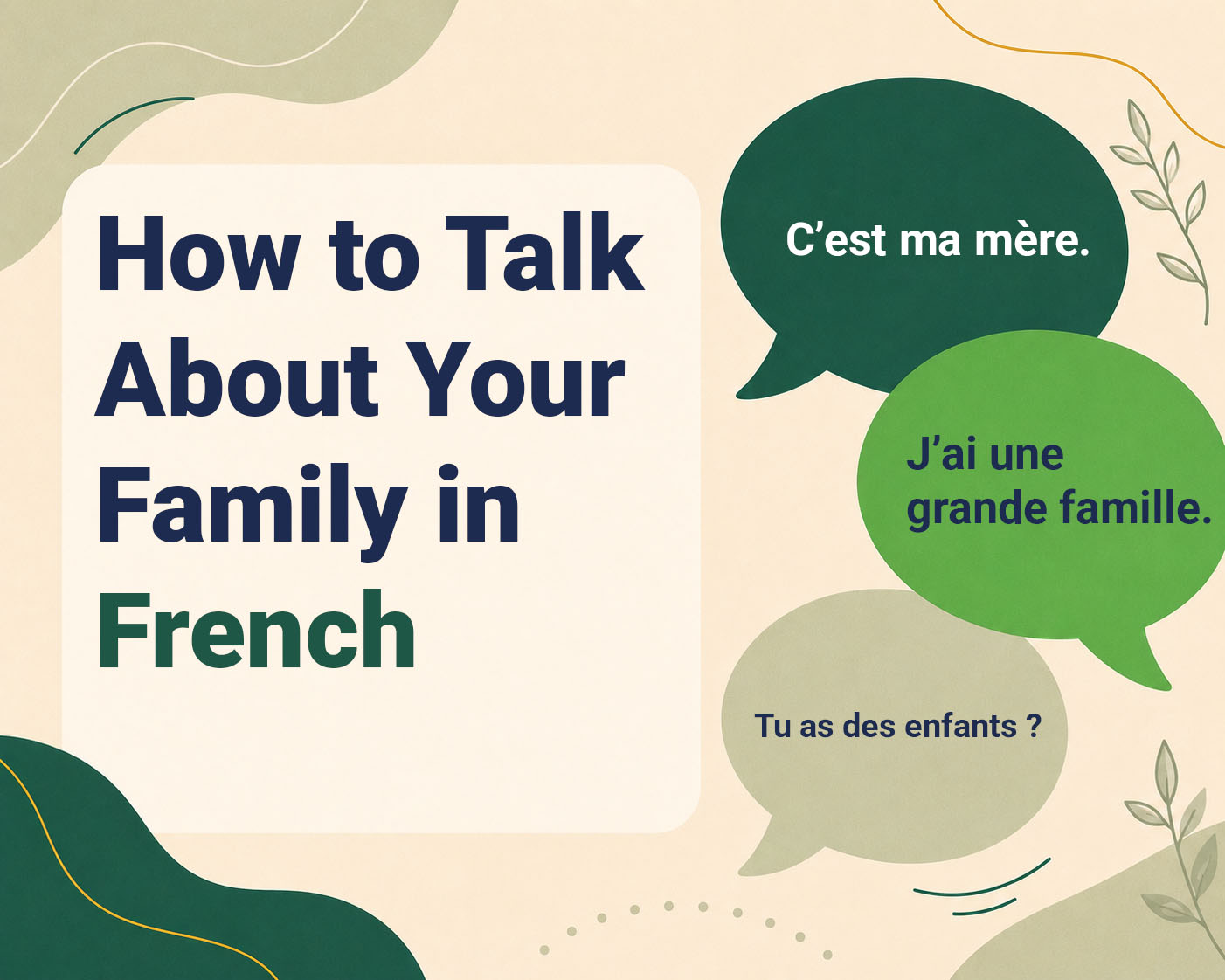
C’est ma mère.
Natural translation: This is my mother.
Pronunciation: say mah mehr
Word for word: C’est = this is/it is · ma = my · mère = mother
Use C’est… to identify or introduce someone. Mère is feminine, so “my” appears as ma. The choice depends on the gender of the noun, not on whether the speaker is a woman or a man.
The accents in mère do not add syllables. The word has one syllable, with a vowel close to the one in English “air,” but without the English glide at the end.
C’est mon père.
Natural translation: This is my father.
Pronunciation: say mohn pehr
Word for word: C’est = this is/it is · mon = my · père = father
Père is masculine, so French uses mon. The final n in mon is not pronounced as a separate English-style consonant; it helps form a nasal vowel.
You can use the same frame with another relative: C’est ma tante (“This is my aunt”), C’est mon oncle (“This is my uncle”) or C’est ma grand-mère (“This is my grandmother”). Before a feminine word beginning with a vowel sound, French uses mon to avoid two vowels meeting: mon amie means “my female friend.”
Talking about brothers and sisters
C’est mon frère.
Natural translation: This is my brother.
Pronunciation: say mohn frehr
Word for word: C’est = this is · mon = my · frère = brother
The French r is produced farther back in the mouth than an English r. It does not need to be exaggerated; the native recording gives a useful model for its light, connected sound inside frère.
French commonly distinguishes age with mon grand frère (“my older brother”) and mon petit frère (“my younger brother”). Here grand and petit usually refer to age, not physical size.
C’est ma sœur.
Natural translation: This is my sister.
Pronunciation: say mah suhr
Word for word: C’est = this is · ma = my · sœur = sister
Sœur is feminine and therefore takes ma. The vowel written œu has no exact English equivalent; keep the lips rounded while producing a short central vowel.
The age expressions are ma grande sœur (“my older sister”) and ma petite sœur (“my younger sister”). In everyday French, “siblings” is often expressed as frères et sœurs, literally “brothers and sisters.” You can say J’ai un frère et une sœur—“I have a brother and a sister.”
Describing the size of your family
J’ai une grande famille.
Natural translation: I have a large family.
Pronunciation: zhay oon grahnd fah-MEE-yuh
Word for word: J’ai = I have · une = a · grande = large · famille = family
J’ai means “I have.” The apostrophe reflects the contraction of je before the vowel sound in ai. Famille is feminine, which explains both une and the adjective form grande.
To say the opposite, use J’ai une petite famille. In this context, grande and petite normally describe the number of people, not their height.
French also has a useful distinction between la famille proche (“close/immediate family”) and la famille élargie (“extended family”). If you have many cousins, aunts and uncles but no siblings, you might clarify: J’ai une grande famille élargie—“I have a large extended family.”
Asking where someone’s parents live
Où vivent vos parents ?
Natural translation: Where do your parents live?
Pronunciation: oo veev voh pah-RAHN
Word for word: Où = where · vivent = live · vos = your · parents = parents
This question uses vos, which is appropriate when addressing someone formally and also when the noun owned is plural. The informal singular version is Où vivent tes parents ? Only the possessive changes from vos to tes.
The spelling vivent contains several silent letters. It is pronounced like one syllable, approximately veev. The final -ent used with many third-person plural verbs is silent.
Mes parents vivent à Oslo.
Natural translation: My parents live in Oslo.
Pronunciation: may pah-RAHN veev ah OSS-loh
Word for word: Mes = my · parents = parents · vivent = live · à = in/at · Oslo = Oslo
Use mes before a plural noun: mes parents, mes enfants, mes frères and mes sœurs. French normally places à before a city: Mes parents vivent à Paris, à Montréal or à Londres.
Countries require different prepositions. Compare Mes parents vivent en France, au Canada and aux États-Unis. Learning the preposition together with the country prevents a common error caused by using à for every destination or location.
Spending time with relatives
J’aime passer du temps avec ma famille.
Natural translation: I like spending time with my family.
Pronunciation: zhem pah-SAY dyoo tahn ah-VEK mah fah-MEE-yuh
Word for word: J’aime = I like · passer du temps = spend time · avec = with · ma famille = my family
The complete expression is passer du temps avec quelqu’un—“to spend time with someone.” You can replace the final part naturally: avec mes enfants (“with my children”), avec mes grands-parents (“with my grandparents”) or avec mes cousins (“with my cousins”).
For visiting people, French normally says rendre visite à: J’ai rendu visite à mes parents means “I visited my parents.” By contrast, visiter is used readily for places: visiter un musée, visiter Paris. Keeping those two structures separate makes the difference easier to remember.
Talking about marriage
Tu es marié ?
Natural translation: Are you married?
Pronunciation: tyoo eh mah-ree-AY
Word for word: Tu = you · es = are · marié = married
This is an informal everyday question. French often turns statement word order into a question through rising intonation. In writing, marié refers to a man and mariée to a woman, although both forms sound the same.
Formal alternatives are Vous êtes marié ? and Vous êtes mariée ? In more careful speech, use inversion: Êtes-vous marié(e) ?
To introduce a spouse, say Voici mon mari (“This is my husband”) or Voici ma femme (“This is my wife”). Femme can mean “woman” or “wife”; the possessive and context establish the intended meaning. A neutral way to refer to a partner is mon compagnon or ma compagne, though personal preferences vary.
Asking about children
Tu as des enfants ?
Natural translation: Do you have children?
Pronunciation: tyoo ah day zahn-FAHN
Word for word: Tu = you · as = have · des = some · enfants = children
This informal question also uses statement order with rising intonation. In des enfants, the normally silent s links to the following vowel and sounds like z. The formal everyday version is Vous avez des enfants ?, while Avez-vous des enfants ? is more formal in structure.
Because family circumstances can be personal, this question is best used when the conversation naturally moves in that direction. When replying, French allows a simple Oui, j’ai… or Non, je n’ai pas d’enfants—“No, I don’t have children.” Notice that des becomes de/d’ after the negative construction.
J’ai un fils.
Natural translation: I have a son.
Pronunciation: zhay uhn fees
Word for word: J’ai = I have · un = a · fils = son
The spelling of fils is unusual: the final s is pronounced, while the l is silent. The word sounds approximately like “fees.”
J’ai une fille.
Natural translation: I have a daughter.
Pronunciation: zhay oon fee-yuh
Word for word: J’ai = I have · une = a · fille = daughter
Fille can mean either “girl” or “daughter.” With J’ai une fille, “I have a daughter” is normally understood. The written ille produces a sound approximately like “yuh,” not the sound of English “ill.”
Combien d’enfants as-tu ?
Natural translation: How many children do you have?
Pronunciation: kohm-BYEN dahn-FAHN ah-tyoo
Word for word: Combien = how many · d’enfants = of children · as-tu = have you
This question uses inversion: tu as becomes as-tu. An informal conversational alternative is Tu as combien d’enfants ? The formal version is Combien d’enfants avez-vous ?
De becomes d’ before the vowel in enfants. This elision avoids two vowel sounds meeting.
J’ai deux enfants.
Natural translation: I have two children.
Pronunciation: zhay duh zahn-FAHN
Word for word: J’ai = I have · deux = two · enfants = children
The final x in deux is usually silent, but before enfants it links to the vowel and sounds like z. This is another liaison: deux enfants sounds approximately like “duh-zahn-FAHN.”
After a number, French does not use des: un enfant, deux enfants, trois enfants. To name both children, you could say J’ai un fils et une fille—“I have a son and a daughter.”
Talking about family resemblance
Il ressemble à sa mère ou à son père ?
Natural translation: Does he look like his mother or his father?
Pronunciation: eel ruh-SAHMBL ah sah mehr oo ah sohn pehr
Word for word: Il = he · ressemble = resembles · à = to · sa mère = his mother · ou = or · à son père = or his father
French uses ressembler à quelqu’un, literally “to resemble someone.” Keep à before the person: Elle ressemble à sa mère means “She looks like her mother.”
The possessives sa and son agree with the following nouns, not with the owner. Both translate as “his” here: sa mère because mère is feminine, and son père because père is masculine. The same possessives can describe a woman’s parents: Elle ressemble à sa mère ou à son père ?
Useful French family vocabulary
| English | French | Example in a complete phrase |
|---|---|---|
| grandparents | les grands-parents | Mes grands-parents vivent à Lyon. |
| grandfather | le grand-père | C’est mon grand-père. |
| grandmother | la grand-mère | Je rends visite à ma grand-mère. |
| uncle | l’oncle | Mon oncle habite à Marseille. |
| aunt | la tante | Ma tante a deux enfants. |
| male cousin | le cousin | Je pars avec mon cousin. |
| female cousin | la cousine | Ma cousine parle français. |
| grandson | le petit-fils | Voici leur petit-fils. |
| granddaughter | la petite-fille | Voici leur petite-fille. |
Beau-père can mean either “stepfather” or “father-in-law,” and belle-mère can mean “stepmother” or “mother-in-law.” Context normally resolves the meaning. When precision matters, speakers can explain the relationship rather than relying on the single compound word.
Informal and formal questions
| Meaning | Informal singular | Formal singular or plural |
|---|---|---|
| Where do your parents live? | Où vivent tes parents ? | Où vivent vos parents ? |
| Are you married? | Tu es marié(e) ? | Vous êtes marié(e) ? |
| Do you have children? | Tu as des enfants ? | Vous avez des enfants ? |
| How many children do you have? | Combien d’enfants as-tu ? | Combien d’enfants avez-vous ? |
Use tu, ton, ta and tes with friends, relatives, children and people with whom you have an informal relationship. Use vous, votre and vos when addressing several people or one person formally.
A short family conversation
Person 1: Tu as une grande famille ?
Person 2: Oui. J’ai un frère et une sœur.
Person 1: Où vivent tes parents ?
Person 2: Mes parents vivent à Oslo.
Person 1: Tu as des enfants ?
Person 2: Oui, j’ai deux enfants.
Natural translation:
Person 1: Do you have a large family?
Person 2: Yes. I have a brother and a sister.
Person 1: Where do your parents live?
Person 2: My parents live in Oslo.
Person 1: Do you have children?
Person 2: Yes, I have two children.
The conversation combines identification, possessive forms and both questions and answers. It also shows why complete phrases matter: mon frère, ma sœur and mes parents each preserve the correct possessive form, while Tu as des enfants ? provides a natural informal question rather than an isolated list of family words.
The main examples in this article are taken from the LinguaBoost French course and recorded by a native French speaker.
Make Family Conversations Feel Natural in French
Continue with practical complete phrases, native-speaker audio and structured review that helps you recognize and use everyday French with more confidence.
Explore the French course