
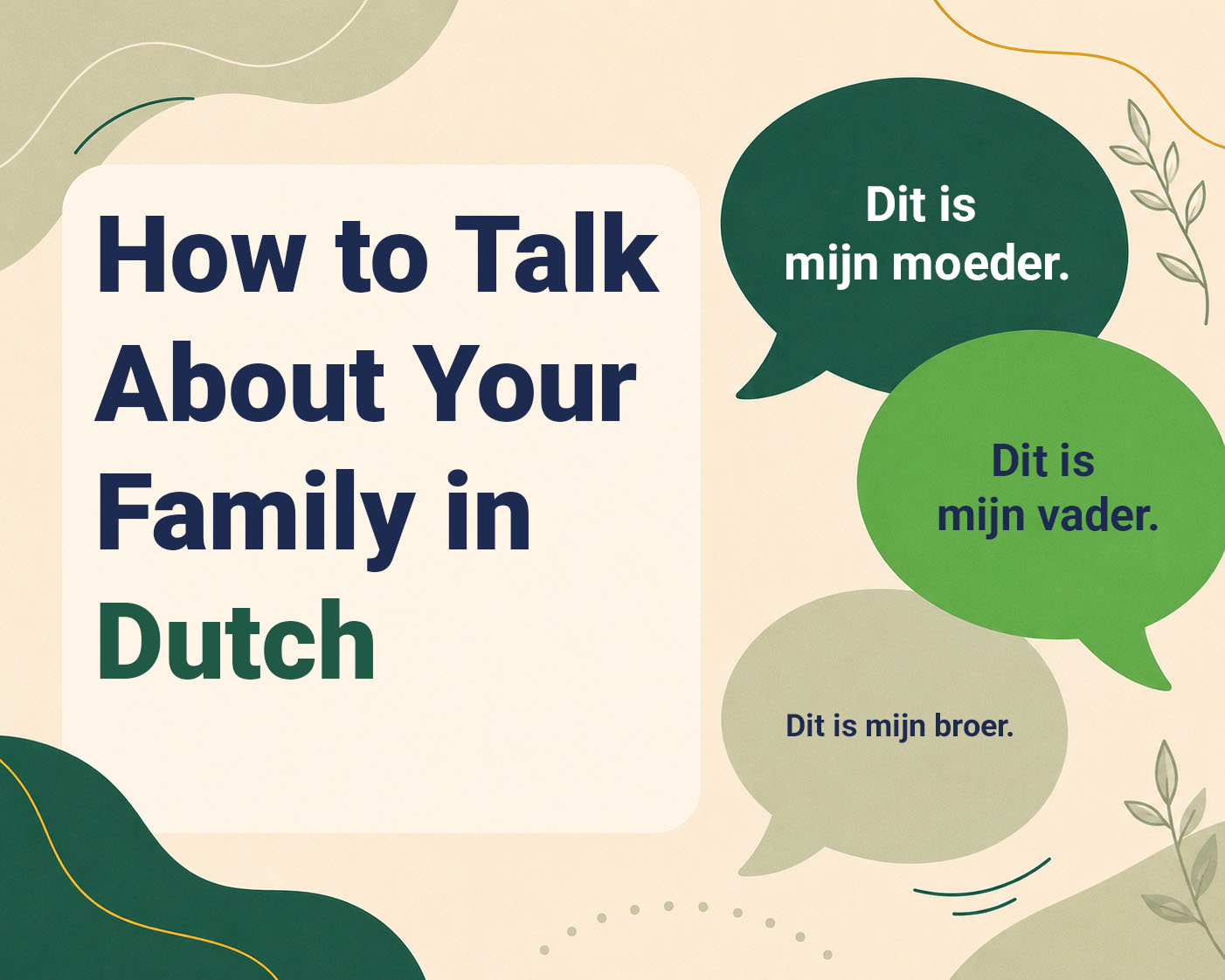
See how Dutch speakers introduce parents and siblings, ask where relatives live, discuss marriage and children, and describe family resemblance. These everyday situations reveal several useful features of Dutch at once: mijn stays the same before different family words, singular and plural subjects change the verb, and questions with ben and heb normally place the verb before the subject.
The main phrases below include native-speaker audio. The additional examples focus on genuine choices a speaker makes—such as je versus u, kinderen versus zoon/dochter, and opa/oma versus grootvader/grootmoeder—rather than padding the article with generic practice instructions.
Introducing your parents
Dit is mijn moeder.
Natural translation: This is my mother.
Word for word: Dit = this · is = is · mijn = my · moeder = mother
Use Dit is… when introducing someone or identifying a person in a photograph. Mijn does not change to match the gender of the relative: it remains mijn moeder, mijn vader, mijn broer and mijn zus. That makes Dutch possessives simpler than those in many other European languages.
In careful pronunciation, mijn contains the Dutch ij sound. It is not exactly the English vowel in “mine”; listen for how the native speaker moves through the vowel without separating it into two exaggerated parts.
Dit is mijn vader.
Natural translation: This is my father.
The frame is identical; only the family word changes. Vader is neutral and standard. In affectionate family speech, Dutch speakers often use papa and mama, but adults also use those words when referring to their own parents. The choice depends more on family habit and tone than on a strict age rule.
For a photograph with several people, you can extend the phrase: Dit zijn mijn ouders means “These are my parents.” The verb changes from singular is to plural zijn because ouders is plural.
Talking about siblings
Dit is mijn broer.
Natural translation: This is my brother.
Broer means “brother.” To specify age, use mijn oudere broer (“my older brother”) or mijn jongere broer (“my younger brother”). The adjective comes before the noun and normally takes -e in these phrases.
Dit is mijn zus.
Natural translation: This is my sister.
The word zus means “sister.” The corresponding age descriptions are mijn oudere zus and mijn jongere zus. Dutch has a collective word, broers en zussen, for “brothers and sisters,” while siblings also appears in some modern contexts but is less basic and less universally natural.
To say what siblings you have, use Ik heb een broer en een zus. The indefinite article een is normally unstressed and often sounds closer to “uhn” than to the number één, which carries emphasis and means exactly “one.”
Describing the size of your family
Ik heb een grote familie.
Natural translation: I have a large family.
Word for word: Ik = I · heb = have · een = a · grote = large · familie = family
The adjective appears as grote before familie. To express the opposite, say Ik heb een kleine familie. In this context, “large” and “small” generally refer to the number of relatives, not their physical size.
Dutch distinguishes naaste familie (“close/immediate family”) from verre familie (“more distant relatives”). Familie can also mean “relatives” collectively. Mijn familie woont verspreid over Nederland means “My family lives spread across the Netherlands.”
Asking where parents live
Waar wonen je ouders?
Natural translation: Where do your parents live?
The subject je ouders is plural, so Dutch uses wonen. Compare the singular Waar woont je zus? (“Where does your sister live?”). With a singular third-person subject, wonen becomes woont.
Je is informal and unstressed. The formal version is Waar wonen uw ouders? Here uw replaces je, while the plural verb remains wonen. In speech, the question word comes first, followed by the verb and then the subject.
Mijn ouders wonen in Oslo.
Natural translation: My parents live in Oslo.
The answer returns to statement order: subject Mijn ouders, then verb wonen, then place in Oslo. You can substitute another location directly: Mijn ouders wonen in Amsterdam or Mijn ouders wonen in België.
For singular relatives, change the verb: Mijn zus woont in Parijs and Mijn broer woont in Madrid. The contrast between wonen and woont is small in sound but grammatically important.
Talking about marriage and partners
Ben je getrouwd?
Natural translation: Are you married?
Yes-or-no questions put the verb first: the statement Je bent getrouwd becomes Ben je getrouwd? Notice that bent loses its final -t when je moves after the verb. This is a regular feature of Dutch inversion with jij/je.
The formal question is Bent u getrouwd? With u, the verb keeps -t. Getrouwd does not change according to the gender of the person, unlike equivalent adjectives in some languages.
Ik ben getrouwd.
Natural translation: I am married.
This answer uses ben, the first-person form of zijn (“to be”). A negative answer is Ik ben niet getrouwd. To introduce a spouse, say Dit is mijn man (“This is my husband”) or Dit is mijn vrouw (“This is my wife”). Vrouw also means “woman,” so the possessive and context determine the meaning.
Partner is a common gender-neutral word: Dit is mijn partner. It works in both everyday and official contexts and avoids making assumptions about marital status.
Asking about children
Heb je kinderen?
Natural translation: Do you have children?
The statement Je hebt kinderen becomes Heb je kinderen? Once again, hebt loses the final -t when je follows the verb. The formal version is Heeft u kinderen?, using heeft with u.
This can be a personal question, so it fits best after the conversation has naturally moved toward family. A concise negative answer is Nee, ik heb geen kinderen. Dutch uses geen to negate an indefinite noun: not niet kinderen.
Ik heb een zoon.
Natural translation: I have a son.
Zoon means “son.” To add age, say Ik heb een zoon van acht (“I have an eight-year-old son”) or Mijn zoon is acht jaar oud (“My son is eight years old”). Dutch uses zijn, not hebben, to state age.
Ik heb een dochter.
Natural translation: I have a daughter.
Dochter means “daughter.” The ch is pronounced at the back of the mouth; it is not the English sound in “church.” For one son and one daughter, say Ik heb een zoon en een dochter.
Ik heb twee kinderen.
Natural translation: I have two children.
The plural of kind is kinderen. It is not formed by simply adding -s, so it is worth learning the singular and plural together: één kind, twee kinderen.
To ask for the number, write Hoeveel kinderen heb je? as one word: hoeveel. A natural answer may give only the total, or add detail: Ik heb twee kinderen: een zoon en een dochter.
Visiting relatives
The useful sentence Ik heb mijn ouders bezocht means “I visited my parents.” Dutch commonly uses the present perfect for a completed event in conversation. The pattern is heb + bezocht, and the past participle moves to the end. Add a time phrase before or after the middle information: Ik heb gisteren mijn ouders bezocht or Ik heb mijn ouders afgelopen weekend bezocht.
Ik heb mijn grootouders bezocht.
Natural translation: I visited my grandparents.
Grootouders is the collective word for grandparents. Individually, grootvader and grootmoeder are clear but can sound more formal than the widely used opa and oma. Adults often say mijn opa and mijn oma naturally.
For maternal or paternal grandparents, Dutch can say mijn grootouders van moederskant and mijn grootouders van vaderskant—literally, grandparents on the mother’s or father’s side.
Describing resemblance
Lijkt hij op zijn moeder of zijn vader?
Natural translation: Does he look like his mother or his father?
The structure is op iemand lijken: literally, “to resemble someone.” In a statement, say Hij lijkt op zijn vader. In the question, the verb moves before the subject: Lijkt hij…? Keep op with the person being compared.
For a woman, use Lijkt zij op haar moeder? Here zijn means “his” and haar means “her.” To ask the listener directly, say Lijk je op je moeder of op je vader? Dutch often repeats op before the second alternative, especially when that makes a longer sentence clearer.
Useful Dutch family vocabulary
| Relationship | Dutch | Natural example |
|---|---|---|
| parents | de ouders | Mijn ouders wonen dichtbij. |
| grandparents | de grootouders | Mijn grootouders komen zondag. |
| grandfather | de opa / grootvader | Mijn opa is tachtig. |
| grandmother | de oma / grootmoeder | Mijn oma woont in Utrecht. |
| uncle | de oom | Mijn oom heeft twee kinderen. |
| aunt | de tante | Mijn tante komt op bezoek. |
| male cousin | de neef | Mijn neef studeert in Leiden. |
| female cousin | de nicht | Mijn nicht spreekt Spaans. |
| grandson | de kleinzoon | Dit is hun kleinzoon. |
| granddaughter | de kleindochter | Dit is hun kleindochter. |
The words neef and nicht can also mean “nephew” and “niece.” Context usually resolves the relationship. When precision matters, speakers can explain it: de zoon van mijn zus (“my sister’s son”) or de dochter van mijn oom (“my uncle’s daughter”).
Informal and formal family questions
| Meaning | Informal with je | Formal with u |
|---|---|---|
| Where do your parents live? | Waar wonen je ouders? | Waar wonen uw ouders? |
| Are you married? | Ben je getrouwd? | Bent u getrouwd? |
| Do you have children? | Heb je kinderen? | Heeft u kinderen? |
| Do you look like your mother? | Lijk je op je moeder? | Lijkt u op uw moeder? |
Use je/jij with friends, relatives and people who invite an informal relationship. Use u and uw in formal service situations, with some older people, or when social distance calls for respect. Dutch usage is changing and varies by speaker, so listen to how the other person addresses you.
A short family conversation
Persoon 1: Heb je een grote familie?
Persoon 2: Ja, ik heb een broer en een zus.
Persoon 1: Waar wonen je ouders?
Persoon 2: Mijn ouders wonen in Oslo. Heb jij kinderen?
Persoon 1: Ja, ik heb twee kinderen: een zoon en een dochter.
Natural translation:
Person 1: Do you have a large family?
Person 2: Yes, I have a brother and a sister.
Person 1: Where do your parents live?
Person 2: My parents live in Oslo. Do you have children?
Person 1: Yes, I have two children: a son and a daughter.
The stressed pronoun jij in Heb jij kinderen? makes the return question sound contrastive: “And do you have children?” That small change is more natural here than repeating an unstressed je without any conversational emphasis.
The main examples in this article are taken from the LinguaBoost Dutch course and recorded by a native Dutch speaker.
Make Family Conversations Feel Natural in Dutch
Continue with practical complete phrases, native-speaker audio and structured review that helps you recognize and use everyday Dutch with more confidence.
Explore the Dutch course