
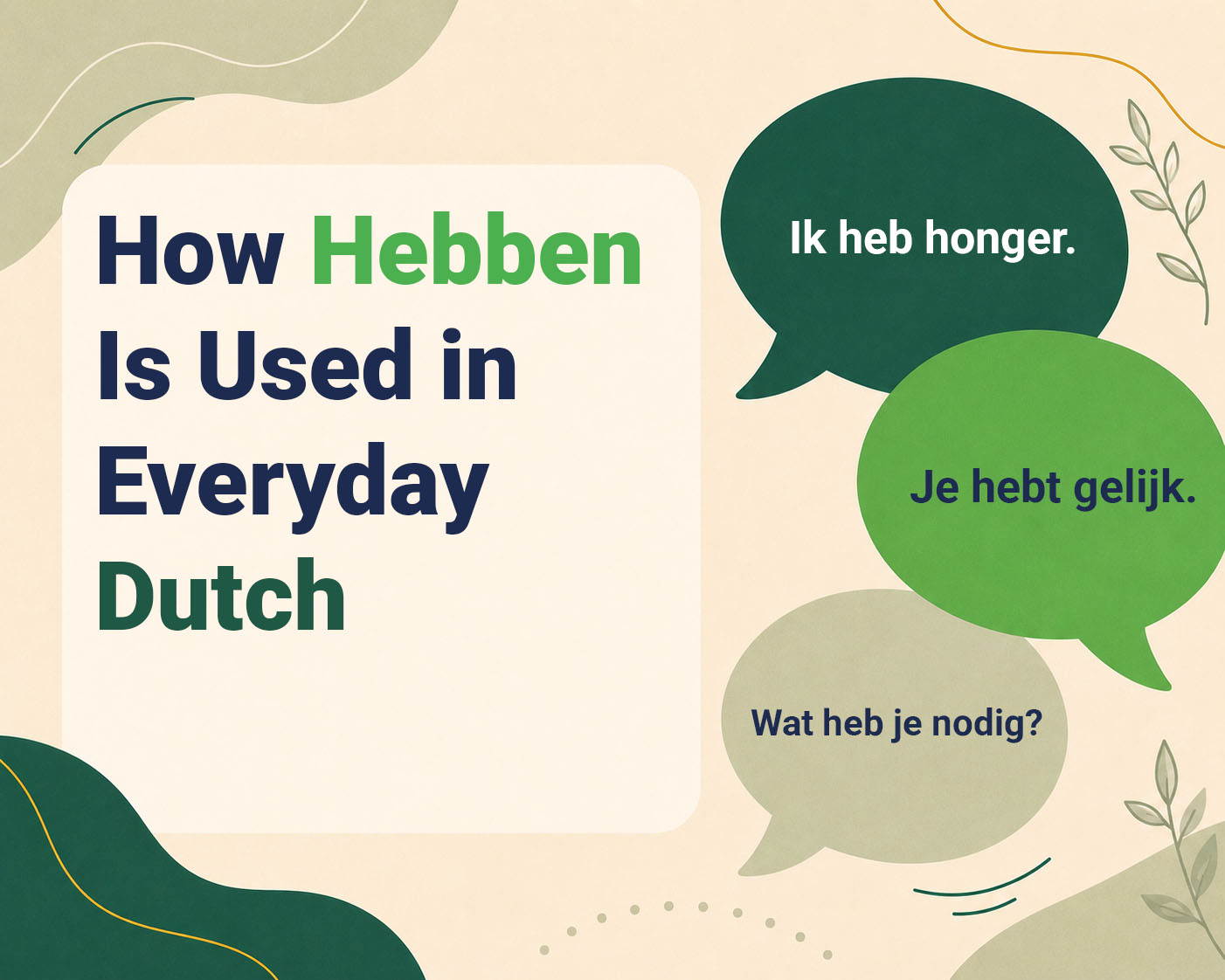
The Dutch verb hebben usually means “to have,” but owning something is only one of its everyday uses.
Dutch speakers also use hebben to talk about hunger, preferences, needs, feelings and available time. It can describe what someone is wearing, and it works as a helping verb in many sentences about the past.
You can hear every main example spoken by a native Dutch speaker. The pronunciation guides are approximate, but they can help English speakers get close to the sound.
The most useful forms of hebben
The form of hebben changes according to the subject:
| Dutch | Meaning | Form of hebben |
|---|---|---|
| ik | I | heb |
| jij / je | you — informal, singular | hebt |
| u | you — formal | hebt / heeft |
| hij / zij / het | he / she / it | heeft |
| wij / we | we | hebben |
| jullie | you — plural | hebben |
| zij / ze | they | hebben |
Both u hebt and u heeft are used for the formal “you.” U heeft is especially common, while u hebt follows the same grammatical pattern as jij hebt.
Dutch usually includes the subject pronoun, so you’ll normally say ik heb (“I have”) rather than using heb alone.
Having or owning something
Ik heb een hond.
Natural translation: I have a dog.
Pronunciation: ik hep uhn hont
Word for word: Ik = I · heb = have · een = a · hond = dog
This is hebben in its most direct sense: having or owning something. You can keep ik heb and change what comes afterwards:
- Ik heb een kat. — I have a cat.
- Ik heb twee katten en een hond. — I have two cats and a dog.
- Ik heb een grote familie. — I have a large family.
The final b in heb sounds closer to p, and the final d in hond sounds closer to t. Dutch often makes voiced consonants such as b and d voiceless at the end of a word.
The word een is frequently reduced in everyday speech. Instead of the carefully pronounced number één (“one”), the article often sounds roughly like “uhn.”
Heb je kinderen?
Natural translation: Do you have children?
Pronunciation: hep yuh KIN-duh-ruhn
Word for word: Heb = have · je = you · kinderen = children
This question shows an important Dutch pattern. In a statement, you say:
Je hebt kinderen. — You have children.
When the verb moves before je to form a question, the final -t disappears:
Heb je kinderen? — Do you have children?
The same change appears in many questions: je hebt becomes heb je? English adds “do,” but Dutch normally forms this kind of question by moving the verb.
The formal version is Heeft u kinderen? You may also hear Hebt u kinderen? Both mean “Do you have children?”
Being hungry or thirsty
Ik heb honger.
Natural translation: I’m hungry.
Pronunciation: ik hep HONG-uhr
Word for word: Ik = I · heb = have · honger = hunger
English describes someone as hungry, but Dutch treats hunger as something you have: honger hebben, literally “to have hunger.”
Thirst uses the same structure:
Ik heb dorst. — I’m thirsty. Literally: “I have thirst.”
The Dutch h is pronounced, unlike the silent h found in some other European languages. In honger, the ng forms one sound, similar to the end of English “sing.”
Saying someone is right
Je hebt gelijk.
Natural translation: You are right.
Pronunciation: yuh hept khuh-LAIK
Word for word: Je = you · hebt = have · gelijk = right/equality
Dutch uses gelijk hebben where English uses “to be right.” The structure is literally “to have right.”
The opposite phrase in the course is:
Je hebt het fout. — You are wrong. Literally: “You have it wrong.”
For a formal conversation, use U heeft gelijk or U hebt gelijk.
The g in gelijk is produced at the back of the mouth and has no exact English equivalent. It can sound rough or breathy, depending on the speaker and region. The Dutch ij sounds approximately like the vowel in English “eye,” although the Dutch sound is shorter and slightly different.
Expressing a preference
Ik heb liever zwarte koffie.
Natural translation: I prefer black coffee.
Pronunciation: ik hep LEE-vuhr ZVAHR-tuh KAW-fee
Word for word: Ik = I · heb = have · liever = preferably/rather · zwarte = black · koffie = coffee
The expression liever hebben is a common way to say that you prefer one thing over another. A question might be:
Heb je liever thee of koffie? — Do you prefer tea or coffee?
Here, liever is close to “rather” in the English phrase “I’d rather have.” Dutch uses the present form ik heb liever very naturally for a current preference.
The w in zwarte is pronounced more softly than an English w and may sound somewhere between English v and w, depending on the region.
Saying what you feel like doing
Waar heb je zin in?
Natural translation: What do you feel like doing?
Pronunciation: vahr hep yuh zin in
Word for word: Waar = where/what · heb = have · je = you · zin = desire/inclination · in = in
The expression zin hebben in means to feel like something or to be in the mood for it. The word-for-word structure—roughly “Where do you have desire in?”—doesn’t translate naturally into English, so it’s best understood as one complete expression.
Dutch w at the beginning of waar is often approximated with English v, although the exact sound varies by region.
Ik heb zin om vanavond uit te gaan.
Natural translation: I feel like going out tonight.
Pronunciation: ik hep zin om vahn-AH-vont owt tuh khahn
Word for word: Ik = I · heb = have · zin = desire/inclination · om = to · vanavond = tonight · uit te gaan = to go out
When zin hebben is followed by an action, Dutch commonly uses om ... te around the rest of the phrase:
Ik heb zin om een bad te nemen. — I feel like taking a bath.
To make the expression negative, add geen:
Ik heb geen zin om naar huis te gaan. — I don’t feel like going home.
The Dutch ui in uit has no direct English equivalent. Start with something near “ow,” but keep the sound tighter and more forward in the mouth.
Talking about what someone needs
Wat heb je nodig?
Natural translation: What do you need?
Pronunciation: vat hep yuh NOH-dukh
Word for word: Wat = what · heb = have · je = you · nodig = necessary/needed
Dutch commonly expresses “to need” with nodig hebben, literally “to have necessary.” This means the language often uses a form of hebben where English uses the separate verb “need.”
Notice the word order. In the question, the words are separated: Wat heb je nodig? In an infinitive phrase, they appear together as nodig hebben.
The final g in nodig is the same type of back-of-the-mouth sound heard in gelijk, although its exact pronunciation varies across the Netherlands and Belgium.
Ik heb een taxi nodig.
Natural translation: I need a taxi.
Pronunciation: ik hep uhn TAK-see NOH-dukh
Word for word: Ik = I · heb = have · een = a · taxi = taxi · nodig = necessary/needed
The thing you need normally appears between hebben and nodig:
- Ik heb hulp nodig. — I need help.
- Ik heb wat tijd nodig. — I need some time.
- Ik heb rust en stilte nodig. — I need some peace and quiet.
This split structure is common in Dutch. Learning it as ik heb ... nodig makes it easier to place new nouns in the middle without rebuilding the whole sentence.
The formal question is Wat heeft u nodig? or Wat hebt u nodig?
Talking about pain
Ik heb hoofdpijn.
Natural translation: I have a headache.
Pronunciation: ik hep HOHFT-pain
Word for word: Ik = I · heb = have · hoofdpijn = headache
Hoofdpijn is a compound word made from hoofd (“head”) and pijn (“pain”). Dutch, like German, frequently combines shorter words to create a more specific one.
When spoken, the d at the end of hoofd sounds like t, which is why the middle of the compound sounds approximately like “hohft.”
The Dutch ij in pijn is roughly similar to English “eye.” Other common pain words include buikpijn (“stomachache”) and rugpijn (“back pain”).
Having time—or not having it
Ik heb geen tijd om TV te kijken.
Natural translation: I don’t have time to watch TV.
Pronunciation: ik hep khayn tait om tay-VAY tuh KAI-kuhn
Word for word: Ik = I · heb = have · geen = no · tijd = time · om = to · TV = television · te kijken = to watch
Tijd hebben means “to have time.” Dutch commonly makes the expression negative with geen tijd, literally “no time.”
The positive version is Ik heb tijd (“I have time” or “I’m available”).
The letters ij appear in both tijd and kijken. Their sound is approximately like English “eye,” but usually shorter. Dutch pronounces the abbreviation TV using the Dutch letter names, approximately “tay-VAY.”
Hebben as a helping verb
Heb je al lunch gegeten?
Natural translation: Have you eaten lunch yet?
Pronunciation: hep yuh al luhnch khuh-GAY-tuhn
Word for word: Heb = have · je = you · al = already/yet · lunch = lunch · gegeten = eaten
Here, hebben doesn’t express possession. It helps form the Dutch perfect tense together with gegeten (“eaten”). This form is extremely common when people talk about completed events.
As in English “Have you eaten?”, the form of hebben comes before the subject in the question. The other part of the verb, gegeten, appears later in the sentence.
The g sounds in gegeten are made at the back of the mouth. The middle syllable carries the stress: khuh-GAY-tuhn.
Ik heb naar muziek geluisterd.
Natural translation: I listened to music.
Pronunciation: ik hep nahr myoo-ZEEK khuh-LUY-stuhrt
Word for word: Ik = I · heb = have · naar = to · muziek = music · geluisterd = listened
The word-for-word structure resembles “I have listened to music,” but natural English often uses the simple past: “I listened to music.” Dutch commonly uses this perfect form when describing what someone did.
Many Dutch verbs form the conversational past with hebben. Some verbs use zijn (“to be”) instead, particularly verbs describing movement or a change of state:
Ik ben thuis gebleven. — I stayed at home.
The ui in geluisterd is one of the most distinctively Dutch vowel combinations. The pronunciation guide can only approximate it, so the native-speaker recording is particularly useful here.
One place Dutch doesn’t use hebben
English speakers might expect hebben when talking about age because several European languages use “to have” in that situation. Dutch doesn’t. It follows the same basic structure as English and uses zijn (“to be”):
Ik ben veertig jaar oud.
Natural translation: I am forty years old.
Pronunciation: ik ben VAYR-tukh yahr owt
Word for word: Ik = I · ben = am · veertig = forty · jaar = year · oud = old
So ik heb veertig jaar isn’t the normal way to state your age. Use ik ben ... jaar oud instead.
Informal and formal forms
Here’s how several expressions change when you speak formally:
| Meaning | Informal | Formal |
|---|---|---|
| Do you have children? | Heb je kinderen? | Heeft u kinderen? / Hebt u kinderen? |
| You are right. | Je hebt gelijk. | U heeft gelijk. / U hebt gelijk. |
| What do you need? | Wat heb je nodig? | Wat heeft u nodig? / Wat hebt u nodig? |
| Have you eaten lunch yet? | Heb je al lunch gegeten? | Heeft u al lunch gegeten? / Hebt u al lunch gegeten? |
Use je or the emphasized form jij in informal conversations. Use u with strangers, customers and in more formal situations.
One useful detail is that the informal -t disappears when jij or je follows the verb: jij hebt, but heb jij? The formal forms don’t follow that pattern: u heeft becomes heeft u?, and u hebt becomes hebt u?
A short everyday exchange
Person 1: Heb je al lunch gegeten?
Person 2: Nee, ik heb honger.
Person 1: Waar heb je zin in?
Person 2: Ik heb liever iets warms.
Person 1: Goed. Ik heb ook wat tijd nodig om na te
denken.
Natural translation:
Person 1: Have you eaten lunch yet?
Person 2: No, I’m hungry.
Person 1: What do you feel like?
Person 2: I’d prefer something warm.
Person 1: Good. I also need some time to think.
The exchange brings together hebben as a helping verb and its uses with hunger, preference, desire and need. English translates these ideas with several different structures, while Dutch repeatedly returns to hebben.
One verb with many everyday uses
Once you start recognizing hebben, it appears in far more places than simple possession. It helps Dutch speakers say what they need, what they prefer, how they feel and what they’ve done.
Learning these uses as complete phrases is more helpful than translating hebben as “to have” every time. Ik heb honger, Je hebt gelijk and Wat heb je nodig? each work as a natural conversational unit.
The main examples in this article are taken from the LinguaBoost Dutch course and recorded by a native Dutch speaker.
Ready to speak more Dutch?
Build on the phrases in this article with structured practice, native-speaker audio and built-in review designed for everyday conversation.
Explore the Dutch course