
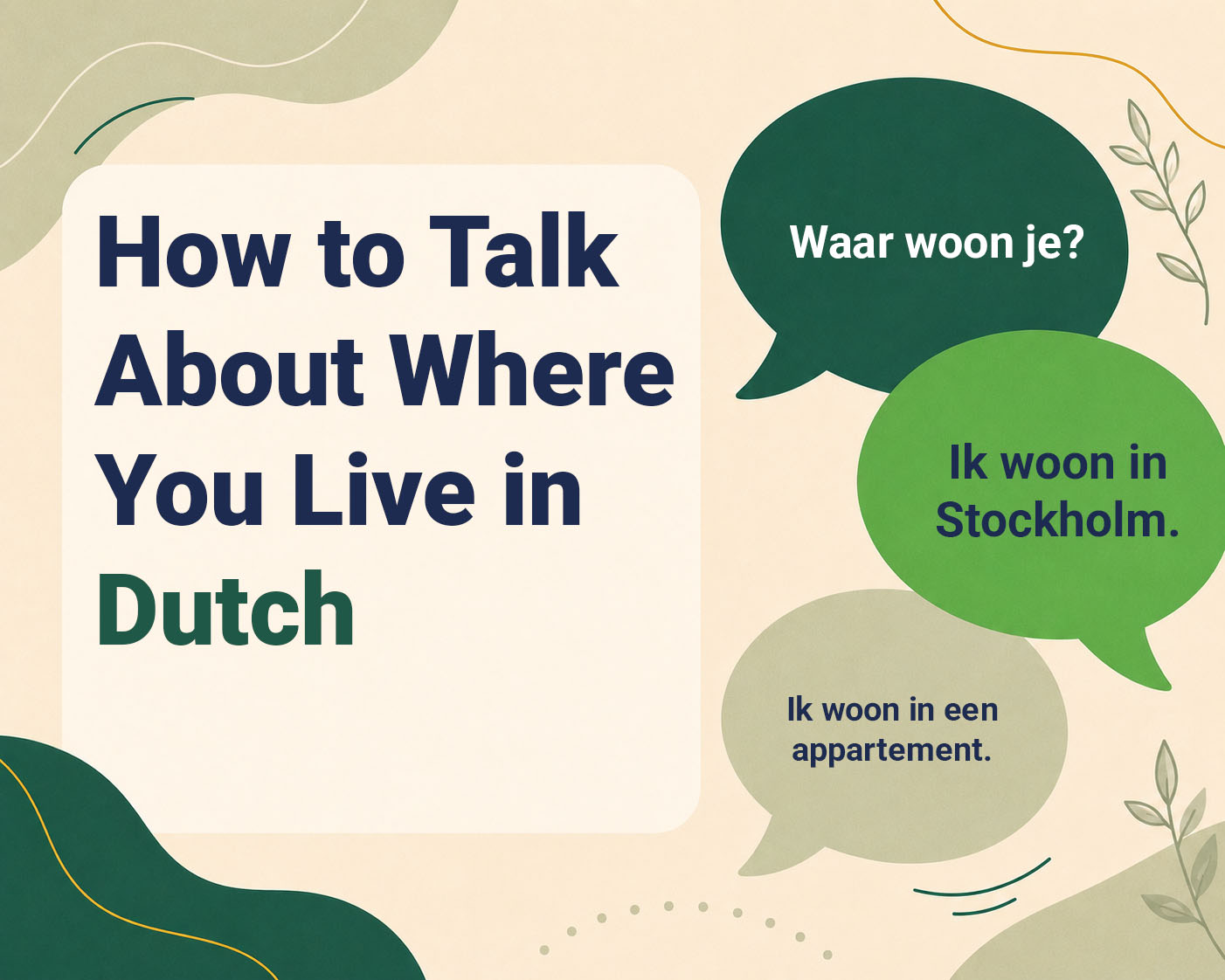
Where someone lives is a natural topic when meeting a new person. In Dutch, the conversation can begin with one short question and then expand into the city, the type of home, family members or the places where someone lived in the past.
The central verb is wonen, meaning “to live” or “to reside.” It is used for the place where you have your home—not simply for being alive. Dutch also makes a useful distinction between asking where someone lives now and asking where that person comes from.
The main phrases below are accompanied by native-speaker recordings. The pronunciation guides are approximate and intended to help English speakers recognise the sounds.
Asking where someone lives
Waar woon je?
Natural translation: Where do you live?
Pronunciation: vahr vohn yuh
Word for word: Waar = where · woon = live · je = you
Waar woon je? is the usual informal question for a friend, colleague or someone you meet in a relaxed setting. Dutch questions often place the verb before the person, so the statement Je woont… becomes Waar woon je?
The spelling changes slightly between the two forms:
- ik woon — I live
- je woont — you live
- woon je? — do you live?
The final -t in woont disappears when je follows the verb in this kind of question. This is why Dutch says Waar woon je?, not Waar woont je?
For a polite or formal question, use:
Waar woont u? — Where do you live? (formal)
Pronunciation: vahr vohnt oo
This form is useful with an older person, a customer or in a more formal professional situation. It is an additional useful version; the recorded phrase uses informal je.
Naming the city
Ik woon in Stockholm.
Natural translation: I live in Stockholm.
Pronunciation: ik vohn in STOCK-holm
Word for word: Ik = I · woon = live · in = in · Stockholm = Stockholm
The answer follows the simple pattern Ik woon in + place. The same structure works with cities and most countries:
- Ik woon in Amsterdam. — I live in Amsterdam.
- Ik woon in Rotterdam. — I live in Rotterdam.
- Ik woon in Nederland. — I live in the Netherlands.
- Ik woon in België. — I live in Belgium.
- Ik woon in Duitsland. — I live in Germany.
- Ik woon in Zweden. — I live in Sweden.
These supplementary place names do not have audio in this article, but they can be inserted into the recorded structure without changing the rest of the sentence.
Dutch normally uses in before a city or country. Place names do not take an article in these examples, with one notable detail: the English name “the Netherlands” corresponds simply to Nederland in Dutch.
Describing the kind of home
Ik woon in een appartement.
Natural translation: I live in an apartment.
Pronunciation: ik vohn in uhn ah-pahr-tuh-MENT
Word for word: Ik = I · woon = live · in = in · een = an · appartement = apartment
Here, in introduces the type of building rather than a geographic place. The indefinite article een is normally pronounced approximately “uhn” when it is unstressed.
Dutch uses appartement in both the Netherlands and Belgium. In informal conversation, you may also hear flat, although appartement is the more neutral choice.
Ik woon in een huis.
Natural translation: I live in a house.
Pronunciation: ik vohn in uhn hœys
Word for word: Ik = I · woon = live · in = in · een = a · huis = house
The vowel in huis does not have an exact English equivalent. It begins with rounded lips and moves toward an “y” sound. The recording is more useful than an English spelling here, because saying it exactly like English “house” gives it the wrong vowel.
Useful supplementary words for describing a home include:
- een studio — a studio apartment
- een rijtjeshuis — a terraced house / row house
- een vrijstaand huis — a detached house
- een studentenkamer — a student room
- een boerderij — a farmhouse
The same frame works with each one: Ik woon in een…
Asking about someone’s parents
Waar wonen je ouders?
Natural translation: Where do your parents live?
Pronunciation: vahr VOH-nuhn yuh OW-ders
Word for word: Waar = where · wonen = live · je = your · ouders = parents
The verb is now wonen because je ouders is plural. Notice that je can mean either informal “you” or “your”; its role becomes clear from the complete phrase.
Dutch also has the more emphatic possessive jouw. Waar wonen jouw ouders? puts extra focus on “your parents,” perhaps in contrast with someone else’s. In a neutral question, unstressed je sounds more natural.
Mijn ouders wonen in Oslo.
Natural translation: My parents live in Oslo.
Pronunciation: mine OW-ders VOH-nuhn in OZ-loh
Word for word: Mijn = my · ouders = parents · wonen = live · in = in · Oslo = Oslo
This answer keeps the plural form wonen. Comparing it with Ik woon makes the pattern visible:
- Ik woon in Stockholm. — I live in Stockholm.
- Mijn ouders wonen in Oslo. — My parents live in Oslo.
In everyday speech, mijn is often pronounced less distinctly than its careful dictionary form. The native recording shows how the words connect naturally.
Talking about one family member
Mijn zus woont in Parijs.
Natural translation: My sister lives in Paris.
Pronunciation: mine züs vohnt in pah-RICE
Word for word: Mijn = my · zus = sister · woont = lives · in = in · Parijs = Paris
With one other person, wonen becomes woont. Dutch city names are not always identical to their English equivalents: Paris is Parijs, pronounced with the stress on the second syllable.
Mijn broer woont in Madrid.
Natural translation: My brother lives in Madrid.
Pronunciation: mine broor vohnt in mah-DRIT
Word for word: Mijn = my · broer = brother · woont = lives · in = in · Madrid = Madrid
The same structure can introduce many people:
- Mijn vriend woont in Utrecht. — My boyfriend / male friend lives in Utrecht.
- Mijn vriendin woont in Gent. — My girlfriend / female friend lives in Ghent.
- Mijn kinderen wonen in Brussel. — My children live in Brussels.
These are supplementary examples. Vriend and vriendin can refer to a romantic partner or a friend, depending on context. Dutch speakers often add more context when the distinction matters.
Describing someone’s home
Hij heeft een erg mooi appartement.
Natural translation: He has a very nice apartment.
Pronunciation: hay hayft uhn erk moy ah-pahr-tuh-MENT
Word for word: Hij = he · heeft = has · een = a · erg = very · mooi = nice/beautiful · appartement = apartment
Once the location is known, the conversation can shift naturally to the home itself. Mooi can mean “beautiful,” “nice” or “attractive,” depending on the context. Erg mooi strengthens it to “very nice” or “very beautiful.”
The Dutch g in erg is produced toward the back of the mouth. Its exact sound varies by region, and speakers in Belgium and the southern Netherlands often use a softer sound than many speakers in the north.
Talking about a place where you lived before
Ik heb een jaar in Londen gewoond.
Natural translation: I lived in London for a year.
Pronunciation: ik hep uhn yahr in LON-duhn khuh-VOHNT
Word for word: Ik = I · heb = have · een jaar = one year · in Londen = in London · gewoond = lived
Dutch commonly uses a form equivalent to “I have lived” when talking about a completed period in the past. The two parts are heb and gewoond, with the time and place between them.
English usually says “I lived in London for a year” in this context. Translating each word separately would sound unnatural, so the complete Dutch phrase is more useful than trying to match the tense word for word.
Ik woonde in Parijs toen ik tien jaar oud was.
Natural translation: I lived in Paris when I was ten years old.
Pronunciation: ik VOHN-duh in pah-RICE toon ik teen yahr owt vas
Word for word: Ik = I · woonde = lived · in Parijs = in Paris · toen = when · ik = I · tien jaar oud = ten years old · was = was
Here Dutch uses the simple past woonde because the sentence describes the background to another time in the past. Toen introduces something that happened or was true at a particular past time.
Both Ik heb… gewoond and Ik woonde… can therefore translate as “I lived,” but the surrounding story influences which form sounds most natural.
Saying that you have lived somewhere for a long time
Ik woon hier al lang.
Natural translation: I’ve lived here for a long time. / I’ve been living here for a long time.
Pronunciation: ik vohn heer ahl lahng
Word for word: Ik = I · woon = live · hier = here · al = already/for · lang = long
Dutch uses the present tense when a situation began in the past and is still true now. English normally uses “have lived” or “have been living,” but Dutch says ik woon.
The small word al connects the present situation with the time that has already passed. You can make the period more precise:
- Ik woon hier al twee jaar. — I’ve lived here for two years.
- Ik woon hier sinds 2022. — I’ve lived here since 2022.
- Ik woon hier nog maar kort. — I’ve only lived here a short time.
These supplementary examples show common extensions of the recorded phrase.
Where you live and where you come from
Waar kom je vandaan?
Natural translation: Where are you from?
Pronunciation: vahr kom yuh vahn-DAHN
Word for word: Waar = where · kom = come · je = you · vandaan = from
Waar kom je vandaan? asks about someone’s origin. Waar woon je? asks about the person’s current home. The answers may be different:
Ik kom uit Zweden, maar ik woon in Nederland. I’m from Sweden, but I live in the Netherlands.
The first part is also a recorded phrase:
Ik kom uit Zweden.
Natural translation: I am from Sweden.
Pronunciation: ik kom oyt ZVAY-duhn
Word for word: Ik = I · kom = come · uit = from · Zweden = Sweden
Use uit for origin and in for the place where you live:
- Ik kom uit België. — I’m from Belgium.
- Ik woon in Duitsland. — I live in Germany.
The Dutch vowel written ui in uit is the same challenging vowel combination heard in huis. Listening to the recording helps separate it from English “out.”
Asking whether someone was born there
Ben je hier geboren?
Natural translation: Were you born here?
Pronunciation: ben yuh heer khuh-BOH-ruhn
Word for word: Ben = are · je = you · hier = here · geboren = born
Dutch literally uses “Are you born here?” rather than the English past form “Were you born here?” The answer keeps the same structure:
Ik ben hier geboren.
Natural translation: I was born here.
Pronunciation: ik ben heer khuh-BOH-ruhn
Word for word: Ik = I · ben = am · hier = here · geboren = born
This does not necessarily mean that the person still lives there. It describes birthplace, while Ik woon hier describes the current situation.
Growing up somewhere or moving there
Ben je hier opgegroeid?
Natural translation: Did you grow up here?
Pronunciation: ben yuh heer OP-khuh-khroyt
Word for word: Ben = are · je = you · hier = here · opgegroeid = grown up
Ik ben hier opgegroeid.
Natural translation: I grew up here.
Pronunciation: ik ben heer OP-khuh-khroyt
Word for word: Ik = I · ben = am · hier = here · opgegroeid = grown up
Someone can have been born in one place and grown up in another. These phrases make it possible to add that distinction without giving a long explanation.
Ik ben hiernaartoe verhuisd toen ik drie was.
Natural translation: I moved here when I was three years old.
Pronunciation: ik ben heer-nahr-TOO vuhr-HŒYST toon ik dree vas
Word for word: Ik = I · ben = am (auxiliary) · hiernaartoe = to here · verhuisd = moved · toen = when · ik = I · drie = three · was = was
Hiernaartoe combines the idea of “here” with movement toward the place. In casual conversation, Dutch speakers also often say hierheen or simply use hier when the direction is already clear.
The phrase explains why the place where someone lives may differ from the place where that person was born.
Informal and formal versions
The recorded questions in this article use informal je, which is natural with friends, relatives, children, colleagues in many workplaces and people you meet in casual settings.
Use u when you want to be polite or when the situation is more formal:
- Waar woon je? — Where do you live? (informal)
- Waar woont u? — Where do you live? (formal)
- Kom je hier vandaan? — Are you from here? (informal)
- Komt u hier vandaan? — Are you from here? (formal)
- Ben je hier geboren? — Were you born here? (informal)
- Bent u hier geboren? — Were you born here? (formal)
The formal versions are supplementary and do not have linked audio in this article. Notice that changing je to u may also change the verb: woon je becomes woont u, kom je becomes komt u, and ben je becomes bent u.
A short everyday exchange
Person 1: Waar woon je? Person 2: Ik woon in Amsterdam, in een appartement. Person 1: Kom je uit Amsterdam? Person 2: Nee, ik kom uit Zweden. Ik woon hier al lang.
Natural translation:
Person 1: Where do you live? Person 2: I live in Amsterdam, in an apartment. Person 1: Are you from Amsterdam? Person 2: No, I’m from Sweden. I’ve lived here for a long time.
The exchange moves from a current home to a person’s origin. That is a common direction for this kind of small talk, and the distinction between wonen and uit… komen keeps the meaning clear.
A simple topic with several directions
Talking about where you live can remain brief—Ik woon in Stockholm—or open into a longer conversation about a home, relatives or personal history. The verb forms woon, woont and wonen identify who lives there, while woonde and heb… gewoond place the situation in the past.
Complete phrases also preserve details that are easy to miss when learning isolated words: in before a city, uit for origin, the word order in Waar woon je?, and the present tense in Ik woon hier al lang.
Hear Dutch Phrases About Where You Live
The main examples in this article are taken from the LinguaBoost Dutch course and recorded by a native Dutch speaker.
Ready to speak more Dutch?
Build on the phrases in this article with structured practice, native-speaker audio and built-in review designed for everyday conversation.