
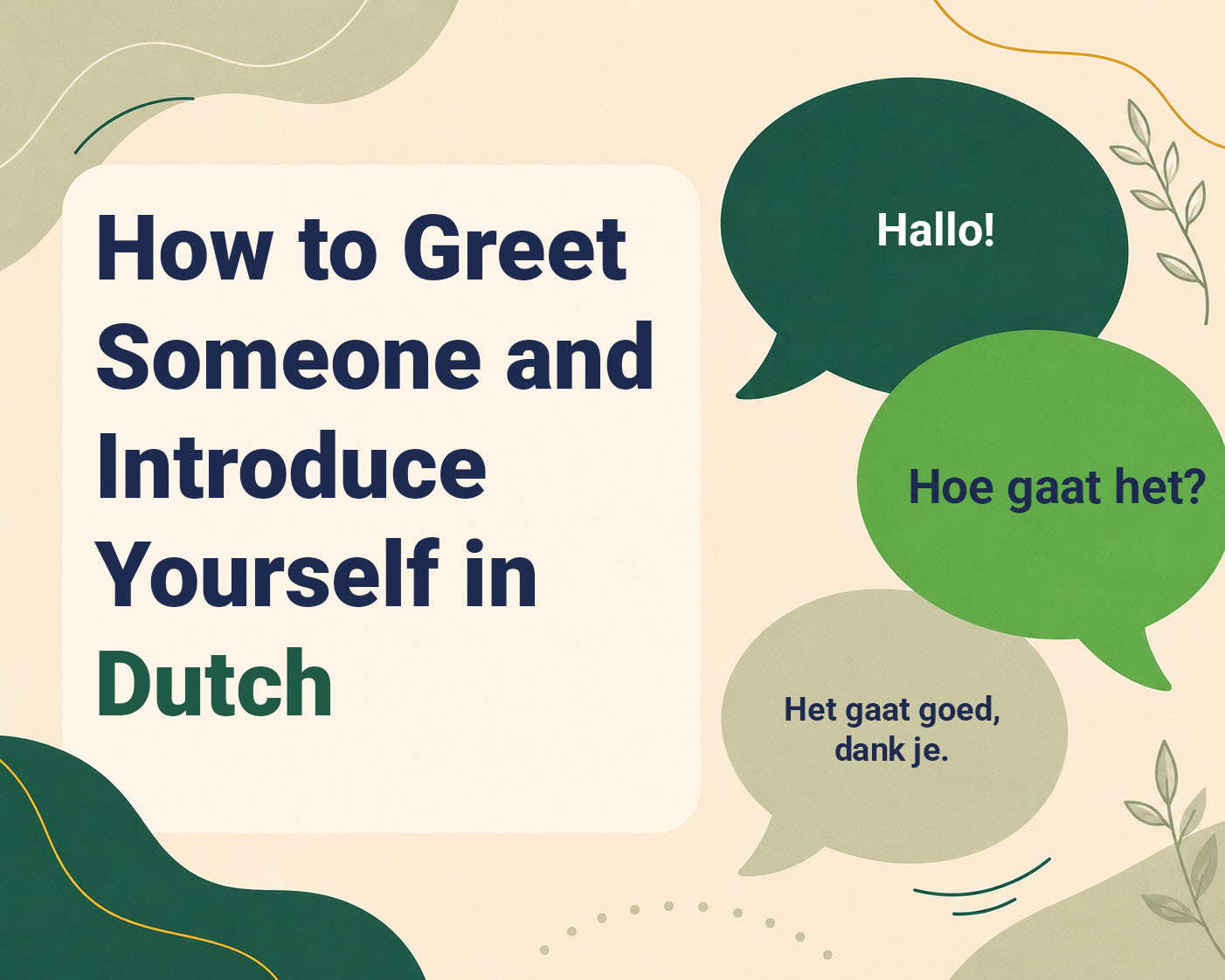
A first conversation in Dutch can move quickly from a greeting to a few basic details: your name, where you come from and where you live. These questions are simple, but they also reveal several useful features of everyday Dutch, including informal and formal forms of “you,” question word order and sounds that are not immediately obvious from the spelling.
Dutch speakers often keep introductions fairly concise. A natural exchange does not require a long prepared speech. A greeting, one or two questions and a friendly closing are usually enough to begin.
You can hear every main phrase spoken by a native Dutch speaker. The pronunciation guides are approximate, but they can help English speakers get close to the sound.
Choosing a Dutch greeting
Hallo!
Natural translation: Hello!
Pronunciation: hah-LOH
Word for word: Hallo = hello
Hallo is a flexible general greeting. It works in informal conversations and in many neutral everyday situations, including shops, workplaces and first meetings.
Dutch also has several common alternatives:
- Hoi! — Hi!; casual and friendly
- Goedemorgen! — Good morning!
- Goedemiddag! — Good afternoon!
- Goedenavond! — Good evening!
The time-based greetings are useful when you want to sound polite without deciding immediately whether the rest of the conversation should be formal or informal.
The stress in hallo normally falls on the second syllable. Both vowels are short and clear; avoid turning the final o into a long English-style “oh” with a strong glide.
Asking how someone is
Hoe gaat het?
Natural translation: How are you? / How is it going?
Pronunciation: hoo khaht ut
Word for word: hoe = how · gaat = goes · het = it
The literal structure is “How goes it?” This makes Hoe gaat het? similar in feeling to English “How is it going?”
The question does not contain a word for “you,” so the same phrase works whether the conversation is formal or informal.
In casual speech, het is often reduced and may sound closer to ut. The Dutch g in gaat is produced at the back of the mouth. Its exact sound varies by region: it may sound strongly rough and breathy or somewhat softer.
Het gaat goed, dank je.
Natural translation: I’m good, thank you.
Pronunciation: hut khaht khoot, dahnk yuh
Word for word: het = it · gaat = goes · goed = well/good · dank je = thank you
This is a natural positive reply. The literal meaning is “It is going well.”
In standard Dutch, dank je is normally written as two words. You will also commonly hear dankjewel, meaning “thank you,” and the more formal dank u or dank u wel.
The informal je is appropriate with people you address casually. In a formal exchange, you can say:
Het gaat goed, dank u. — I’m good, thank you. (formal)
The final d in goed sounds closer to t, a common feature of Dutch pronunciation at the end of words.
Asking someone’s name
Wat is je naam?
Natural translation: What is your name?
Pronunciation: vaht is yuh nahm
Word for word: wat = what · is = is · je = your · naam = name
Wat is je naam? is informal because it uses je, the familiar singular form of “your.” It is suitable in relaxed social situations and when speaking to someone around your own age.
The formal equivalent is:
Wat is uw naam? — What is your name? (formal)
Here, uw is the possessive form connected with formal u. It is written without an accent and pronounced approximately like the Dutch vowel in nu, although the exact sound has no perfect English equivalent.
Another very common way to ask someone’s name is:
Hoe heet je? — What is your name? / What are you called? (informal)
The formal version is Hoe heet u? Both structures are natural; Wat is je naam? is especially transparent for beginners because it closely resembles the English sentence.
The Dutch w in wat is softer than an English w and may sound somewhat close to v, particularly to English-speaking ears.
Mijn naam is…
Natural translation: My name is…
Pronunciation: mine nahm is
Word for word: mijn = my · naam = name · is = is
Add your name directly after Mijn naam is:
- Mijn naam is Anna. — My name is Anna.
- Mijn naam is David. — My name is David.
In ordinary conversation, Dutch speakers also often say Ik ben..., meaning “I am...,” or simply give their name after the other person introduces themself.
The letter combination ij in mijn is a distinct Dutch vowel. English “eye” is a useful approximation, but the Dutch sound is usually shorter and begins slightly farther forward in the mouth.
Asking where someone comes from
Waar kom je vandaan?
Natural translation: Where are you from?
Pronunciation: vahr kom yuh vahn-DAHN
Word for word: waar = where · kom = come · je = you · vandaan = from
Dutch asks where someone “comes from.” The word vandaan normally appears later in the sentence, giving the split structure Waar ... vandaan?
The question is informal. In a formal conversation, say:
Waar komt u vandaan? — Where are you from? (formal)
Notice two changes: je becomes u, and kom becomes komt. With informal je after the verb, Dutch uses kom je without the final -t. With formal u, komt u keeps it.
The double aa in waar and the final syllable of vandaan represent long vowel sounds. The strongest stress in vandaan falls on the final syllable.
Ik kom uit Zweden.
Natural translation: I am from Sweden.
Pronunciation: ik kom oyt ZVAY-duhn
Word for word: ik = I · kom = come · uit = from/out of · Zweden = Sweden
The frame Ik kom uit... can be followed by a country or city:
- Ik kom uit Nederland. — I am from the Netherlands.
- Ik kom uit België. — I am from Belgium.
- Ik kom uit Duitsland. — I am from Germany.
- Ik kom uit Frankrijk. — I am from France.
- Ik kom uit Spanje. — I am from Spain.
- Ik kom uit Italië. — I am from Italy.
- Ik kom uit Noorwegen. — I am from Norway.
- Ik kom uit Canada. — I am from Canada.
Some country names require an article:
- Ik kom uit de Verenigde Staten. — I am from the United States.
- Ik kom uit het Verenigd Koninkrijk. — I am from the United Kingdom.
The Dutch vowel ui in uit has no exact English equivalent. Something near “owt” can serve as a first approximation, but the Dutch sound is made more toward the front of the mouth.
The z at the beginning of Zweden is voiced. The following w is soft, so the beginning may sound approximately like zv to English speakers.
Asking where someone lives
Waar woon je?
Natural translation: Where do you live?
Pronunciation: vahr vohn yuh
Word for word: waar = where · woon = live · je = you
Origin and residence are not always the same, so Waar woon je? is a natural follow-up to Waar kom je vandaan?
The verb wonen means “to live” in the sense of residing somewhere. The informal statement is Je woont..., but the final -t disappears when the verb comes before je in this question: woon je?
In a formal conversation, ask:
Waar woont u? — Where do you live? (formal)
Here the final -t remains with u: woont u.
The double oo in woon is a long Dutch vowel. Keep it steadier than the English vowel in “phone,” which usually moves noticeably from one sound to another.
Ik woon in Stockholm.
Natural translation: I live in Stockholm.
Pronunciation: ik vohn in STOCK-holm
Word for word: ik = I · woon = live · in = in · Stockholm = Stockholm
Replace Stockholm with your own city:
- Ik woon in Amsterdam. — I live in Amsterdam.
- Ik woon in Brussel. — I live in Brussels.
- Ik woon in Londen. — I live in London.
- Ik woon in Parijs. — I live in Paris.
- Ik woon in New York. — I live in New York.
Dutch generally uses in before a city in this type of sentence. The structure stays the same regardless of whether the speaker is male or female.
If you want to describe the kind of home, the course also includes Ik woon in een appartement (“I live in an apartment”) and Ik woon in een huis (“I live in a house”).
Saying that it is nice to meet someone
Leuk om je te ontmoeten!
Natural translation: Nice to meet you!
Pronunciation: luhk om yuh tuh ont-MOO-tuhn
Word for word: leuk = nice/enjoyable · om ... te ontmoeten = to meet · je = you
This course phrase is informal because it uses je. It is natural after you and the other person have exchanged names.
The formal version is:
Leuk u te ontmoeten. — Nice to meet you. (formal)
You can also say Aangenaam, a short expression meaning approximately “Pleased to meet you.” It is useful in a polite introduction and avoids choosing between je and u.
The vowel in leuk has no exact English equivalent. Begin with something near the vowel in “lurk,” but do not pronounce an r. In ontmoeten, stress falls on moe, pronounced approximately like “moo.”
Introducing another person
Wie is dit?
Natural translation: Who is this?
Pronunciation: vee is dit
Word for word: wie = who · is = is · dit = this
Wie is dit? can be used when asking about a person in a photograph, on a call or in the immediate situation.
The answer begins with Dit is..., meaning “This is...”:
- Dit is mijn moeder. — This is my mother.
- Dit is mijn vader. — This is my father.
- Dit is mijn broer. — This is my brother.
- Dit is mijn zus. — This is my sister.
The same structure works with a name: Dit is Emma. — “This is Emma.”
The w in wie sounds closer to English v than to English w. The final t in dit is pronounced clearly.
Ending the conversation
Tot ziens!
Natural translation: Goodbye! / See you!
Pronunciation: tot zeens
Word for word: tot = until · ziens = seeing
Tot ziens is a polite, neutral goodbye. Its literal sense is close to “until seeing,” and it works well with strangers, customers and people you may meet again.
For a casual goodbye, Dutch commonly uses Doei!:
Doei!
Natural translation: Bye!
Pronunciation: doo-ee
Word for word: Doei = bye
Doei is informal and friendly. You may also hear Dag, which can function as “Hello” or “Bye” depending on the context and region.
Other useful course phrases include:
- Zie je later! — See you later!
- Fijne dag! — Have a nice day!
- Zie je morgen! — See you tomorrow!
Fijne dag is especially useful when leaving a shop, office or daytime interaction. The Dutch g in dag is again pronounced at the back of the mouth.
Informal and formal Dutch at a glance
Dutch uses je/jij in informal singular conversation and u when a more respectful form is appropriate. Jullie addresses more than one person informally.
| Informal | Formal | Meaning |
|---|---|---|
| Hoe gaat het? | Hoe gaat het? | How are you? |
| Wat is je naam? | Wat is uw naam? | What is your name? |
| Hoe heet je? | Hoe heet u? | What is your name? |
| Waar kom je vandaan? | Waar komt u vandaan? | Where are you from? |
| Waar woon je? | Waar woont u? | Where do you live? |
| Leuk om je te ontmoeten. | Leuk u te ontmoeten. | Nice to meet you. |
| Dank je. | Dank u. | Thank you. |
The formal form does not always require a completely different sentence. Often only the pronoun and verb ending change.
In the Netherlands, adults frequently move to je once a conversation becomes relaxed, but u remains useful with customers, older strangers and in more formal professional situations. Usage varies by person and setting, so following the form used by the other speaker is a practical guide.
A natural first conversation can stay simple
An introduction does not need to include every phrase in this article. A short exchange might contain Hallo, Hoe gaat het?, a name, one question about origin or residence, and Leuk om je te ontmoeten.
The phrases connect naturally because each answer creates a possible follow-up. Mijn naam is... can lead to Waar kom je vandaan?, while Ik kom uit... can lead to Waar woon je?
Learning these expressions as complete units also gives you useful Dutch patterns: Waar ... vandaan?, the question order in woon je?, and the contrast between informal je and formal u.
The aim is not to deliver a perfect introduction. It is to have enough familiar language to greet someone, exchange a few details and leave the conversation on a friendly note.
Hear Dutch Introductions Spoken Naturally
The main examples in this article are taken from the LinguaBoost Dutch course and recorded by a native Dutch speaker.
Ready to speak more Dutch?
Build on the phrases in this article with structured practice, native-speaker audio and built-in review designed for everyday conversation.
Explore the Dutch course