
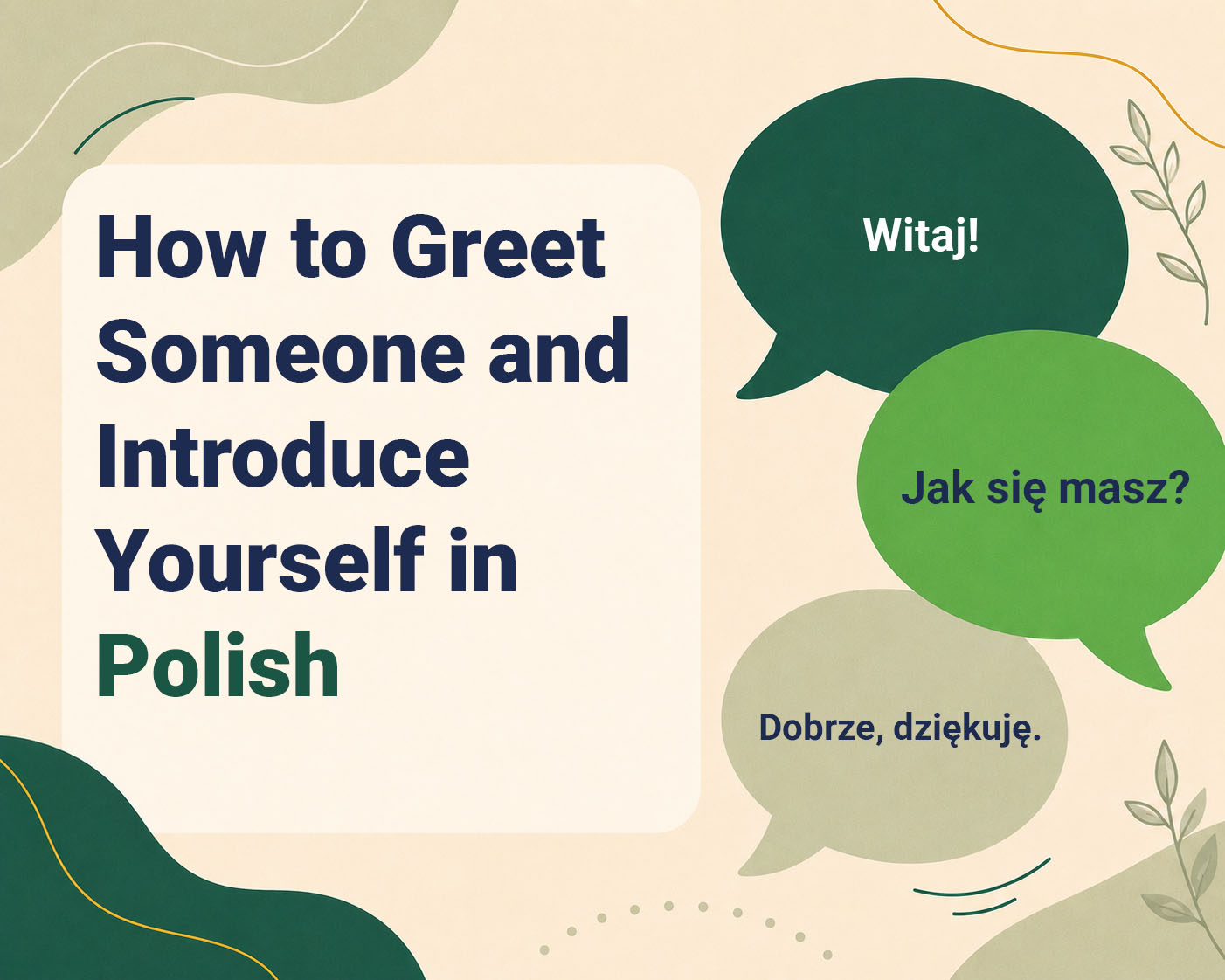
A first conversation in Polish often moves through a familiar sequence: a greeting, a question about how someone is, an exchange of names and perhaps a few details about where each person comes from or lives.
The individual phrases are short, but they also reveal an important feature of Polish conversation: the language changes according to how well you know the other person. What sounds natural with a new friend may be too informal for a customer, an older stranger or a professional introduction.
Witaj: a friendly hello
Witaj!
Natural translation: Hello! / Welcome!
Pronunciation: VEE-tie
Word for word: Witaj = hello/welcome (informal singular)
Witaj is a friendly greeting addressed to one person. It is connected to the verb witać, meaning “to greet” or “to welcome,” so it can carry a warmer sense than a completely neutral “hello.”
The Polish letter w sounds like English v, while j sounds like English y. This gives the approximate pronunciation VEE-tie.
In spontaneous everyday conversation, cześć is often the more common casual greeting between friends, relatives, classmates and people who use informal language with one another:
Cześć! — Hi! / Bye!
The combination cz sounds like English ch, while ść creates a soft ending that has no exact English equivalent. A rough guide is cheshch.
Cześć can be used both when meeting and when leaving. Witaj is mainly a greeting or welcome.
For a stranger or a more formal situation, use:
- Dzień dobry. — Good morning. / Good afternoon. / Hello.
- Dobry wieczór. — Good evening.
Dzień dobry is one of the safest Polish greetings in shops, hotels, workplaces and first meetings. It avoids assuming an informal relationship too soon.
These common alternatives provide useful context, although Witaj is the recorded course phrase featured here.
Asking how someone is
Jak się masz?
Natural translation: How are you?
Pronunciation: yahk shyeh mahsh
Word for word: Jak = how · się = oneself · masz = you have
Jak się masz? is informal and addressed to one person. It is natural with someone you would address as ty—a friend, relative, child or another person with whom an informal relationship has been established.
The phrase is not built like English “How are you?” Word for word, it is closer to “How do you have yourself?”, but it functions as a complete everyday question and is best understood as a whole expression.
The small word się contains a soft sound. The guide shyeh is only approximate; listening to the recording makes the combination much clearer.
In a respectful conversation, Polish can use:
- Jak się pan ma? — How are you? (to a man)
- Jak się pani ma? — How are you? (to a woman)
Pan and pani function as respectful forms of address. Grammatically, they take third-person verb forms rather than the informal second-person form used with ty.
A formal greeting does not always require an extended “How are you?” exchange. In a brief interaction with a cashier or member of staff, Dzień dobry may be enough. Jak się masz? is more personal than a simple hello.
Dobrze, dziękuję.
Natural translation: I’m good, thank you.
Pronunciation: DOH-bzheh, jen-KOO-yeh
Word for word: Dobrze = well/good · dziękuję = I thank/thank you
Dobrze literally means “well,” making it a natural short response to Jak się masz?
The combination rz in dobrze sounds similar to the sound in the middle of English “measure.” The beginning of dziękuję contains a soft consonant and a nasal vowel that English spelling cannot represent exactly. jen-KOO-yeh provides a useful starting point, but the native recording should be the main pronunciation model.
You can return the question informally with:
A ty? — And you?
In a formal exchange, use A pan? to a man or A pani? to a woman.
Asking someone’s name informally
Jak się nazywasz?
Natural translation: What is your name?
Pronunciation: yahk shyeh nah-ZIH-vahsh
Word for word: Jak = how · się = oneself · nazywasz = you call/name
Jak się nazywasz? is the informal singular way to ask someone’s name. Its literal structure is closer to “What do you call yourself?”
The ending -sz identifies the informal “you” form. Polish sz sounds like English sh, so the end of nazywasz is approximately -vahsh.
With someone you address respectfully, the question becomes:
- Jak się pan nazywa? — What is your name? (to a man)
- Jak się pani nazywa? — What is your name? (to a woman)
These questions can ask for a person’s full name and are suitable in formal introductions or administrative situations.
If you specifically want to ask for a first name, Polish can use:
- Jak masz na imię? — What is your first name? (informal)
- Jak ma pan na imię? — What is your first name? (formal, to a man)
- Jak ma pani na imię? — What is your first name? (formal, to a woman)
In a casual meeting, Jak masz na imię? can feel more directly focused on the first name than Jak się nazywasz? Both are common and useful.
Giving your name
Nazywam się...
Natural translation: My name is... / I’m called...
Pronunciation: nah-ZIH-vahm shyeh
Word for word: Nazywam = I call/name · się = myself
Add your name directly after Nazywam się:
Nazywam się Anna.
My name is Anna.
The phrase works in both formal and informal situations. You do not need to change it according to the listener.
Another common way to give a first name is:
Mam na imię Anna. — My name is Anna. / My first name is Anna.
The literal structure is “I have Anna as a name.” This version specifically introduces a first name, while Nazywam się... can naturally introduce either a first name or a fuller name.
Polish also allows a simple Jestem Anna (“I’m Anna”), particularly in a relaxed spoken introduction. Nazywam się... remains a dependable option across a wider range of situations.
Asking where someone is from
Skąd jesteś?
Natural translation: Where are you from?
Pronunciation: skont YEHS-tesh
Word for word: Skąd = from where · jesteś = you are
Skąd jesteś? is informal singular. The word skąd combines the idea of “where” with movement or origin from a place, so Polish does not need a separate preposition equivalent to English “from” in the question.
The letter ą represents a nasal vowel. Before d, it is commonly heard with an on-like sound, making skąd approximately skont.
Formal versions use pan or pani and a third-person verb form:
- Skąd pan jest? — Where are you from? (to a man)
- Skąd pani jest? — Where are you from? (to a woman)
Polish normally writes pan and pani with lowercase letters in ordinary sentences. Capital letters may be used as a sign of respect in direct written correspondence.
Jestem ze Szwecji.
Natural translation: I am from Sweden.
Pronunciation: YEHS-tem zeh SHVEH-tsyee
Word for word: Jestem = I am · ze = from · Szwecji = Sweden
Polish uses z or ze before the country name in a form that often differs from the dictionary form. Szwecja (“Sweden”) becomes Szwecji after ze.
Ze is used here because it is easier to pronounce before the consonant group at the beginning of Szwecji. The form of the country also changes because Polish uses the genitive case after z/ze when expressing origin.
Some useful country names are:
- Jestem z Polski. — I am from Poland.
- Jestem z Niemiec. — I am from Germany.
- Jestem z Francji. — I am from France.
- Jestem z Hiszpanii. — I am from Spain.
- Jestem z Włoch. — I am from Italy.
- Jestem z Kanady. — I am from Canada.
- Jestem z Wielkiej Brytanii. — I am from the United Kingdom.
- Jestem ze Stanów Zjednoczonych. — I am from the United States.
These forms are worth learning with the preposition rather than trying to create them from the English country name during a conversation.
Origin and nationality are related but different
Jestem ze Szwecji answers “Where are you from?” It identifies a country of origin without directly stating nationality.
Polish can also describe nationality with a noun or adjective-like form. These forms often change according to gender:
- Jestem Polakiem. — I am Polish. (said by a man)
- Jestem Polką. — I am Polish. (said by a woman)
- Jestem Szwedem. — I am Swedish. (said by a man)
- Jestem Szwedką. — I am Swedish. (said by a woman)
For a beginner, the origin structure Jestem z/ze... has an advantage: the form does not change according to the speaker’s gender. You still need the correct country form, but one answer works for everyone.
Asking where someone lives
Gdzie mieszkasz?
Natural translation: Where do you live?
Pronunciation: gjeh MYEH-shkahsh
Word for word: Gdzie = where · mieszkasz = you live
Origin and current residence are not necessarily the same. Skąd jesteś? asks where someone is from, while Gdzie mieszkasz? asks where the person lives now.
The ending -sz again marks an informal second-person form. Respectful versions are:
- Gdzie pan mieszka? — Where do you live? (to a man)
- Gdzie pani mieszka? — Where do you live? (to a woman)
The opening gdzie contains a consonant combination that is difficult to represent in English. Gjeh gives only an approximation; the native recording shows how Polish compresses the beginning into one smooth syllable.
Mieszkam w Sztokholmie.
Natural translation: I live in Stockholm.
Pronunciation: MYEH-shkahm f shtohk-HOL-myeh
Word for word: Mieszkam = I live · w = in · Sztokholmie = Stockholm
After w (“in”), a city name usually appears in the locative case. Sztokholm therefore becomes Sztokholmie.
The written w normally sounds like English v, but before the voiceless szt group it is pronounced more like f. This makes the connection approximately f shtohk-.
Other common city answers include:
- Mieszkam w Warszawie. — I live in Warsaw.
- Mieszkam w Krakowie. — I live in Kraków.
- Mieszkam w Londynie. — I live in London.
- Mieszkam w Berlinie. — I live in Berlin.
- Mieszkam w Paryżu. — I live in Paris.
The city ending varies, so complete phrases are more reliable than adding one universal ending to every place name.
Introducing another person
Kto to jest?
Natural translation: Who is this?
Pronunciation: ktoh toh yest
Word for word: Kto = who · to = this/that · jest = is
Kto to jest? is a simple way to ask who someone is. The initial kt in kto should be pronounced as a cluster rather than given an extra vowel.
An answer can begin with To jest..., meaning “This is...” or “That is...”
To jest mój brat.
Natural translation: This is my brother.
Pronunciation: toh yest mooy braht
Word for word: To = this · jest = is · mój = my · brat = brother
The word for “my” changes according to the gender of the noun:
- To jest mój brat. — This is my brother.
- To jest mój ojciec. — This is my father.
- To jest moja siostra. — This is my sister.
- To jest moja matka. — This is my mother.
Mój is masculine singular, while moja is feminine singular. The letter ó sounds like Polish u, roughly the oo in English “food.”
In an everyday family introduction, many speakers would naturally use mama and tata rather than the more neutral or formal nouns matka and ojciec:
- To jest moja mama. — This is my mother/mum.
- To jest mój tata. — This is my father/dad.
The recorded course phrases demonstrate the grammar clearly, while mama and tata are useful additions for relaxed conversation.
When introducing a person by name, the structure is even simpler:
To jest Anna. — This is Anna.
Saying that it was nice to meet someone
Miło było cię poznać!
Natural translation: It was nice to meet you! / Nice meeting you!
Pronunciation: MEE-woh BIH-woh chyeh POZ-nahtch
Word for word: Miło = pleasantly/nice · było = it was · cię = you · poznać = to meet/get to know
Because this course phrase contains past było (“was”), it is most naturally used when the meeting or conversation is ending. The English sense is “It was nice to meet you” or “Nice meeting you,” rather than the greeting said at the exact moment two people are introduced.
At the beginning of a meeting, the shorter form is natural:
Miło cię poznać. — Nice to meet you. (informal)
The pronoun cię is informal singular. Respectful versions refer differently to a man and a woman:
- Miło pana poznać. — Nice to meet you. (to a man)
- Miło panią poznać. — Nice to meet you. (to a woman)
At the end of the meeting, add było:
- Miło było pana poznać. — It was nice to meet you. (to a man)
- Miło było panią poznać. — It was nice to meet you. (to a woman)
The course spreadsheet writes Cię with a capital letter. In direct written correspondence, Polish may capitalize pronouns referring respectfully to the reader. In ordinary sentence text, lowercase cię is standard. The pronunciation is identical.
Informal and formal introductions at a glance
Polish does not normally use informal ty with every new adult immediately. Pan and pani are standard respectful choices for strangers, customers, older people and many professional interactions.
| Meaning | Informal | Respectful |
|---|---|---|
| Hello | Cześć! / Witaj! | Dzień dobry. |
| How are you? | Jak się masz? | Jak się pan/pani ma? |
| What is your name? | Jak się nazywasz? | Jak się pan/pani nazywa? |
| Where are you from? | Skąd jesteś? | Skąd pan/pani jest? |
| Where do you live? | Gdzie mieszkasz? | Gdzie pan/pani mieszka? |
| Nice to meet you | Miło cię poznać. | Miło pana/panią poznać. |
In speech, pan and pani take third-person verb forms. Avoid combining them with informal endings: Jak się pan nazywa? is correct, not Jak się pan nazywasz?
Polish speakers may agree to switch to first names and informal ty, particularly among colleagues or adults of a similar age. Until that shift is clear, respectful forms are the safer choice in a formal setting.
What a natural first conversation can contain
A first exchange does not need to include every possible personal question. A short informal conversation can move naturally through these ideas:
Witaj! Jak się masz?
Hello! How are you?
>
Dobrze, dziękuję. A ty?
I’m good, thank you. And you?
>
Jak się nazywasz?
What is your name?
>
Nazywam się Anna. A ty?
My name is Anna. And you?
>
Skąd jesteś?
Where are you from?
>
Jestem ze Szwecji.
I’m from Sweden.
Not every line in this sample is a separate recording, but the central questions and answers come directly from the course phrases featured above.
In a formal situation, begin with Dzień dobry and use pan or pani questions. You do not need to insert a formal pronoun into your own answers: Nazywam się... and Jestem ze Szwecji stay the same.
Names, places and relationships make an introduction memorable
An introduction becomes a conversation when it moves beyond a memorized hello. A name provides a way to address the person. Origin and residence reveal possible shared places, languages or travel experiences. Introducing a friend or relative brings another person into the exchange.
The phrases also contain reusable Polish structures:
- Nazywam się... introduces a name.
- Jestem z/ze... introduces a country of origin.
- Mieszkam w... introduces a place of residence.
- To jest... introduces another person.
Once these openings are familiar, the information after them can change without rebuilding the whole sentence.
The native-speaker recordings are especially useful for Polish consonant groups and soft sounds. Written approximations cannot fully represent się, cię, gdzie or the ending of poznać. Hearing them inside complete phrases makes the rhythm and connections much clearer.
Hear Polish greetings and introductions spoken naturally
The main examples in this article are taken from the LinguaBoost Polish course and recorded by a native Polish speaker.
Ready to speak more Polish?
Build on the phrases in this article with structured practice, native-speaker audio and built-in review designed for everyday conversation.
Explore the Polish course