
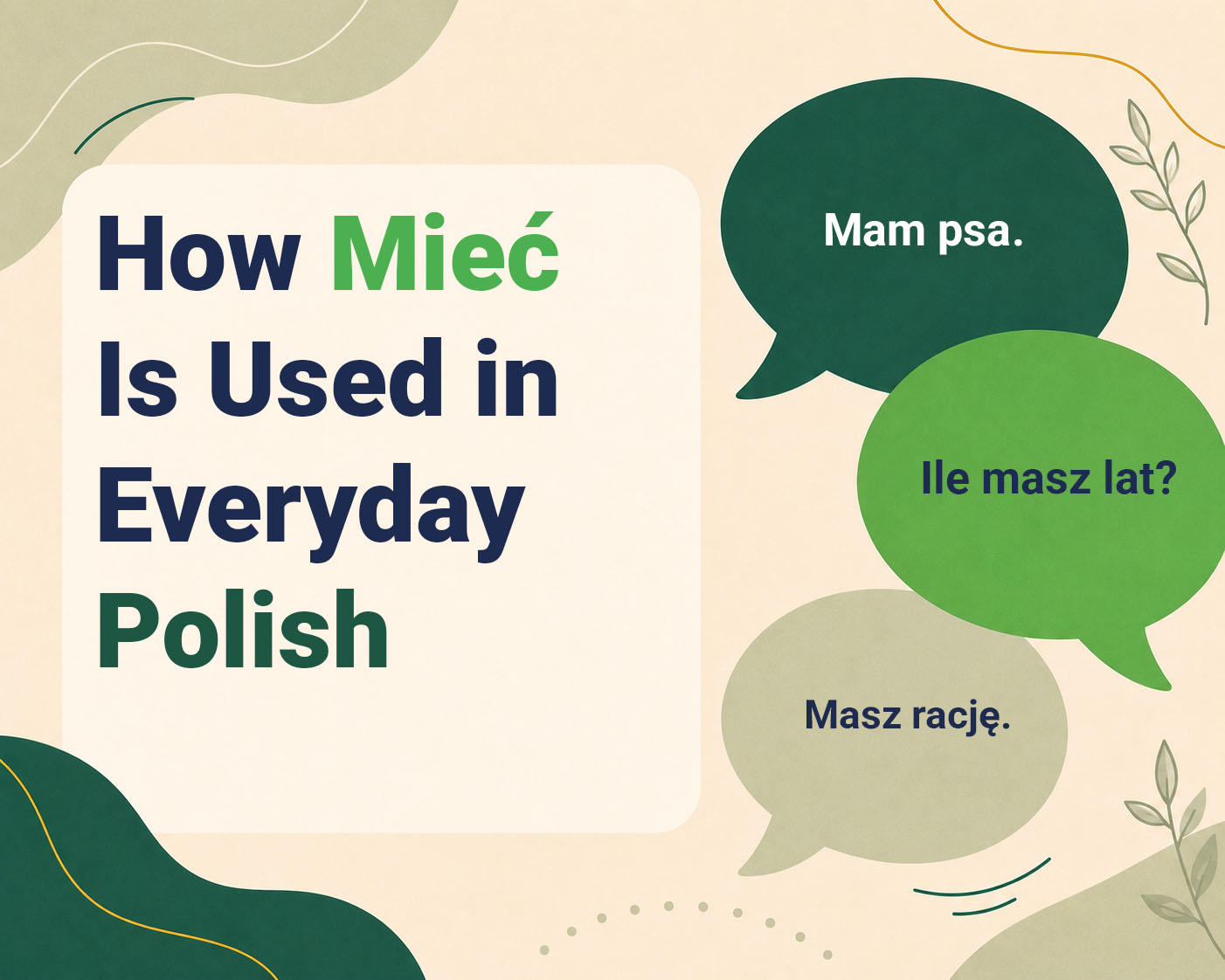
The Polish verb mieć is usually translated as “to have.” It expresses possession, but it also appears in several everyday structures that English builds differently.
Polish uses mieć when talking about age, children, being right and what someone feels like doing. This makes forms such as mam, masz and ma useful far beyond conversations about what a person owns.
You can hear every main phrase spoken by a native Polish speaker. The pronunciation guides are approximate, but they can help English speakers get close to the sound.
The basic forms of mieć
The infinitive mieć means “to have.” Its final ć is a soft sound without an exact English equivalent. It is close to a lightly pronounced “ch,” with the tongue raised toward the front of the roof of the mouth.
In the present tense, the verb changes according to the person:
| Polish | Meaning |
|---|---|
| mam | I have |
| masz | you have — informal singular |
| ma | he/she/it has; formal “you have” with Pan/Pani |
| mamy | we have |
| macie | you have — informal plural |
| mają | they have |
Polish often leaves out subject pronouns because the verb form already shows who is involved. Mam by itself means “I have,” while masz already contains the informal singular “you.”
Having or owning something
On ma bardzo ładne mieszkanie.
Natural translation: He has a very nice apartment.
Pronunciation: on mah BAHR-dzoh WAD-neh mye-sh-KAH-nyeh
Word for word: On = he · ma = has · bardzo = very · ładne = nice · mieszkanie = apartment
This is the most direct use of mieć: someone possesses or has something. Ma is the third-person singular form and can mean “he has,” “she has” or “it has,” depending on the subject.
Here, on makes the meaning “he has” explicit. Polish can often omit the pronoun when the context is already clear:
Ma bardzo ładne mieszkanie. — He/She has a very nice apartment.
The letter ł in ładne sounds similar to the English w. The combination sz in mieszkanie sounds like English “sh.”
You can use the same structure with other things:
- Ona ma nowy samochód. — She has a new car.
- On ma duży dom. — He has a large house.
- Mam nowy telefon. — I have a new phone.
The noun and any describing word may change form according to Polish grammar, but the form of mieć still tells you who has it.
Mam psa.
Natural translation: I have a dog.
Pronunciation: mahm psah
Word for word: Mam = I have · psa = a dog
Mam means “I have.” Notice that the dictionary form pies (“dog”) becomes psa after mam because a living masculine noun normally takes the accusative case here.
The course includes several related phrases:
- Mam kota. — I have a cat.
These changes can make a familiar noun look different inside a sentence. Learning Mam psa and Mam kota as complete phrases helps connect the noun form with a real use rather than leaving it as an isolated grammar rule.
Talking about family
Mam dużą rodzinę.
Natural translation: I have a large family.
Pronunciation: mahm DOO-zhom roh-DZEE-neh
Word for word: Mam = I have · dużą = large · rodzinę = family
Polish uses mieć naturally when describing the size of your family. Both dużą and rodzinę have endings associated here with a feminine noun in the accusative case.
The letter ż in dużą is similar to the sound in the middle of English “measure.” A final ę is often pronounced with little or no obvious nasal sound in everyday speech, so rodzinę may sound close to roh-DZEE-neh.
To describe a smaller family, you could say:
Mam małą rodzinę. — I have a small family.
As in English, the phrase normally refers to the number of people in the family rather than their physical size.
Nie mam wielu przyjaciół.
Natural translation: I don’t have many friends.
Pronunciation: nyeh mahm VYEH-loo pshih-YAH-choow
Word for word: Nie = not · mam = I have · wielu = many · przyjaciół = friends
To make mam negative, place nie directly before it: nie mam means “I don’t have.”
Negation also affects the noun phrase that follows. Polish commonly uses the genitive case after a negated verb, which is one reason przyjaciół appears in this form.
The beginning of przyjaciół is difficult to represent with English spelling. The letters przy blend into a sound roughly like “pshih,” while the final ł again sounds like English w.
The negative pattern is highly reusable:
- Nie mam czasu. — I don’t have time.
- Nie mam samochodu. — I don’t have a car.
- Nie mam pytania. — I don’t have a question.
Polish uses “have” for age
Ile masz lat?
Natural translation: How old are you?
Pronunciation: EE-leh mahsh laht
Word for word: Ile = how many · masz = you have · lat = years
Polish asks how many years someone has, rather than how old they are. The literal structure is “How many years do you have?”
Masz is the informal singular form. Use it with a friend, relative, child or someone else you address informally.
In a formal conversation, ask:
- Ile ma Pan lat? — How old are you? (to a man)
- Ile ma Pani lat? — How old are you? (to a woman)
The formal forms use ma, the third-person singular form, together with Pan or Pani. Polish does not normally create a formal question simply by using a plural “you” in the way some other European languages do.
Age can be a more personal subject with an adult you have just met, so grammatical politeness does not necessarily make the question appropriate in every situation.
Mam czterdzieści lat.
Natural translation: I am forty years old.
Pronunciation: mahm chtehr-DJESH-chee laht
Word for word: Mam = I have · czterdzieści = forty · lat = years
The answer follows the same “have years” structure: Mam czterdzieści lat literally means “I have forty years.”
The form of “year” changes according to the number:
- Mam jeden rok. — I am one year old.
- Mam dwa lata. — I am two years old.
- Mam pięć lat. — I am five years old.
- Mam czterdzieści lat. — I am forty years old.
After numbers such as five, ten, eighteen and forty, Polish uses lat. The complete age phrase lets you use the correct form without deciding on the noun ending word by word.
The course also includes:
On ma osiemnaście lat. — He is eighteen.
Ona ma piętnaście lat. — She is fifteen.
English changes “have” into “be” in the natural translation, but Polish continues to use ma.
Asking about children
Czy masz dzieci?
Natural translation: Do you have children?
Pronunciation: chih mahsh JYEH-chee
Word for word: Czy = question marker · masz = you have · dzieci = children
Czy can introduce a yes-or-no question. The word order remains close to the statement, while czy signals that a question follows.
This course phrase uses informal masz. In a formal conversation, say:
- Czy ma Pan dzieci? — Do you have children? (to a man)
- Czy ma Pani dzieci? — Do you have children? (to a woman)
The letters ci in dzieci represent a soft sound. The word is approximately JYEH-chee, though the Polish consonants are softer than the English guide suggests.
Like questions about age, questions about children may feel personal in some settings. The phrase is grammatically neutral, but context and relationship still matter.
Mam syna.
Natural translation: I have a son.
Pronunciation: mahm SIH-nah
Word for word: Mam = I have · syna = a son
The dictionary word for “son” is syn, but it becomes syna in this sentence. As with Mam psa, a living masculine noun changes form after mam.
Mam córkę.
Natural translation: I have a daughter.
Pronunciation: mahm TSOOR-keh
Word for word: Mam = I have · córkę = a daughter
The dictionary form córka changes to córkę after mam. This is the common accusative ending for many feminine nouns.
The Polish letter ó sounds like u, approximately the “oo” in English “food.” The initial c in córkę sounds like ts, not like English k or s.
You can also say:
Mam dwójkę dzieci. — I have two children.
The natural English translations are simple, but the complete Polish phrases reveal the noun forms needed after mam.
Using mieć to say that someone is right
Masz rację.
Natural translation: You are right.
Pronunciation: mahsh RAHTS-yeh
Word for word: Masz = you have · rację = right/reason
Polish says that someone has right or reason: mieć rację means “to be right.” Translating the verb as English “have” produces an unnatural sentence, so this expression is best treated as a complete unit.
The opposite is also built with mieć:
Nie masz racji. — You are wrong. / You are not right.
Additional unrecorded example.
Informal and formal versions are:
| Meaning | Informal | Formal to a man | Formal to a woman |
|---|---|---|---|
| You are right. | Masz rację. | Ma Pan rację. | Ma Pani rację. |
| You are wrong. | Nie masz racji. | Nie ma Pan racji. | Nie ma Pani racji. |
In the formal versions, Pan and Pani are normally capitalized in direct written communication as a sign of respect. General style conventions vary, but the third-person verb ma remains essential.
Mieć ochotę: feeling like something
Na co masz ochotę?
Natural translation: What do you feel like doing? / What would you like?
Pronunciation: nah tso mahsh oh-HOH-teh
Word for word: Na co = for what · masz = you have · ochotę = desire/inclination
Additional unrecorded example.
The expression mieć ochotę means “to feel like,” “to be in the mood for” or sometimes “to fancy.” The best English translation depends on what follows and on the situation.
Na co masz ochotę? can ask what someone would like to eat, drink or do. It is broader and less literal than “What are you planning to do?”
In a formal conversation, ask:
- Na co ma Pan ochotę? — What would you like? (to a man)
- Na co ma Pani ochotę? — What would you like? (to a woman)
The letter c in co sounds like ts. In ochotę, ch is pronounced farther back in the mouth, somewhat like a stronger English h.
Mam ochotę na kąpiel.
Natural translation: I feel like taking a bath.
Pronunciation: mahm oh-HOH-teh nah KOM-pyel
Word for word: Mam = I have · ochotę = desire/inclination · na = for · kąpiel = bath
Additional unrecorded example.
One common pattern is mieć ochotę na followed by a noun:
- Mam ochotę na kawę. — I feel like having a coffee.
- Mam ochotę na pizzę. — I feel like having pizza.
- Mam ochotę na spacer. — I feel like taking a walk.
- Mam ochotę na kąpiel. — I feel like taking a bath.
The noun following na takes the accusative case in this expression, which is why kawa becomes kawę and pizza becomes pizzę.
The vowel written ą in kąpiel is nasal. Before the following p, it can sound roughly like “om,” though the exact sound is not identical to an English sequence of two separate letters.
Nie mam ochoty iść do domu.
Natural translation: I don’t feel like going home.
Pronunciation: nyeh mahm oh-HOH-tih eeshch doh DOH-moo
Word for word: Nie mam = I don’t have · ochoty = desire/inclination · iść = to go · do domu = home/to the house
Additional unrecorded example.
When mieć ochotę is negative, ochotę changes to ochoty because Polish commonly uses the genitive after negation:
- Mam ochotę. — I feel like it.
- Nie mam ochoty. — I don’t feel like it.
The expression can be followed by an infinitive:
- Mam ochotę wyjść. — I feel like going out.
- Mam ochotę coś zjeść. — I feel like eating something.
- Nie mam ochoty iść do domu. — I don’t feel like going home.
The course also includes Mam ochotę gdzieś wyjść wieczorem, meaning “I feel like going out tonight,” with native-speaker audio:
Additional unrecorded example.
Mieć in the past
The past form of mieć changes according to the speaker’s gender. A man says miałem for “I had,” while a woman says miałam.
The course phrase shows both forms:
Miałem ochotę na spacer tego rana. / Miałam ochotę na spacer tego rana.
Natural translation: I felt like taking a walk this morning.
Pronunciation: MYAH-wem / MYAH-wahm oh-HOH-teh nah SPAH-tsehr TEH-goh RAH-nah
Word for word: Miałem/Miałam = I had (male/female speaker) · ochotę = desire/inclination · na spacer = for a walk · tego rana = this morning
Additional unrecorded example.
English translates the expression as “I felt like,” but Polish keeps the idea of “having the inclination.”
Gender appears in many Polish past-tense forms, not only in mieć. The choice reflects the gender of the person speaking:
- miałem — I had, said by a man
- miałam — I had, said by a woman
When addressing someone informally, “you had” also changes:
- miałeś — you had, to a man
- miałaś — you had, to a woman
Informal and formal forms at a glance
The course’s questions mainly use informal masz. In more formal situations, Polish normally uses Pan when addressing a man and Pani when addressing a woman, together with the third-person form ma.
| Meaning | Informal | Formal to a man | Formal to a woman |
|---|---|---|---|
| How old are you? | Ile masz lat? | Ile ma Pan lat? | Ile ma Pani lat? |
| Do you have children? | Czy masz dzieci? | Czy ma Pan dzieci? | Czy ma Pani dzieci? |
| You are right. | Masz rację. | Ma Pan rację. | Ma Pani rację. |
| What do you feel like? | Na co masz ochotę? | Na co ma Pan ochotę? | Na co ma Pani ochotę? |
Use the informal form with friends, relatives, children and people who have invited you to address them casually. The Pan/Pani forms are the safer choice with an adult you do not know, in professional situations or when respect and distance are appropriate.
A short conversation with mieć
Here is how several uses can appear in one exchange:
Person 1: Czy masz dzieci?
Person 2: Tak, mam syna i córkę.
Person 1: Ile mają lat?
Person 2: Mój syn ma osiemnaście lat, a córka
piętnaście.
Person 1: Masz ochotę pokazać mi zdjęcie?
Person 2: Oczywiście.
Natural translation:
Person 1: Do you have children?
Person 2: Yes, I have a son and a daughter.
Person 1: How old are they?
Person 2: My son is eighteen and my daughter is
fifteen.
Person 1: Do you feel like showing me a photo?
Person 2: Of course.
Not every line in the dialogue is a recorded course phrase, but the exchange shows how mam, masz, ma and mają connect possession, family, age and inclination.
One Polish verb, several everyday meanings
Once you recognize the forms of mieć, many common Polish expressions become easier to understand.
The verb can tell you what someone owns, describe their family, express their age, show that they are right or explain what they feel like doing. English uses several different structures for these meanings, while Polish connects them through the same verb.
Learning the expressions as complete phrases is more useful than translating mieć as “to have” every time. Mam czterdzieści lat, Masz rację and Mam ochotę na kawę each work as a natural conversational unit with its own meaning.
The main examples in this article are taken from the LinguaBoost Polish course and recorded by a native Polish speaker.
Ready to speak more Polish?
Build on the phrases in this article with structured practice, native-speaker audio and built-in review designed for everyday conversation.
Explore the Polish course