
Wanting something, needing help and feeling like doing something are related ideas, but Polish does not express them all with one verb.
Chcieć is used for what someone wants or intends to do. Potrzebować expresses a need. Mieć ochotę describes what someone feels like doing at a particular moment. Polish also uses the impersonal word trzeba, which often presents something as necessary without making the person the grammatical subject.
The difference is not only one of vocabulary. Each expression brings its own sentence pattern, and the forms of the words around it may change. Learning these ideas inside complete phrases makes those patterns easier to recognise.
You can hear each main example below spoken by a native Polish speaker. The pronunciation guides are approximate and cannot represent every Polish sound exactly, but they can help English speakers approach the rhythm and consonant combinations.
Saying what you want to do
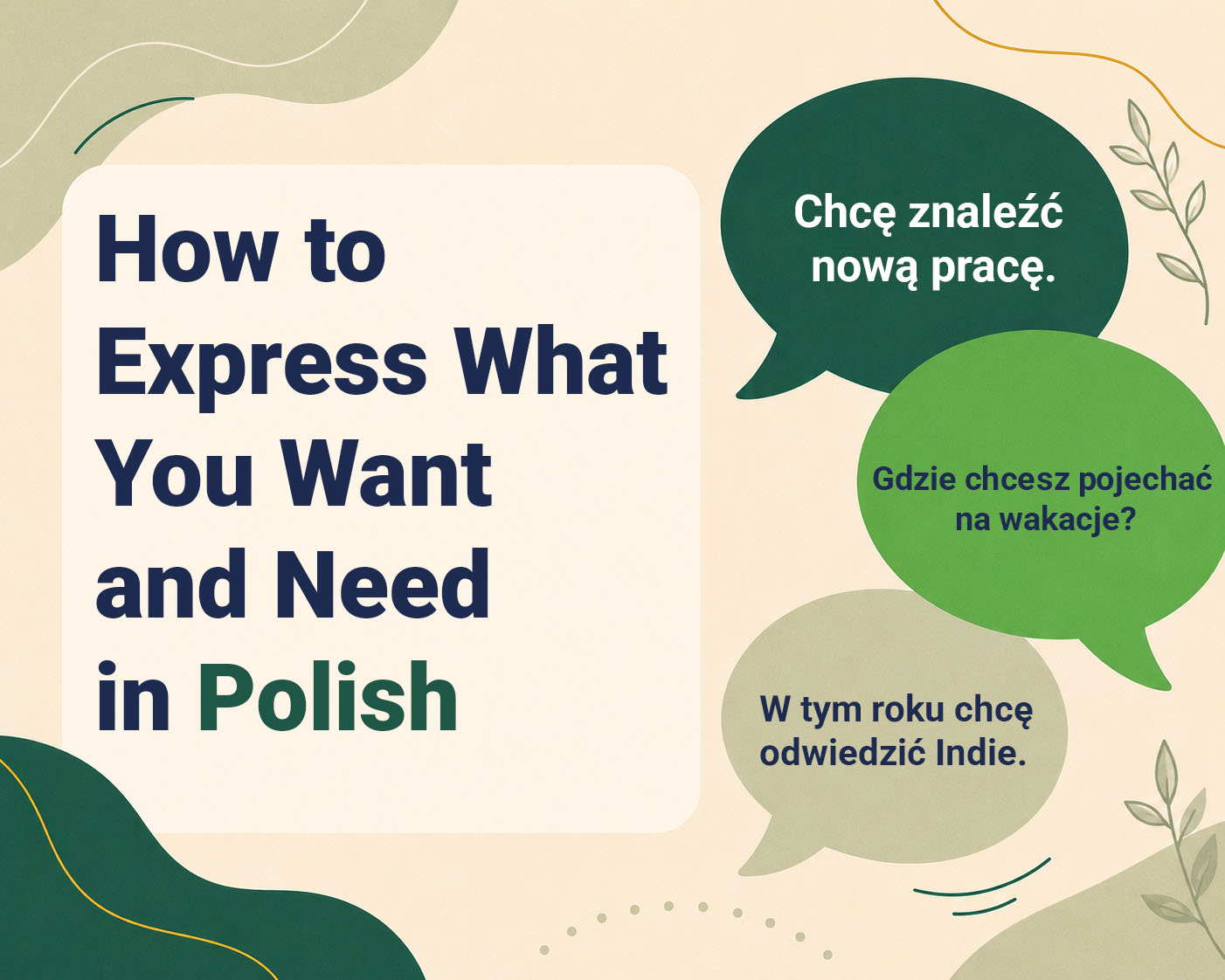
Chcę znaleźć nową pracę.
Natural translation: I want to find a new job.
Pronunciation: h-tseh(n) ZNAH-leshch NOH-vohn PRAH-tseh
Word for word: Chcę = I want · znaleźć = to find · nową pracę = a new job
Chcę is the first-person singular form of chcieć, “to want.” When the wanted action follows immediately, Polish uses the infinitive:
chcę + infinitive
In this phrase, the infinitive is znaleźć—“to find.” The ending of nową pracę shows that the job is the object being found. Polish endings carry information that English often expresses through word order.
The consonants at the beginning of chcę can be difficult at first. Ch is produced toward the back of the mouth, while c is a ts sound. The final ę is nasal, although at the end of a word the nasal quality may be quite light in natural speech.
Asking what another person wants
Gdzie chcesz pojechać na wakacje?
Natural translation: Where do you want to go on holiday?
Pronunciation: gjyeh h-tsehsh poh-YEH-hatch nah vah-KAH-tsyeh
Word for word: Gdzie = where · chcesz = you want · pojechać = to go/travel · na wakacje = on holiday
Chcesz is the informal singular form used with someone addressed as ty. Polish normally omits the subject pronoun because the verb ending already identifies the person. Gdzie chcesz…? therefore means “Where do you want…?” without an explicit word for “you.”
Pojechać describes going somewhere by a form of transport and presents the journey as a complete event. For going on foot, Polish would use a different motion verb.
The phrase na wakacje is a fixed and useful way to say “on holiday” or “on vacation.” A word-for-word translation of the preposition is less useful than remembering the complete expression.
Talking about a specific plan or intention
W tym roku chcę odwiedzić Indie.
Natural translation: This year I want to visit India.
Pronunciation: f teem ROH-koo h-tseh(n) od-VYEH-jeetch EEN-dyeh
Word for word: W tym roku = this year · chcę = I want · odwiedzić = to visit · Indie = India
The time phrase comes first, giving the sentence a clear frame before the intention. Polish word order is flexible, so Chcę odwiedzić Indie w tym roku is also possible. Placing w tym roku first makes the time period the starting point.
Country names can change form according to their role in a sentence. Here Indie is the object of odwiedzić. With a destination introduced by “to,” Polish may use a different form and preposition, as in do Indii—“to India.”
Wanting to learn a language
Chcę się nauczyć polskiego.
Natural translation: I want to learn Polish.
Pronunciation: h-tseh(n) shyeh nah-OO-chitch pol-SKYEH-go
Word for word: Chcę = I want · się nauczyć = to learn · polskiego = Polish
The verb nauczyć się means to learn or succeed in acquiring a skill. The small word się is part of the verb and appears between chcę and nauczyć in this phrase.
The language name takes the genitive form polskiego after nauczyć się. Compare:
- polski — Polish, as a basic dictionary adjective or language label
- po polsku — in Polish / speaking Polish
- uczyć się polskiego — to learn/study Polish
Other language names follow comparable patterns:
- Chcę się nauczyć hiszpańskiego. — I want to learn Spanish.
- Chcę się nauczyć niemieckiego. — I want to learn German.
- Chcę się nauczyć włoskiego. — I want to learn Italian.
These supplementary versions use the same structure as the recorded course phrase.
Chcę can sound direct in a request
Chcę is perfectly natural when stating a goal or intention: wanting to change jobs, visit a country or learn a language. When ordering or asking another person to provide something, however, a direct “I want” can sound demanding.
Polish often softens a request with:
- Chciałbym… — I would like… (male speaker)
- Chciałabym… — I would like… (female speaker)
- Poproszę… — I’ll have… / I would like…
For example:
- Chciałbym kawę. — I would like a coffee. (male speaker)
- Chciałabym kawę. — I would like a coffee. (female speaker)
- Poproszę kawę. — A coffee, please. / I’ll have a coffee.
These are supplementary examples without linked course audio in this article. The gender difference in chciałbym/chciałabym refers to the speaker, not the person being addressed.
What you feel like doing now
Na co masz ochotę?
Natural translation: What do you feel like doing? / What are you in the mood for?
Pronunciation: nah tsoh mash oh-HOH-teh(n)
Word for word: Na co = for what · masz = you have · ochotę = inclination/desire
Polish uses mieć ochotę, literally “to have an inclination/desire,” for something a person feels like doing. It is often more immediate and mood-based than chcieć.
Compare the ideas:
- Chcę pojechać do Włoch. — I want to go to Italy. (a wish or intention)
- Mam ochotę gdzieś wyjść. — I feel like going out somewhere. (a current mood)
The recorded question uses informal masz, addressed to one person.
Feeling like a particular thing
Mam ochotę na kąpiel.
Natural translation: I feel like taking a bath.
Pronunciation: mam oh-HOH-teh(n) nah KOM-pyel
Word for word: Mam = I have · ochotę = inclination/desire · na = for · kąpiel = bath
When mieć ochotę is followed by a noun, the common structure is:
mieć ochotę na + noun
The noun after na takes the accusative form. In kąpiel, the written form happens to look the same as the dictionary form, but other nouns may visibly change.
Useful supplementary examples include:
- Mam ochotę na kawę. — I feel like having coffee.
- Mam ochotę na pizzę. — I feel like having pizza.
- Mam ochotę na spacer. — I feel like taking a walk.
The expression can refer to food, drink, an activity or another experience someone wants at that moment.
Feeling like doing an activity
Mam ochotę gdzieś wyjść wieczorem.
Natural translation: I feel like going out somewhere tonight.
Pronunciation: mam oh-HOH-teh(n) gjyesh vyishch vyeh-CHOH-rem
Word for word: Mam ochotę = I feel like · gdzieś = somewhere · wyjść = to go out · wieczorem = in the evening/tonight
Before an infinitive, mieć ochotę does not require na:
- Mam ochotę na kawę. — I feel like coffee. (na + noun)
- Mam ochotę wyjść. — I feel like going out. (infinitive)
The course phrase places gdzieś before wyjść, meaning “to go out somewhere.” Wieczorem can refer generally to “in the evening” or, in the right context, “tonight.”
Saying that you do not feel like something
Nie mam ochoty iść do domu.
Natural translation: I don’t feel like going home.
Pronunciation: nyeh mam oh-HOH-tih eeshch doh DOH-moo
Word for word: Nie = not · mam = I have · ochoty = inclination/desire · iść = to go · do domu = home/to the house
Negation changes ochotę to ochoty. This is a common Polish pattern: direct objects often take the genitive after a negated verb.
The expression is softer and more situational than saying Nie chcę iść do domu—“I don’t want to go home.” Nie mam ochoty suggests that the speaker is simply not in the mood.
Talking about what another person feels like
On ma ochotę coś zjeść.
Natural translation: He feels like eating something.
Pronunciation: on mah oh-HOH-teh(n) tsohsh zyeshch
Word for word: On = he · ma ochotę = feels like · coś = something · zjeść = to eat
The form of mieć changes from mam to ma, while ochotę stays the same. Zjeść describes eating something as a completed action, so the phrase is close to “having something to eat.”
Polish subject pronouns are often omitted, but on can be included to clarify who is being discussed or to create contrast.
Asking what someone needs
Czego Ci trzeba?
Natural translation: What do you need?
Pronunciation: CHEH-go chee TSHEH-bah
Word for word: Czego = what/of what · Ci = to you · trzeba = is needed/necessary
This phrase uses trzeba, an impersonal word meaning that something is needed or necessary. The person appears in the dative form ci—“to you”—rather than as the grammatical subject.
The capital Ci is sometimes used in personal writing as a sign of respect or warmth. In ordinary running text, lowercase ci is also standard. The form itself is informal singular.
A very common alternative built with the verb potrzebować is:
Czego potrzebujesz? — What do you need? (informal)
This supplementary version treats the person as the subject and is often easier for learners to extend.
Saying what you need
Potrzebuję taksówki.
Natural translation: I need a taxi.
Pronunciation: poh-tsheh-BOO-yeh tak-SOOF-kee
Word for word: Potrzebuję = I need · taksówki = a taxi/of a taxi
Potrzebuję is the first-person form of potrzebować, “to need.” The object normally takes the genitive case. That is why the dictionary form taksówka becomes taksówki.
The same pattern appears in several everyday needs:
- potrzebuję wody — I need water
- potrzebuję pieniędzy — I need money
- potrzebuję lekarza — I need a doctor
- potrzebuję pomocy — I need help
These are supplementary examples. The changing endings are part of the phrase, not optional decoration.
Asking whether someone needs anything
Potrzeba Ci czegoś?
Natural translation: Do you need anything?
Pronunciation: poh-TSHEH-bah chee CHEH-gohsh
Word for word: Potrzeba = is needed · Ci = to you · czegoś = something/anything
This is another impersonal construction. Intonation turns it into a question.
Nie, nic mi nie trzeba.
Natural translation: No, I don’t need anything.
Pronunciation: nyeh, neets mee nyeh TSHEH-bah
Word for word: Nie = no · nic = nothing · mi = to me · nie trzeba = is not needed
Polish normally uses nic together with a negative verb or expression. The two negative elements reinforce one another; they do not cancel each other as they would in formal English logic.
A parallel version with potrzebować is Nie, niczego nie potrzebuję—“No, I don’t need anything.”
Needing time to think
Potrzebuję czasu na przemyślenie.
Natural translation: I need some time to think it over.
Pronunciation: poh-tsheh-BOO-yeh CHAH-soo nah psheh-MYSH-leh-nyeh
Word for word: Potrzebuję = I need · czasu = time · na = for · przemyślenie = thinking it over/consideration
The dictionary form czas becomes the genitive czasu after potrzebuję. Na przemyślenie explains the purpose of the time: considering the matter carefully before deciding.
This phrase is useful when discussing an offer, plan or important choice. A shorter Muszę się zastanowić means “I need to think about it” or literally “I must consider it.” It is a supplementary alternative without linked audio here.
Talking about another person’s need
On potrzebuje pomocy.
Natural translation: He needs help.
Pronunciation: on poh-tsheh-BOO-yeh poh-MOH-tsih
Word for word: On = he · potrzebuje = needs · pomocy = help/of help
The third-person form potrzebuje sounds the same as potrzebuję in ordinary speech; the difference is visible in writing through the final accent mark on ę.
The noun pomoc becomes pomocy because potrzebować takes the genitive. With a female subject, the sentence becomes Ona potrzebuje pomocy.
Na wesele będą potrzebować kwiatów.
Natural translation: They will need flowers for a wedding.
Pronunciation: nah veh-SEH-leh BEHN-dohn poh-tsheh-BOH-vatch KVYAH-toof
Word for word: Na wesele = for a wedding · będą = they will · potrzebować = need · kwiatów = flowers/of flowers
Supplementary example without linked audio in this article.
The future is formed with będą plus the infinitive potrzebować. The plural noun kwiaty changes to the genitive kwiatów.
A need that has just been satisfied
Tego mi było trzeba.
Natural translation: That’s what I needed. / I needed that.
Pronunciation: TEH-goh mee BIH-woh TSHEH-bah
Word for word: Tego = that/of that · mi = to me · było = was · trzeba = needed/necessary
Supplementary example without linked audio in this article.
This expression is often used after something welcome: a rest, a good meal, some fresh air or reassuring news. It can be close to English “That was just what I needed.”
Because the construction is impersonal, Polish says literally that this “was needed to me.” Remembering the phrase as a whole is more useful than trying to rebuild it from an English sentence.
Saying that someone does not need help
Z tego co wiem, nie potrzeba mu żadnej pomocy.
Natural translation: As far as I know, he doesn’t need any help.
Pronunciation: z TEH-goh tsoh vyem, nyeh poh-TSHEH-bah moo ZHAD-ney poh-MOH-tsih
Word for word: Z tego co wiem = as far as I know · nie potrzeba = is not needed · mu = to him · żadnej pomocy = any help
Supplementary example without linked audio in this article.
The person is again expressed through a dative pronoun: mi (to me), ci (to you) or mu (to him). The negative phrase żadnej pomocy takes the genitive and means “no help” or “any help” in a negative sentence.
The opening Z tego co wiem makes the statement less absolute. It signals that the speaker is reporting what they know rather than claiming complete certainty.
Informal and formal forms
The recorded questions use informal singular forms:
- Gdzie chcesz pojechać? — Where do you want to go?
- Na co masz ochotę? — What do you feel like?
- Czego ci trzeba? — What do you need?
These are natural with friends, relatives, children and people you address as ty.
Polish normally uses pan for a man and pani for a woman in polite singular address. The verb then takes a third-person form:
- Gdzie chce pan pojechać? — Where would you like to go, sir?
- Gdzie chce pani pojechać? — Where would you like to go, ma’am?
- Na co ma pan ochotę? — What do you feel like, sir?
- Czego pani potrzebuje? — What do you need, ma’am?
These formal versions are supplementary and do not have linked course audio in this article. Polish does not normally use ty with a stranger simply because English would use “you.”
Want, feel like, need or must?
The expressions overlap, but they do not communicate the same thing:
- Chcę odpocząć. — I want to rest. A wish or intention.
- Mam ochotę odpocząć. — I feel like resting. A current mood.
- Potrzebuję odpoczynku. — I need some rest. A genuine need; the noun takes the genitive.
- Muszę odpocząć. — I have to rest. An obligation or necessity.
Muszę is stronger than wanting and is often used when circumstances leave little choice. Trzeba can express general necessity, as in Trzeba odpocząć—“One needs to rest / It is necessary to rest.” These additional examples help separate desire from obligation.
A short everyday exchange
Person 1: Gdzie chcesz pojechać na wakacje?
Person 2: W tym roku chcę odwiedzić Indie. Potrzebuję
wakacji.
Person 1: Rozumiem. Potrzebujesz czasu, żeby wszystko
zaplanować?
Person 2: Tak. Potrzebuję czasu na przemyślenie.
Natural translation:
Person 1: Where do you want to go on holiday?
Person 2: This year I want to visit India. I need a
holiday.
Person 1: I understand. Do you need time to plan
everything?
Person 2: Yes. I need some time to think it over.
The exchange combines recorded course phrases with a small natural extension. It moves from a desired plan to a genuine need and shows how chcieć and potrzebować can appear in the same conversation without meaning the same thing.
Three useful ways to express desire and need
Chcieć + infinitive states what someone wants to do. Mieć ochotę na + noun or mieć ochotę + infinitive describes what appeals at that moment. Potrzebować expresses a need and normally places the following noun in the genitive.
The impersonal trzeba offers another perspective: instead of making the person the subject, Polish presents the thing as necessary “to” someone through forms such as mi, ci and mu.
These structures become easier to use when learned through complete expressions. The phrases preserve verb forms, case endings, pronouns and the difference between a direct intention, a passing inclination and a real necessity.
The main examples in this article are taken from the LinguaBoost Polish course and recorded by a native Polish speaker.
Hear Wants and Needs in Complete Polish Phrases
The LinguaBoost Polish course introduces useful expressions in everyday contexts, with native-speaker audio and built-in review to help them become familiar.