
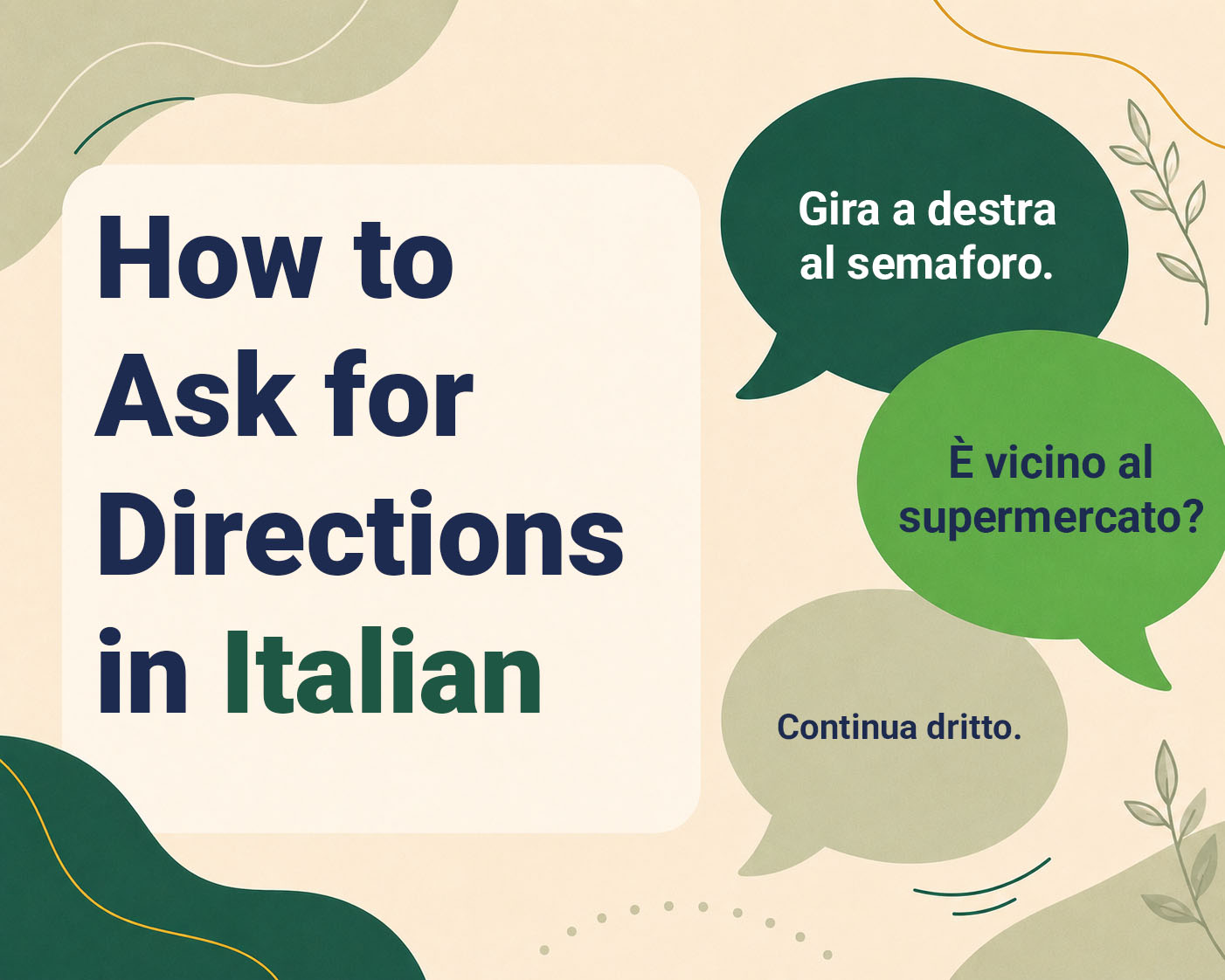
When you need directions in Italy, a few complete phrases can do more than a long list of place names. You need a polite way to get someone’s attention, a clear question, and enough directional language to understand landmarks such as a traffic light, supermarket, building or station. The Italian phrases below show how speakers describe where a place is and how to move toward it, with native-speaker recordings for the principal examples.
Italian directions often rely on short combinations: a destra for “to the right,” dritto for “straight ahead,” vicino a for “near,” and di fronte a for “opposite” or “in front of.” The small words matter. Italian contracts prepositions and articles, so a + il semaforo becomes al semaforo, while di + la strada becomes della strada. Learning these combinations inside full phrases makes them easier to recognize when someone answers quickly.
Start with a polite question
Before asking a stranger, Mi scusi is a useful polite opener. You can then ask:
- Mi scusi, dov’è la stazione? — Excuse me, where is the station?
- Mi scusi, sa come arrivare in centro? — Excuse me, do you know how to get to the city centre?
- Può indicarmi la strada per il museo? — Can you show me the way to the museum?
These are supplementary examples without playable audio in this article. Mi scusi addresses one person formally. With someone you know, Scusa is the informal singular form. Dov’è is the contraction of dove è, “where is”; the accent on è distinguishes the verb “is” from e, meaning “and.”
Use per when asking for the route to a destination: la strada per il museo, “the way to the museum.” With arrivare, the preposition depends on the destination: arrivare in centro, arrivare alla stazione, and arrivare dal parrucchiere. The last expression uses da + il = dal because Italian commonly treats a professional’s premises as going “to” that person.
Turning right at a landmark
Gira a destra al semaforo.
Natural translation: Turn right at the traffic light.
Pronunciation: JEE-rah ah DEH-strah ahl seh-MAH-foh-roh
Word for word: gira = turn · a destra = to the right · al semaforo = at the traffic light
Gira is an informal command addressed to one person. When a stranger gives polite directions, the formal form is Giri a destra al semaforo. The change from gira to giri is not a simple plural; it reflects the formal Lei command.
The phrase also shows two different uses of a. A destra is a fixed directional expression, while al semaforo identifies the point where the turn happens. Other natural landmarks include all’incrocio (“at the intersection”), alla farmacia (“at the pharmacy”) and alla fine della strada (“at the end of the street”).
In gira, the letter g before i has the soft sound heard in English “jeep.” Keep destra compact: the consonants str belong together rather than receiving separate inserted vowels.
Checking whether a place is nearby
È vicino al supermercato?
Natural translation: Is it close to the supermarket?
Pronunciation: eh vee-CHEE-noh ahl soo-pehr-mehr-KAH-toh
Word for word: è = is · vicino = near · al supermercato = to the supermarket
Italian uses vicino a, literally “near to.” That required a combines with the article: vicino al supermercato, vicino alla stazione, vicino all’hotel and vicino ai giardini. The article changes with the noun, but the relationship remains vicino a.
The subject is understood from context. If you have already asked about the museum, È vicino al supermercato? means “Is it close to the supermarket?” To name the place, say Il museo è vicino al supermercato?
For distance, compare vicino a with lontano da:
| Meaning | Italian example | What changes |
|---|---|---|
| near the station | vicino alla stazione | a + la becomes alla |
| near the hotel | vicino all’hotel | a + l’ becomes all’ |
| far from the station | lontano dalla stazione | da + la becomes dalla |
| far from the hotel | lontano dall’hotel | da + l’ becomes dall’ |
Continuing straight ahead
Continua dritto.
Natural translation: Continue straight ahead.
Pronunciation: kohn-TEE-noo-ah DREET-toh
Word for word: continua = continue · dritto = straight ahead
This is another informal singular instruction. The polite form is Continui dritto. You may also hear Vada sempre dritto, “Keep going straight,” where vada is the formal command of andare.
Dritto can describe the direction by itself, but speakers often add a limit or landmark: Continua dritto fino all’incrocio means “Continue straight to the intersection,” and Continui dritto per due isolati means “Continue straight for two blocks.” Fino a marks an endpoint; before l’incrocio, it becomes fino all’incrocio.
The doubled tt in dritto should be held slightly longer than a single consonant. That contrast can distinguish words in Italian, so the brief extra closure is worth hearing in the recording.
Describing the opposite side of the street
È dall’altra parte della strada rispetto alla stazione di polizia.
Natural translation: It is across the street from the police station.
Pronunciation: eh dahl-LAHL-trah PAR-teh DEHL-lah STRAH-dah ree-SPEHT-toh AHL-lah stah-TSYOH-neh dee poh-lee-TSEE-ah
Word for word: è = it is · dall’altra parte = on the other side · della strada = of the street · rispetto alla = in relation to/opposite · stazione di polizia = police station
The core location is dall’altra parte della strada, literally “on the other side of the street.” Rispetto a identifies the reference point. In ordinary conversation, the shorter È dall’altra parte della strada, di fronte alla stazione di polizia is also natural when the two places directly face each other.
Do not translate English “across” with a single word in every context. Crossing as an action is attraversare: Attraversi la strada means “Cross the street.” Being located across the street is essere dall’altra parte della strada. The English word covers both ideas, but Italian keeps movement and position distinct.
Behind a building or in front of it
È dietro quell’edificio?
Natural translation: Is it behind that building?
Pronunciation: eh DYEH-troh kwehl-leh-dee-FEE-choh
Word for word: è = is · dietro = behind · quell’edificio = that building
Dietro can be followed directly by the place in conversational Italian: dietro quell’edificio, dietro la banca, dietro il museo. You will also see dietro a, especially in speech and with pronouns, as in dietro a me (“behind me”).
Quell’ is the form of “that” used before a masculine singular noun beginning with a vowel. Compare quell’edificio, quel museo and quello stadio. The demonstrative changes to fit the sound and article pattern of the noun.
No, è di fronte a quell’edificio laggiù.
Natural translation: No, it is in front of that building over there.
Pronunciation: noh eh dee FROHN-teh ah kwehl-leh-dee-FEE-choh lahd-JOO
Word for word: no = no · è = it is · di fronte a = in front of/opposite · quell’edificio = that building · laggiù = over there
Di fronte a can mean “in front of” or “opposite/facing,” depending on the layout. Davanti a also means “in front of,” often with a stronger sense that one thing is positioned before another. For two buildings facing across a street, di fronte a is especially useful.
Laggiù points to a place farther away: “over there.” Lì or là can simply mean “there.” A speaker may combine the word with a gesture, so listen for both the phrase and the indicated direction.
Using one place as a landmark
Il negozio di fiori è di fronte alla stazione ferroviaria.
Natural translation: The flower shop is opposite the train station.
Pronunciation: eel neh-GOHT-tsyoh dee FYOH-ree eh dee FROHN-teh AHL-lah stah-TSYOH-neh fehr-roh-VYAH-ryah
Word for word: il negozio di fiori = the flower shop · è = is · di fronte alla = opposite the · stazione ferroviaria = train station
This sentence is a reusable location frame:
[Place] è di fronte a [landmark].
Natural supplementary examples include La farmacia è di fronte al bar (“The pharmacy is opposite the café”) and Il museo è di fronte alla piazza (“The museum is opposite the square”). The contraction after a changes to match the landmark: al bar, alla piazza, all’hotel.
The adjective ferroviaria agrees with feminine stazione. A railway bridge is un ponte ferroviario, with the masculine form. For asking directions, you do not need to produce every agreement pattern immediately, but recognizing the ending helps you follow a longer answer.
Useful position words for a route
| Italian | Natural meaning | Example |
|---|---|---|
| a destra | to/on the right | La banca è a destra. — The bank is on the right. |
| a sinistra | to/on the left | La stazione è a sinistra. — The station is on the left. |
| dritto | straight ahead | Vada dritto. — Go straight. |
| all’angolo | at the corner | Giri all’angolo. — Turn at the corner. |
| accanto a | next to | È accanto alla farmacia. — It is next to the pharmacy. |
| tra | between | È tra la banca e il bar. — It is between the bank and the café. |
| davanti a | in front of | Il taxi è davanti all’hotel. — The taxi is in front of the hotel. |
The examples in this table are supplementary and do not have separate playable audio here. Notice that a destra and a sinistra can describe either movement or position. The verb supplies the difference: giri a destra is an instruction to turn, while è a destra describes where something is.
Confirm the route before leaving
Long directions are easier to manage when you repeat the important steps. A useful confirmation is Quindi, vado dritto e poi giro a destra?—“So, I go straight and then turn right?” You can also ask Dopo il semaforo? (“After the traffic light?”) or Prima dell’incrocio? (“Before the intersection?”).
The sequence words are often the key to the answer:
- prima — first / before
- poi — then
- dopo — after
- fino a — as far as / until
- alla fine — at the end
If you miss a detail, Può ripetere, per favore? politely asks someone to repeat. Più lentamente, per favore asks for slower speech. These short requests are more useful than pretending to understand and walking in the wrong direction.
The main examples in this article are taken from the LinguaBoost Italian course and recorded by a native Italian speaker.
Find Your Way with Practical Italian
Build from short direction phrases to complete exchanges with structured listening, native-speaker audio and regular review.