
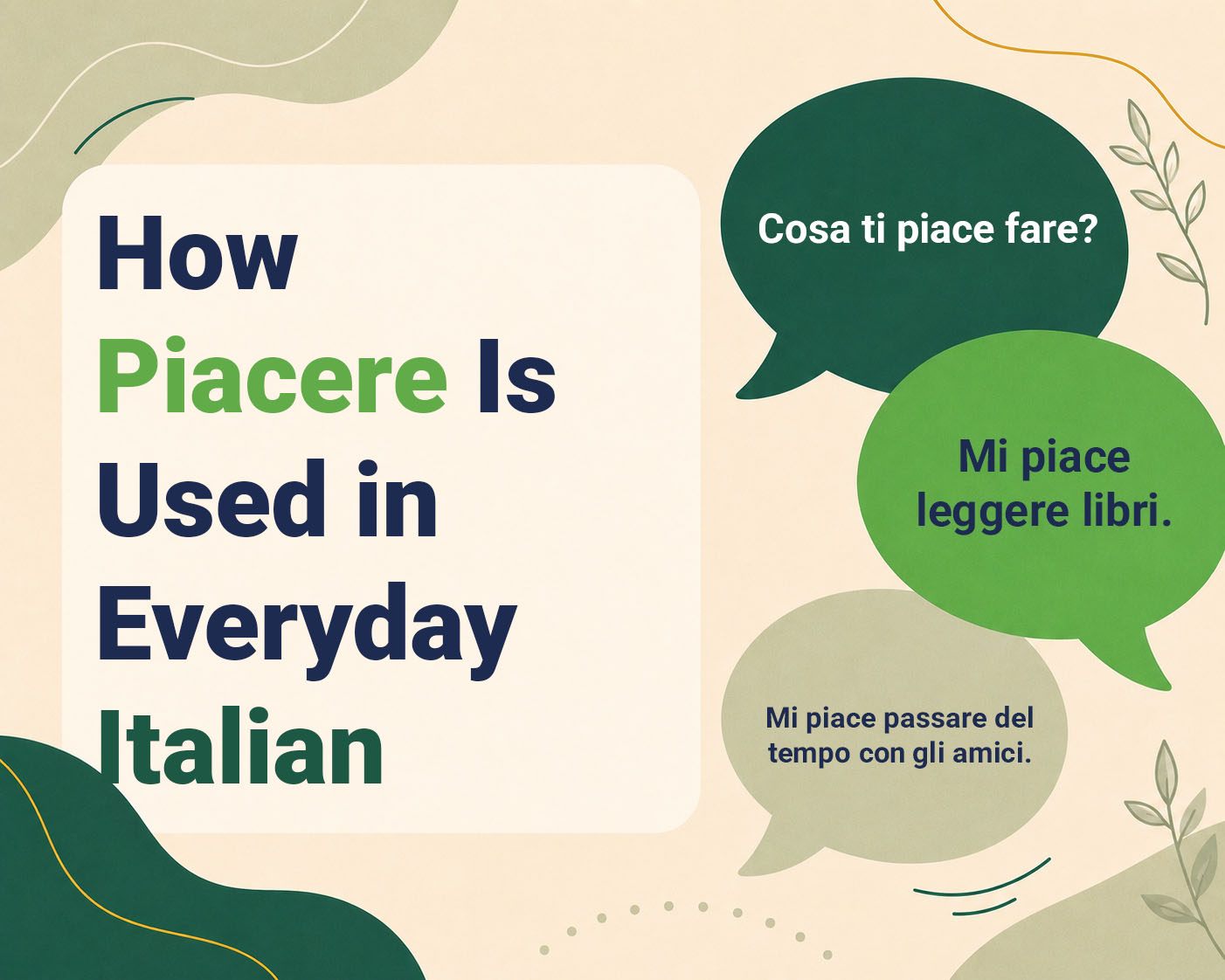
The Italian verb piacere is usually introduced through mi piace, meaning “I like.” It is one of the most useful expressions for talking about food, music, books, travel and almost anything else you enjoy.
Its structure, however, is different from English “to like.” Italian presents the person or activity as something that is pleasing to someone. That difference explains why the verb may appear as piace or piacciono, and why small words such as mi, ti, gli and le come before it.
The same verb can also express what someone would like to do and appears in the familiar introduction Piacere di conoscerti—“Nice to meet you.”
You can hear each main example below spoken by a native Italian speaker. The pronunciation guides are approximate, but they can help English speakers get close to the sound.
Asking what someone likes to do
Cosa ti piace fare?
Natural translation: What do you like to do?
Pronunciation: KOH-zah tee PYAH-cheh FAH-reh
Word for word: Cosa = what · ti = to you · piace = is pleasing · fare = to do
This is an informal question addressed to one person. Although the natural English translation is “What do you like to do?”, the Italian structure is closer to “What is pleasing to you to do?”
The small word ti identifies the person experiencing the preference. It means “to you” in this construction.
The c in piace comes before e, so it has the soft sound heard in English “check.” The two written vowels ia combine smoothly into one syllable: PYAH-cheh.
When speaking formally to one person, ti becomes le:
Cosa le piace fare? — What do you like to do? (formal)
For more than one person, Italian can use vi:
Cosa vi piace fare? — What do you all like to do?
Mi piace followed by an activity
Mi piace leggere libri.
Natural translation: I like to read books. / I like reading books.
Pronunciation: mee PYAH-cheh LED-jeh-reh LEE-bree
Word for word: Mi = to me · piace = is pleasing · leggere = to read · libri = books
When the thing you like is an activity, Italian commonly places the infinitive after mi piace:
Mi piace + infinitive
The infinitive is the unchanged verb form ending in -are, -ere or -ire.
Other course phrases use the same structure:
- Mi piace fare passeggiate. — I like to take walks.
The double gg in leggere is held slightly longer than a single consonant. Italian consonant length can affect how natural and clear a word sounds, so the middle of leggere should not be rushed.
Even though libri is plural, the verb remains piace because the grammatical subject is the activity leggere libri—reading books—treated as one idea.
Likes connected to everyday life
Mi piace passare del tempo con gli amici.
Natural translation: I like to spend time with friends.
Pronunciation: mee PYAH-cheh pahs-SAH-reh del TEM-poh kon lyee ah-MEE-chee
Word for word: Mi = to me · piace = is pleasing · passare del tempo = to spend time · con gli amici = with friends
This sentence still follows mi piace + infinitive, although the activity contains several words.
The combination gli has a sound similar to “lyee,” produced with the middle of the tongue close to the roof of the mouth. In amici, the c before i sounds like English ch.
The related course phrase Mi piace passare del tempo con la mia famiglia means “I like to spend time with my family.”
Mi piace viaggiare.
Natural translation: I like to travel. / I like travelling.
Pronunciation: mee PYAH-cheh vyad-JAH-reh
Word for word: Mi = to me · piace = is pleasing · viaggiare = to travel
The double gg in viaggiare gives a longer soft j sound. The main stress falls on gia: vyad-JAH-reh.
The course also uses Mi piace visitare l’Italia for “I enjoy visiting Italy.” English may choose “enjoy” as the natural translation, but Italian keeps the familiar mi piace structure.
Liking a thing
Mi piace la pizza.
Natural translation: I like pizza.
Pronunciation: mee PYAH-cheh lah PEET-tsah
Word for word: Mi = to me · piace = is pleasing · la pizza = the pizza
Italian commonly includes the definite article when referring to something as a general category. English says “I like pizza,” while Italian says Mi piace la pizza.
The article agrees with the noun:
- Mi piace il caffè. — I like coffee.
- Mi piace la musica. — I like music.
- Mi piace lo sport. — I like sport.
- Mi piace l’Italia. — I like Italy.
The noun is the grammatical subject of piace. That is why Italian uses the subject form together with its article rather than treating it as the direct object of a verb meaning “to like.”
The double zz in pizza is pronounced as a longer ts sound.
Piace or piacciono?
The form of piacere agrees with the thing that is liked, not with the person who likes it.
Use piace before:
- one singular thing: Mi piace la pizza.
- an activity: Mi piace leggere.
- a longer activity: Mi piace passare del tempo con gli amici.
Use piacciono before plural things:
- Mi piacciono i libri. — I like books.
- Mi piacciono le commedie romantiche. — I like romantic comedies.
- Mi piacciono la matematica e la scienza. — I like mathematics and science.
The final example uses piacciono because two subjects—mathematics and science—are joined together.
The person can change without automatically changing piace:
| Italian | Natural meaning |
|---|---|
| mi piace | I like it |
| ti piace | you like it — informal singular |
| gli piace | he likes it |
| le piace | she likes it / you like it — formal |
| ci piace | we like it |
| vi piace | you all like it |
| gli piace / a loro piace | they like it |
Change piace to piacciono when the things liked are plural: Mi piacciono i libri, Le piacciono i libri and A loro piacciono i libri.
Asking about food preferences
Cosa ti piace mangiare?
Natural translation: What do you like to eat?
Pronunciation: KOH-zah tee PYAH-cheh mahn-JAH-reh
Word for word: Cosa = what · ti = to you · piace = is pleasing · mangiare = to eat
This informal question follows the same structure as Cosa ti piace fare?, with mangiare replacing fare.
The combination gi in mangiare has the soft j sound. The i helps create that sound and is not pronounced as a separate full syllable.
The formal question is Cosa le piace mangiare? For several people, use Cosa vi piace mangiare?
A simple answer can name a food directly: Mi piace la pizza—“I like pizza.”
Saying that you do not like something
Non mi piace il caffè.
Natural translation: I don’t like coffee.
Pronunciation: non mee PYAH-cheh eel kahf-FEH
Word for word: Non = not · mi = to me · piace = is pleasing · il caffè = the coffee
To make mi piace negative, place non before it:
- Mi piace il caffè. — I like coffee.
- Non mi piace il caffè. — I don’t like coffee.
The written accent in caffè shows that the stress falls on the final syllable. The double ff should also be held slightly longer than a single consonant.
For a softer dislike, Italian can say Non mi piace molto—“I don’t like it very much.” When the thing is already clear, Non mi piace is enough to mean “I don’t like it.”
Talking about another person’s preferences
Non gli piace guardare la televisione.
Natural translation: He doesn’t like to watch television.
Pronunciation: non lyee PYAH-cheh gwar-DAH-reh lah teh-leh-vee-ZYOH-neh
Word for word: Non = not · gli = to him · piace = is pleasing · guardare = to watch · la televisione = television
The person marker changes from mi (“to me”) to gli (“to him”). The activity remains the grammatical subject, so piace stays singular.
For a woman, Italian uses le:
A lei piace il suo lavoro.
Natural translation: She likes her job.
Pronunciation: ah lay PYAH-cheh eel soo-oh lah-VOH-roh
Word for word: A lei = to her · piace = is pleasing · il suo lavoro = her job
The longer phrase a lei makes the person explicit and can add contrast or emphasis. A shorter Le piace il suo lavoro is also possible when the context makes the meaning clear.
Because le can also be formal “to you,” Le piace il suo lavoro? could politely mean “Do you like your job?” Context and intonation clarify the intended meaning.
A formal question in a shop
Questo le piace?
Natural translation: Do you like this one? — formal
Pronunciation: KWEH-stoh leh PYAH-cheh
Word for word: Questo = this/this one · le = to you · piace = is pleasing
Supplementary example without linked audio in this article.
This question is useful in a shop when a salesperson asks for a customer’s opinion. The formal le corresponds to Lei, the polite singular “you.”
The informal version is Questo ti piace?
Questo is masculine singular. For a feminine item, use questa:
- Questa le piace? — Do you like this one? (feminine item, formal)
- Questa ti piace? — Do you like this one? (feminine item, informal)
Italian can place the item before the verb, as in the course phrase, especially when pointing to it or contrasting it with another choice.
Saying what you would like to do
Cosa ti piacerebbe fare?
Natural translation: What would you like to do? / What do you feel like doing?
Pronunciation: KOH-zah tee pyah-cheh-REB-beh FAH-reh
Word for word: Cosa = what · ti = to you · piacerebbe = would be pleasing · fare = to do
Supplementary example without linked audio in this article.
Piacerebbe is the conditional form of piacere. It softens the idea and asks what would be pleasing to the person.
A course answer is:
Mi piacerebbe fare un bagno.
Natural translation: I’d like to take a bath. / I feel like taking a bath.
Pronunciation: mee pyah-cheh-REB-beh FAH-reh oon BAH-nyoh
Word for word: Mi = to me · piacerebbe = would be pleasing · fare = to take/do · un bagno = a bath
Supplementary example without linked audio in this article.
The combination gn in bagno sounds similar to ny in English “canyon.”
The formal question is Cosa le piacerebbe fare? For a group, use Cosa vi piacerebbe fare?
Italian also uses avere voglia di for a more immediate feeling or desire: Ho voglia di uscire stasera means “I feel like going out tonight.” Mi piacerebbe can sound more hypothetical or polite, while ho voglia di often focuses on what someone feels like doing now.
Saying what you prefer
Preferisci tè o caffè?
Natural translation: Do you prefer tea or coffee?
Pronunciation: preh-feh-REE-shee teh oh kahf-FEH
Word for word: Preferisci = you prefer · tè = tea · o = or · caffè = coffee
Supplementary example without linked audio in this article.
Preferire is useful when comparing alternatives. It behaves more like an ordinary English verb than piacere: its ending identifies the person who prefers something.
The formal form is Preferisce tè o caffè? For several people, use Preferite tè o caffè?
Preferisco il caffè nero.
Natural translation: I prefer black coffee.
Pronunciation: preh-feh-REE-skoh eel kahf-FEH NEH-roh
Word for word: Preferisco = I prefer · il caffè nero = black coffee
Supplementary example without linked audio in this article.
The same verb can be followed by an activity: Preferisco rimanere a casa means “I prefer to stay at home.”
Supplementary example without linked audio in this article.
Unlike piacere, preferire does not require a small indirect pronoun such as mi or ti.
A stronger dislike
Odio il formaggio.
Natural translation: I hate cheese.
Pronunciation: OH-dyoh eel for-MAD-joh
Word for word: Odio = I hate · il formaggio = the cheese
Supplementary example without linked audio in this article.
Odio is much stronger than non mi piace. Use it for a genuinely strong dislike or an intentionally emphatic comment.
The course also contains Odio il mio lavoro—“I hate my job.”
Supplementary example without linked audio in this article.
Non mi piace il mio lavoro would mean “I don’t like my job” and sound less forceful.
The ggi in formaggio creates a soft, lengthened j sound. The final o remains clearly pronounced.
Piacere as “pleasure”
Piacere di conoscerti!
Natural translation: Nice to meet you!
Pronunciation: pyah-CHEH-reh dee koh-NOH-sher-tee
Word for word: Piacere = pleasure · di = of/to · conoscerti = to meet/know you
Supplementary example without linked audio in this article.
Here piacere functions as a noun meaning “pleasure,” rather than as the conjugated verb seen in mi piace. The full sense is “A pleasure to meet you.”
Conoscerti is informal singular. When speaking formally, use:
Piacere di conoscerla. — Nice to meet you.
In everyday introductions, the shorter Piacere! is also common and corresponds naturally to “Nice to meet you.”
Informal and formal forms
The distinction between informal ti and formal le appears throughout expressions with piacere:
| Meaning | Informal singular | Formal singular |
|---|---|---|
| What do you like to do? | Cosa ti piace fare? | Cosa le piace fare? |
| What do you like to eat? | Cosa ti piace mangiare? | Cosa le piace mangiare? |
| Do you like this one? | Questo ti piace? | Questo le piace? |
| What would you like to do? | Cosa ti piacerebbe fare? | Cosa le piacerebbe fare? |
| Nice to meet you. | Piacere di conoscerti. | Piacere di conoscerla. |
Use informal tu forms with friends, relatives, children and people who have agreed to speak casually. Use formal Lei forms with strangers, customers, older people and in more formal professional situations.
When Lei is the polite “you,” it is often capitalised in formal writing, but lowercase is also common in contemporary usage. The indirect form le is pronounced the same whether it means “to her” or formal “to you.”
A short everyday exchange
Person 1: Cosa ti piace fare?
Person 2: Mi piace leggere e ascoltare musica.
Person 1: Ti piace anche viaggiare?
Person 2: Sì. Mi piace molto visitare l’Italia.
Natural translation:
Person 1: What do you like to do?
Person 2: I like reading and listening to music.
Person 1: Do you also like travelling?
Person 2: Yes. I really enjoy visiting Italy.
The exchange uses one familiar structure to move between several interests. Once mi piace + infinitive is available, the activity can change without rebuilding the whole sentence.
One verb, several everyday roles
Piacere connects many useful conversational ideas. Mi piace expresses a like, non mi piace expresses a dislike, and mi piacciono introduces plural things. Changing the small pronoun shows who experiences the preference, while piacerebbe adds the meaning “would like.”
Learning these forms inside complete phrases makes the unusual structure easier to use. Mi piace la pizza, Mi piace leggere and Cosa le piacerebbe fare? each preserve the word order, agreement and social register needed in a real conversation.
The main examples in this article are taken from the LinguaBoost Italian course and recorded by a native Italian speaker.
Hear Piacere in Complete Italian Phrases
The LinguaBoost Italian course introduces useful expressions in everyday contexts, with native-speaker audio and built-in review to help them become familiar.