
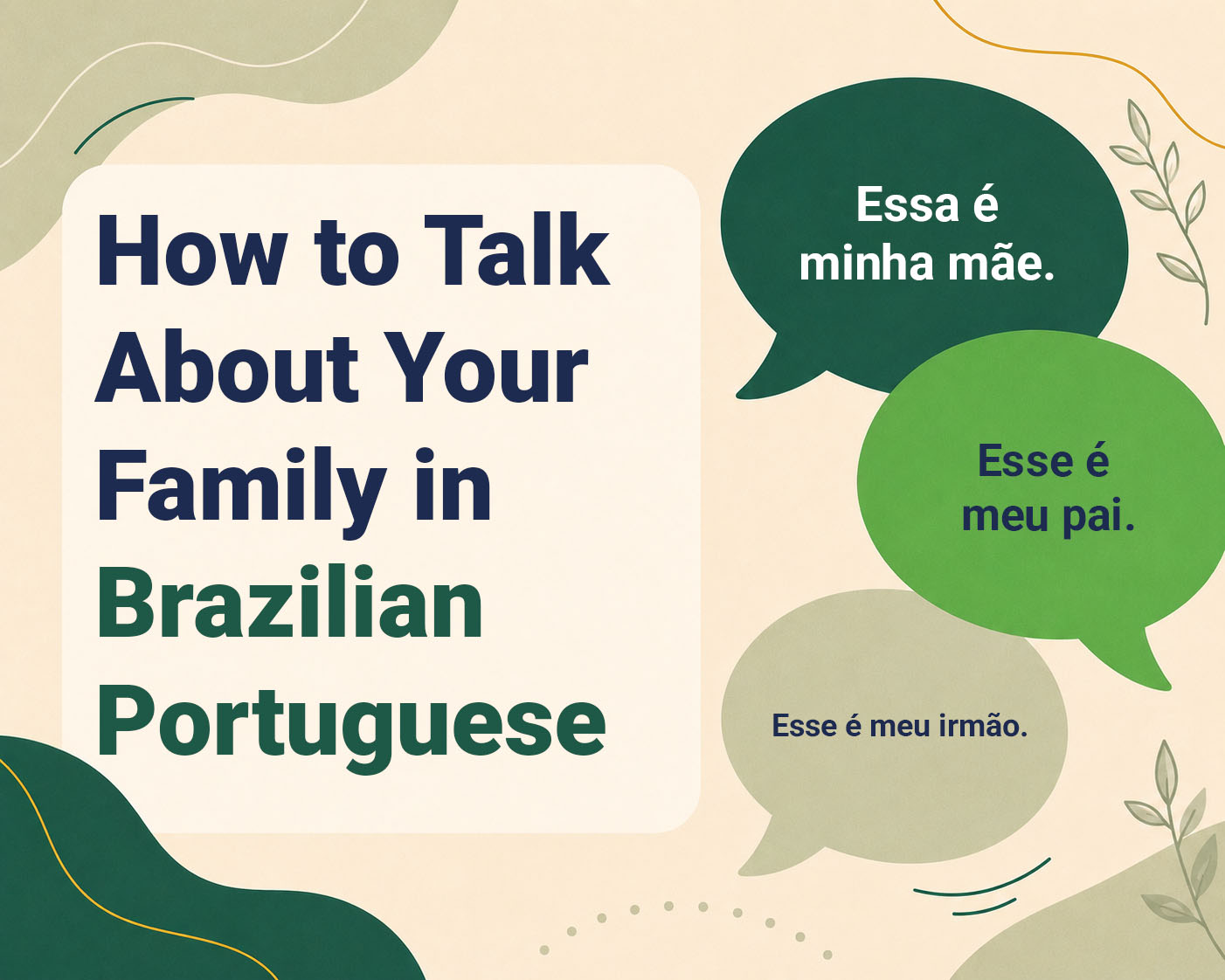
See how Brazilian Portuguese speakers introduce relatives, ask about parents and children, describe family size, and talk about resemblance. Family is one of the most common subjects when people are getting acquainted, but it also brings together several details that English speakers can easily miss: meu and minha agree with the family word, você takes third-person verb forms, and words such as filhos and crianças do not always divide meaning in exactly the same way as “children.”
The recorded examples below give you complete phrases for real conversations. The explanations then show how to change the relative, level of formality, number, or answer without turning the language into a mechanical list of substitutions.
Introducing your parents
Essa é minha mãe.
Natural translation: This is my mother.
Word for word: Essa = this/that one · é = is · minha = my · mãe = mother
Use this phrase while showing a photograph or introducing someone nearby. In Brazilian conversation, essa is frequently heard where a textbook might contrast esta (“this one, close to me”) with essa (“that one, close to you”). Actual usage varies by region and situation, so the recorded phrase is a natural conversational model rather than a rigid map of physical distance.
Minha is feminine because mãe is feminine. It does not tell you whether the speaker is a woman or a man. The vowel in mãe is nasal: allow air to pass through the nose instead of adding a clearly pronounced final n.
Esse é meu pai.
Natural translation: This is my father.
Word for word: Esse = this/that one · é = is · meu = my · pai = father
Because pai is masculine, “my” becomes meu. The same pattern gives you meu avô (“my grandfather”), meu tio (“my uncle”) and meu primo (“my male cousin”). With feminine nouns, use minha avó, minha tia and minha prima.
In an introduction, Este é meu pai is also possible. You may also hear Esse aqui é meu pai, with aqui making it clear that the person or image is right here. The important reusable frame is Esse/Essa é meu/minha…, with both demonstrative and possessive matching the person named.
Talking about brothers and sisters
Esse é meu irmão.
Natural translation: This is my brother.
Irmão means “brother.” To distinguish age, say meu irmão mais velho (“my older brother”) or meu irmão mais novo (“my younger brother”). Portuguese normally places these descriptions after the noun. Mais velho literally means “older,” while mais novo means “younger.”
Essa é minha irmã.
Natural translation: This is my sister.
The feminine form is irmã, and the possessive changes to minha. Compare meu irmão and minha irmã aloud: the ending and nasal vowel change, but the family connection remains easy to recognize.
Portuguese has no single everyday word used exactly as often as English “siblings.” In natural speech, people commonly say irmãos, which can mean brothers or siblings as a mixed group. Tenho dois irmãos may therefore mean “I have two brothers” or “I have two siblings”; add um irmão e uma irmã when the distinction matters.
Describing your family
Eu tenho uma família grande.
Natural translation: I have a large family.
Word for word: Eu = I · tenho = have · uma família = a family · grande = large
Tenho is the first-person singular form of ter, “to have.” You can omit eu when the context is clear because the verb already points to the speaker: Tenho uma família grande sounds complete.
The adjective grande follows família and does not change for gender. To describe a smaller family, say Tenho uma família pequena. If you want to distinguish immediate and extended family, use família próxima or família imediata for the closest household relationships and família extensa for grandparents, aunts, uncles and cousins.
Asking where someone’s parents live
Onde os seus pais vivem?
Natural translation: Where do your parents live?
With você, Brazilian Portuguese uses third-person verb forms, so the question uses vivem because os seus pais is plural. In conversation, Onde seus pais moram? is another very common way to ask the same thing. Morar focuses on residing somewhere; viver can mean living or having one’s life somewhere.
Possessives with seu/sua can occasionally be ambiguous because they may mean “your,” “his,” “her” or “their.” Here the person being addressed makes “your parents” clear. When there is any doubt, Brazilian speakers often use os pais dele (“his parents”) or os pais dela (“her parents”).
Meus pais vivem em Oslo.
Natural translation: My parents live in Oslo.
The plural possessive is meus before masculine or mixed plural nouns: meus pais, meus irmãos, meus avós. Use minhas with feminine plurals: minhas irmãs, minhas tias.
Portuguese normally uses em before a city in this construction: Meus pais vivem em Recife. With countries, em often combines with an article: no Brasil, na Itália, nos Estados Unidos. Some place names commonly appear without an article, so it is useful to learn the complete location phrase.
Talking about marriage
Você é casado? / Você é casada?
Natural translation: Are you married?
The adjective agrees with the person addressed: use casado for a man and casada for a woman. The pronoun você itself does not show gender. A natural answer follows the same agreement: Sou casado or Sou casada. Portuguese often drops eu in the answer.
For a more formal conversation, you may hear O senhor é casado? or A senhora é casada? Whether this subject is appropriate depends on the setting; marital status can be personal, so it is better to follow the other person’s lead.
Asking about children
Você tem filhos?
Natural translation: Do you have children?
Again, você takes a third-person verb: você tem, not você tenho. Filhos can mean sons, but it also commonly means children collectively. A negative answer is Não tenho filhos; Portuguese does not need an equivalent of “any” in that sentence.
Eu tenho um filho.
Natural translation: I have a son.
Use um filho for one son. To add age, say Tenho um filho de oito anos—literally, “I have a son of eight years.” Portuguese uses ter to state age: Ele tem oito anos.
Eu tenho uma filha.
Natural translation: I have a daughter.
The feminine forms are uma filha. If you have one of each, say Tenho um filho e uma filha. In a mixed plural, dois filhos can refer to two children, but the more explicit um filho e uma filha removes ambiguity.
Quantas crianças você tem?
Natural translation: How many children do you have?
Quantas agrees with the feminine plural noun crianças. The order você tem remains the same as in a statement; the question word and intonation make it a question.
In many family conversations, Quantos filhos você tem? is more precise for “How many children do you have?” Crianças usually emphasizes children as young people, while filhos expresses the parent-child relationship and can refer to adult sons and daughters too.
Eu tenho duas crianças.
Natural translation: I have two children.
Because crianças is feminine, the number appears as duas. Compare duas crianças with dois filhos. A parent would also naturally answer Tenho dois filhos, especially when the children are adults.
Visiting and spending time with family
The useful sentence Eu visitei meus pais means “I visited my parents.” Visitei is a completed past form of visitar. It works naturally for people as well as places: Visitei meus pais no fim de semana and Visitei Salvador no ano passado. To say that your parents visited you, switch the subject: Meus pais me visitaram.
Eu visitei meus avós.
Natural translation: I visited my grandparents.
Written accents distinguish avô (“grandfather”) and avó (“grandmother”). The plural avós normally means grandparents and can include both. Meus avós maternos are your maternal grandparents; meus avós paternos are your paternal grandparents.
Describing family resemblance
Ele se parece com a mãe dele ou com o pai dele?
Natural translation: Does he look like his mother or his father?
Brazilian Portuguese uses se parecer com alguém for physical resemblance: Ela se parece com a mãe means “She looks like her mother.” The phrase repeats com before each alternative, which keeps the relationship clear.
Dele and dela literally combine “of” with “him” or “her.” They are especially useful where seu/sua could be unclear. For character rather than appearance, you can say Ele puxou ao pai in informal Brazilian speech, but Ele se parece com o pai is widely understandable and neutral.
Useful family vocabulary in complete phrases
| Relationship | Portuguese | Natural example |
|---|---|---|
| grandparents | os avós | Meus avós moram perto. |
| grandfather | o avô | Meu avô tem oitenta anos. |
| grandmother | a avó | Minha avó mora no Rio. |
| uncle | o tio | Meu tio vem amanhã. |
| aunt | a tia | Minha tia tem dois filhos. |
| male cousin | o primo | Meu primo mora em Brasília. |
| female cousin | a prima | Minha prima fala inglês. |
| husband | o marido | Esse é meu marido. |
| wife | a esposa / a mulher | Essa é minha esposa. |
Mulher can mean “woman” or “wife,” depending on context. Esposa is unambiguous and can sound slightly more formal. For “partner,” companheiro/companheira and parceiro/parceira are possible, but their tone and preferred use vary.
Informal and more formal choices
| Meaning | Everyday with você | More formal |
|---|---|---|
| Where do your parents live? | Onde seus pais moram? | Onde os seus pais moram, senhor/senhora? |
| Are you married? | Você é casado/casada? | O senhor é casado? / A senhora é casada? |
| Do you have children? | Você tem filhos? | O senhor/A senhora tem filhos? |
Brazilian Portuguese uses você widely, but usage differs by region; tu is also common in parts of Brazil, with verb patterns that vary locally. For a broadly useful beginner model, keep você with the third-person forms é, tem, vive and mora.
A short family conversation
Pessoa 1: Você tem uma família grande?
Pessoa 2: Tenho. Tenho um irmão e uma irmã.
Pessoa 1: Onde seus pais moram?
Pessoa 2: Meus pais moram em Oslo. E você tem filhos?
Pessoa 1: Tenho dois filhos, um filho e uma filha.
Natural translation:
Person 1: Do you have a large family?
Person 2: I do. I have a brother and a sister.
Person 1: Where do your parents live?
Person 2: My parents live in Oslo. And do you have children?
Person 1: I have two children, a son and a daughter.
This exchange shows several natural omissions and clarifications. The short answer Tenho is enough because the verb identifies the speaker. The final speaker first gives the total, then explains it with um filho e uma filha. That is often more natural than forcing every detail into the first answer.
The main examples in this article are taken from the LinguaBoost Brazilian Portuguese course and recorded by a native Brazilian Portuguese speaker.
Make Family Conversations Feel Natural in Brazilian Portuguese
Continue with practical complete phrases, native-speaker audio and structured review that helps you recognize and use everyday Brazilian Portuguese with more confidence.
Explore the Brazilian Portuguese course