
The Portuguese verb ter is usually translated as “to have,” but its everyday uses extend well beyond owning something. In Brazilian Portuguese, ter appears when people talk about their family, age, fears, available time, plans and even physical appearance.
Some of these structures are close to English. Others use “have” where English naturally chooses “be” or another expression. Learning ter through complete phrases makes these differences much easier to recognize.
You can hear every main phrase spoken by a native Brazilian Portuguese speaker. The pronunciation guides are approximate, but they can help English speakers get close to the sound.
The most useful forms of ter
The present-tense form changes according to who has or experiences something:
| Portuguese | Meaning | Form of ter |
|---|---|---|
| eu | I | tenho |
| você | you — singular | tem |
| ele / ela | he / she | tem |
| nós | we | temos |
| vocês | you — plural | têm |
| eles / elas | they | têm |
The accent in têm distinguishes the plural form from singular tem in writing. They are also pronounced differently: tem has one nasal vowel, while têm is commonly heard with a slight glide at the end.
Brazilian Portuguese often uses você for an everyday singular “you.” In regions where tu is common, you may hear either the traditional form tu tens or tu tem in informal speech, depending on local usage. The course phrases use você, which is widely understood throughout Brazil.
Subject pronouns can sometimes be left out when the meaning is clear. Tenho already means “I have,” so both Eu tenho tempo and Tenho tempo are possible. In everyday speech, the shorter version is often natural.
Having or owning something
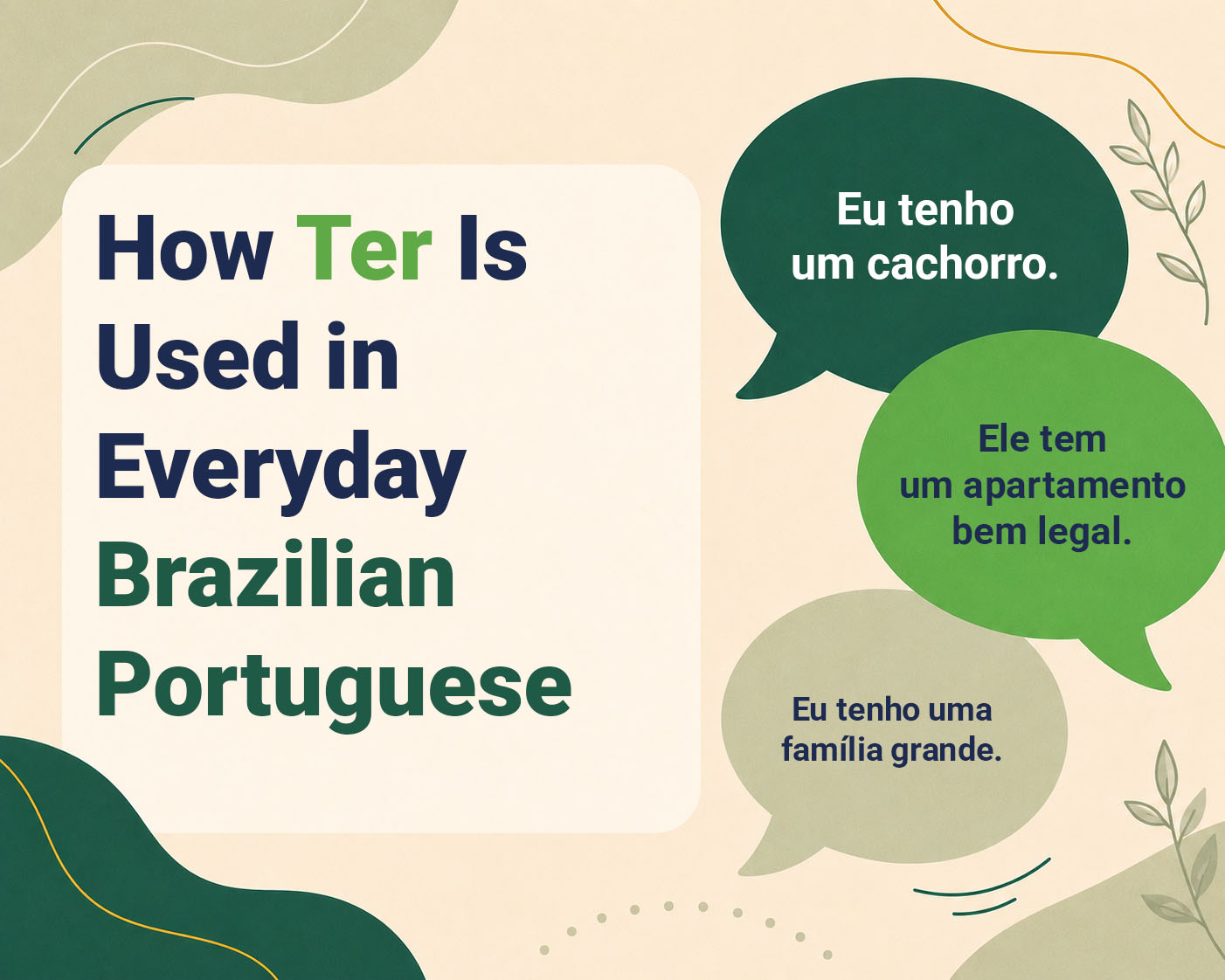
Eu tenho um cachorro.
Natural translation: I have a dog.
Pronunciation: eh-OO TEN-yoo oong kah-SHOH-hoo
Word for word: Eu = I · tenho = have · um = a · cachorro = dog
This is the most direct use of ter: someone has or owns something. Tenho is the first-person singular form, and the subject eu makes “I” explicit.
The spelling nh in tenho represents a sound similar to ny in the English word “canyon.” The final -o in unstressed Brazilian Portuguese often sounds closer to “oo,” which is why tenho is approximately TEN-yoo rather than “ten-ho.”
The course includes two closely related phrases:
- Eu tenho um gato. — I have a cat.
- Eu tenho dois gatos e um cachorro. — I have two cats and a dog.
In cachorro, the double rr has a strong sound that varies across Brazil. It may resemble an English h, a raspier sound from the throat or another regional pronunciation. You do not need to produce one single “perfect” version to be understood.
Ele tem um apartamento bem legal.
Natural translation: He has a very nice apartment.
Pronunciation: EH-lee teng oong ah-pahr-tah-MEN-too beng leh-GOW
Word for word: Ele = he · tem = has · um = an · apartamento = apartment · bem = very · legal = nice/cool
Here, tem means “has” because the subject is ele. The same form is used with ela and você:
- Ela tem... — She has...
- Você tem... — You have...
The adjective legal is extremely common in Brazilian Portuguese. In this context it means “nice,” “cool” or “great,” not “legal” in the sense of being permitted by law.
Both tem and bem contain nasal vowels. The final letters are not pronounced as a clear English m. Instead, the vowel itself becomes nasal.
Talking about family
Eu tenho uma família grande.
Natural translation: I have a large family.
Pronunciation: eh-OO TEN-yoo OO-mah fah-MEE-lyah GRAHN-jee
Word for word: Eu = I · tenho = have · uma = a · família = family · grande = large
Portuguese uses ter naturally when describing your family. Uma família grande normally means a family with many people rather than one whose members are physically large.
The accent in família shows where the stress falls: fah-MEE-lyah. In much of Brazil, the d in grande is pronounced with a soft “j” sound before the final i-like vowel, giving an approximate ending of -jee. Pronunciation varies by region.
Você tem filhos?
Natural translation: Do you have children?
Pronunciation: voh-SEH teng FEE-lyoos
Word for word: Você = you · tem = have · filhos = children
Portuguese does not add a separate verb equivalent to English “do” when forming this question. Você tem filhos can be a statement with falling intonation or a question with rising intonation and a question mark.
Você is the normal everyday form in many parts of Brazil. If you want to address someone more respectfully, especially an older person or someone in a clearly formal setting, you can say:
- O senhor tem filhos? — Do you have children? (to a man)
- A senhora tem filhos? — Do you have children? (to a woman)
The grammar is the same because você, o senhor and a senhora all use tem.
Questions about children can be personal, of course. The sentence is linguistically neutral, but whether it is appropriate depends on the conversation and your relationship with the other person.
Eu tenho um filho.
Natural translation: I have a son.
Pronunciation: eh-OO TEN-yoo oong FEE-lyoo
Word for word: Eu = I · tenho = have · um = a · filho = son
The spelling lh in filho represents a sound similar to lli in the English word “million,” although the Portuguese sound is produced as one smooth consonant.
Other family answers from the course include:
- Eu tenho uma filha. — I have a daughter.
- Eu tenho duas crianças. — I have two children.
- Eles têm duas crianças. — They have two children.
In everyday Brazilian Portuguese, filhos can mean “children” collectively, even when the children are not all boys. Crianças specifically means children or kids and does not indicate the family relationship by itself.
Portuguese uses ter for age
Eu tenho quarenta anos.
Natural translation: I am forty years old.
Pronunciation: eh-OO TEN-yoo kwah-REN-tah AH-noos
Word for word: Eu = I · tenho = have · quarenta = forty · anos = years
English says that someone is a certain age, but Portuguese says that the person has a number of years. The literal structure is “I have forty years.”
You can replace quarenta with another number while keeping the same pattern:
- Eu tenho vinte anos. — I am twenty years old.
- Eu tenho trinta anos. — I am thirty years old.
- Eu tenho cinquenta anos. — I am fifty years old.
Do not use sou or estou to give your age. In Portuguese, age is expressed with ter.
The course also includes:
- Ele tem dezoito. — He is eighteen.
- Ela tem quinze. — She is fifteen.
Here, anos is understood and can be omitted when everyone already knows that age is the subject.
Eu vivi em Paris quando eu tinha 10 anos de idade.
Natural translation: I lived in Paris when I was ten years old.
Pronunciation: eh-OO vee-VEE eng pah-REES KWAHN-doo eh-OO TEEN-yah dez AH-noos jee ee-DAH-jee
Word for word: Eu = I · vivi = lived · em Paris = in Paris · quando = when · eu tinha = I had · 10 anos de idade = ten years of age
Tinha is a past form of ter. It describes a situation or condition that was in progress at a past time, making it the natural form for someone’s age in the background of a story.
Portuguese still uses “had” where the natural English sentence uses “was”: eu tinha 10 anos literally means “I had ten years.”
In a shorter everyday sentence, de idade can be left out: Eu tinha dez anos also means “I was ten years old.”
Expressing fear with ter medo
Do que você tem medo?
Natural translation: What are you scared of?
Pronunciation: doo kee voh-SEH teng MEH-doo
Word for word: Do que = of what · você = you · tem = have · medo = fear
The expression ter medo means “to be afraid” or “to be scared.” Word for word, the question asks, “Of what do you have fear?”
Because medo is followed by de, the question begins with de que. The preposition and article often combine in answers: de + o = do and de + a = da.
For a more respectful form of address, você can be replaced without changing the verb:
- Do que o senhor tem medo? — What are you scared of? (to a man)
- Do que a senhora tem medo? — What are you scared of? (to a woman)
Eu tenho medo do escuro.
Natural translation: I’m scared of the dark.
Pronunciation: eh-OO TEN-yoo MEH-doo doo es-KOO-roo
Word for word: Eu = I · tenho = have · medo = fear · do = of the · escuro = dark
Additional unrecorded example.
Do escuro contains the contraction do, formed from de and masculine o. The complete expression is worth learning as a unit: ter medo de something.
The same structure appears in several course phrases:
- Falando francamente, eu tenho medo de voar. — Frankly speaking, I’m scared of flying.
Additional unrecorded example.
- Como você já sabe, ela tem medo de aranhas. — As you already know, she is scared of spiders.
Additional unrecorded example.
- Eu não tenho medo de voar. — I’m not scared of flying.
Additional unrecorded example.
- Eles têm medo de palhaços. — They are scared of clowns.
Additional unrecorded example.
To make the expression negative, place não before the form of ter: não tenho medo means “I’m not afraid.” In Brazilian Portuguese, unstressed não may sound lighter in rapid speech, but its nasal vowel remains important.
Having time—or not having it
Não tenho tempo para assistir à TV.
Natural translation: I don’t have time to watch TV.
Pronunciation: nowng TEN-yoo TEM-poo pah-rah ah-sees-CHEER ah teh-VEH
Word for word: Não = not · tenho = I have · tempo = time · para = to/for · assistir = watch · à TV = TV
Additional unrecorded example.
As in English, Portuguese uses ter tempo to say that time is available. Negation is straightforward: não comes before the verb.
The subject pronoun is omitted here. Não tenho already identifies the speaker as “I,” and this shorter form is completely natural.
The written form à combines the preposition a, required by assistir in standard usage, with the feminine article a before TV. In informal Brazilian speech, you may hear variation, but assistir à TV is the standard written form.
The same basic pattern can be adapted naturally:
- Tenho tempo. — I have time.
- Você tem tempo? — Do you have time?
- Não temos muito tempo. — We don’t have much time.
Asking about plans and ideas
Você tem planos para amanhã?
Natural translation: Do you have any plans for tomorrow?
Pronunciation: voh-SEH teng PLAH-noos pah-rah ah-mah-NYAHNG
Word for word: Você = you · tem = have · planos = plans · para = for · amanhã = tomorrow
Additional unrecorded example.
This question uses ter in almost the same way as English, but Portuguese does not need a separate equivalent of “do.” The word any is also unnecessary in the natural Portuguese sentence.
The final vowel in amanhã is nasal, marked by ã, and the stress falls on the last syllable: ah-mah-NYAHNG.
This is an everyday, neutral question. With a more formal form of address, you can say O senhor tem planos para amanhã? or A senhora tem planos para amanhã?
Você tem alguma ideia?
Natural translation: Do you have any ideas?
Pronunciation: voh-SEH teng aw-GOO-mah ee-DEH-yah
Word for word: Você = you · tem = have · alguma = any/some · ideia = idea
Additional unrecorded example.
Portuguese uses the singular alguma ideia, while the most natural English translation often uses plural “any ideas.” A more literal translation would be “Do you have any idea?” Both English versions can fit depending on the context.
The spelling of ideia has no accent under the current Portuguese orthographic rules. Its strongest syllable is dei: ee-DEH-yah.
You can also remove alguma and ask Você tem uma ideia? when you are asking whether someone has a particular suggestion in mind.
Describing physical features
Ele tem cabelo castanho e olhos azuis.
Natural translation: He has brown hair and blue eyes.
Pronunciation: EH-lee teng kah-BEH-loo kah-STAHN-yoo ee OH-lyoos ah-ZOOS
Word for word: Ele = he · tem = has · cabelo castanho = brown hair · e = and · olhos azuis = blue eyes
Additional unrecorded example.
Portuguese uses ter to describe the hair, eyes and other features a person has. Unlike English, Portuguese normally uses singular cabelo when referring to someone’s hair as a whole.
Both castanho and olhos contain sounds represented by letter combinations that English does not spell in the same way. Nh is similar to “ny,” while lh is close to the sound in “million.”
The adjective agrees with the noun it describes. Cabelo castanho is masculine singular, while olhos azuis is masculine plural.
Another course phrase describes a woman:
Ela tem cabelos escuros e encaracolados e olhos verdes. — She has dark curly hair and green eyes.
Additional unrecorded example.
Here, cabelos is plural. Both singular and plural can occur when talking about hair, though singular cabelo is very common when describing hair in general.
Ter as part of a compound verb
Eu tenho vivido aqui por um bom tempo.
Natural translation: I’ve been living here for a long time.
Pronunciation: eh-OO TEN-yoo vee-VEE-doo ah-KEE por oong bong TEM-poo
Word for word: Eu = I · tenho = have · vivido = lived · aqui = here · por = for · um bom tempo = a long time
Additional unrecorded example.
Here, ter works with the past participle vivido. The construction ter + past participle often describes something that has been happening repeatedly or continuously over a recent period.
This does not always match the English present perfect exactly. English uses “have lived” in many situations where Brazilian Portuguese would more naturally choose the present tense with há or faz, depending on the intended meaning. Tenho vivido aqui... places more emphasis on the ongoing recent experience of living here.
That difference is a useful reminder: even when Portuguese and English both appear to use “have,” their verb systems do not line up in every context.
Ter in the past and infinitive
Ele queria ter estudado mais para a prova.
Natural translation: He wishes he had studied more for the test.
Pronunciation: EH-lee keh-REE-ah tehr es-too-DAH-doo mais pah-rah ah PROH-vah
Word for word: Ele = he · queria = wanted/wished · ter estudado = to have studied · mais = more · para a prova = for the test
Additional unrecorded example.
In ter estudado, ter remains in the infinitive and combines with the past participle estudado. Together they mean “to have studied.”
The natural English sentence uses “wishes he had studied,” while the Portuguese structure is closer to “wanted to have studied.” Queria can express a wish or regret when the surrounding context makes clear that the opportunity has passed.
This is a more advanced use than tenho, tem and temos, but it shows how the same verb becomes part of longer structures.
Tem and têm: a small written difference with a big job
Two course phrases make the singular–plural contrast clear:
- Ele tem um apartamento bem legal. — He has a very nice apartment.
- Eles têm duas crianças. — They have two children.
The subject changes from singular ele to plural eles, and the written verb changes from tem to têm.
The circumflex does not appear in the infinitive ter, the first-person form tenho or temos. It specifically marks the plural third-person form:
- você tem — you have
- ele tem / ela tem — he/she has
- vocês têm — you all have
- eles têm / elas têm — they have
This accent is required in standard writing, even though learners may initially find the two forms difficult to distinguish in fast conversation.
A verb that reaches far beyond possession
The most useful way to understand ter is not to search for one English translation every time. Instead, notice the complete structure surrounding it:
- ter um cachorro — to have a dog
- ter filhos — to have children
- ter quarenta anos — to be forty years old
- ter medo de — to be afraid of
- ter tempo — to have time
- ter planos — to have plans
- ter cabelo castanho — to have brown hair
- ter vivido — to have been living / to have lived repeatedly
In some phrases, English also uses “have.” In others, the natural translation changes completely. The Portuguese expressions become easier to use when you remember them as whole pieces of language rather than translating ter on its own.
The native-speaker recordings also reveal details that spelling cannot fully show: nasal vowels in tem and tenho, the soft sounds in filho and tenho, and the way unstressed vowels change in natural Brazilian speech.
Hear ter in complete Brazilian Portuguese phrases
The main examples in this article are taken from the LinguaBoost Brazilian Portuguese course and recorded by a native Brazilian Portuguese speaker.
Ready to speak more Brazilian Portuguese?
Build on the phrases in this article with structured practice, native-speaker audio and built-in review designed for everyday conversation.
Explore the Brazilian Portuguese course