
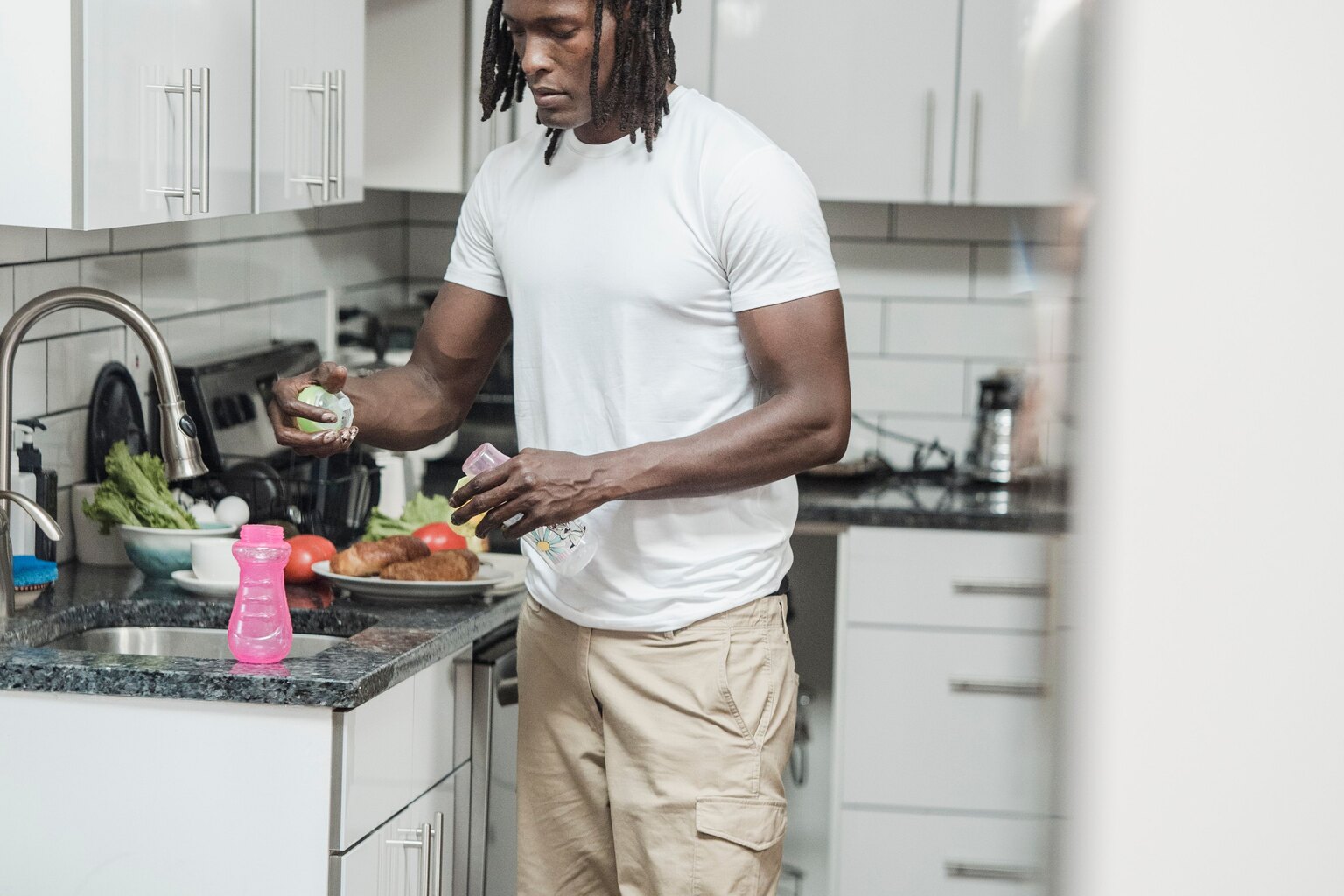
Putting away a shopping bag, choosing clothes or getting ready to make dinner gives you something concrete to talk about. There is an action, a reason and an outcome in front of you. With a few familiar sentence patterns, those ordinary moments can become short opportunities to retrieve language and say a complete message aloud.
The useful step is deciding what you want your words to accomplish. You might announce your next action, explain a choice or rehearse a request you will soon make to another person. A manageable task gives the speaking a purpose and makes it easier to notice what you can already say.
Give the activity one speaking purpose
Choose a familiar activity that leaves you enough attention to speak. Putting a clean cup on a shelf or deciding what to pack is easier to combine with a short sentence than following a complicated new recipe. Use a pause before or after any part of a task that needs close attention.
Then give the moment one purpose. “Talk about the kitchen” is broad. “Say what I need before I start” produces a much clearer task. You can finish it with one or two sentences and return to the activity.
Three purposes cover many useful situations:
- Describe an action: Say what you are about to do or what you have just finished.
- Explain a choice: Choose between two real options and give one reason.
- Prepare an interaction: Rehearse the request, question or reply you expect to need.
Choose one purpose for the first attempt. Trying to narrate every movement adds language decisions faster than most learners can resolve them.
Begin with a sentence you can trust
Select a short pattern you have already heard, understood and checked. Keep its meaning beside it while preparing. During the activity, look away from the model and try to retrieve the sentence from the situation.
For someone studying Spanish, a dinner-preparation scene could use these written illustrations, without audio:
| Purpose | Sentence | Meaning |
|---|---|---|
| State a plan | Voy a preparar la cena. | I’m going to prepare dinner. |
| Identify a need | Necesito un plato limpio. | I need a clean plate. |
| Report the result | La cena ya está lista. | Dinner is ready now. |
These three messages connect language to different stages of one ordinary activity. The word plato alone names an object; the complete sentence states what you need. You have a reason to say it before looking for the plate.
Treat these as examples of the method, rather than a script for every household task. Choose equivalent, verified phrases in the language you are learning. There is no need to invent a new grammatical structure each time you pick something up.
Describe a small action with a clear endpoint
Give your first attempt a boundary. While packing a bag, state the next action and one item you need. Once those messages are complete, stop. A useful endpoint prevents a thirty-second exercise from turning into a difficult account of everything happening around you.
The content can be very ordinary: putting a bottle in the bag, looking for a key, or checking whether a notebook is inside. Select the part that matches language you already know. If the verb for fastening a particular buckle is unfamiliar, another part of the activity can provide a better starting point.
Say the message once at a comfortable pace. If an important word disappears, pause and rebuild the sentence. Then make one complete attempt. The aim is a usable message, with enough attention left to know what you intended to say.
Explain a real choice
Choices create a natural reason to go beyond naming things. Set two options in front of you: two shirts, a small and a large bag, or two items to take on a short outing. Choose one and explain one relevant reason.
Prepare the language for the reason in advance. Depending on what you know, you might say that something is lighter, warmer, easier to carry or suitable for the weather. Keep the explanation within your existing vocabulary. A simple reason you can express clearly is enough.
The choice should remain consistent with what you say. If you choose the larger bag, explain why the extra space matters. If you change your mind, say the revised choice. This gives your words a small consequence inside the exercise and helps you avoid repeating a sentence without checking its meaning.
Rehearse the first exchange you will need
An upcoming errand provides another useful prompt. Before entering a shop or making a call, identify the first message you expect to use. It might be a request for a bag, a question about opening hours or a brief explanation of what you are looking for.
Prepare two turns: your opening and a likely reply. Then practice your next response. If the imagined reply is a question about quantity, you need a quantity answer. If it offers an alternative, you need a choice or a polite refusal. These are different speaking jobs, even when the same errand supplies the context.
Keep imagined exchanges short and mark them as rehearsal. A real person may answer differently. Use the exercise to make your opening easier to retrieve and to prepare a clarification request, such as asking someone to repeat a detail, in a form you have verified.
Work with a simple before–during–after sequence
One task can support three moments without requiring continuous commentary:
| Moment | Speaking job | What to prepare |
|---|---|---|
| Before | State the plan | One sentence about the intended action |
| During a suitable pause | Identify a need or explain a choice | One request or one reason |
| After | Report the result | One sentence about what is finished or still missing |
For packing, the sequence might concern your destination, an item you need and whether the bag is ready. For a meal, it might concern the food you plan to prepare, a utensil and the finished dish. The activity supplies the situation; your current language determines how much detail to include.
You can practice only one moment if that is enough. A complete sentence before leaving home is a finished exercise in its own right.
Make variations that preserve the whole sentence
Once a pattern is familiar, change a real detail. Check the entire revised sentence, because a change in number or noun can affect other words.
The written dinner example Voy a preparar la cena can become Voy a preparar el desayuno, “I’m going to prepare breakfast.” The article changes from la to el because desayuno is masculine. Necesito un plato limpio becomes Necesito dos platos limpios, “I need two clean plates.” Both the noun and adjective become plural.
These are useful variations because they match a different plan or need. Build one checked variation at a time. After practicing it, return to the real situation and decide which version actually expresses what you mean.
Handle a missing word without abandoning the message
When one word blocks you, simplify the message using language you know. You may be able to state the intention without naming every object, or choose a broader description that remains clear. Finish the idea, then note the missing expression for later checking.
Keep that note specific. “Ask for a smaller bag” identifies a useful phrase to find. “Learn shopping words” leaves the problem much less defined. After checking a natural expression and hearing a reliable model when available, use it in another short rehearsal.
Avoid building a long list from every object you encounter. Choose the gap that interrupted your message. That keeps the next session connected to something you wanted to communicate.
Move from one sentence to a brief explanation
When the opening comes easily, add a second sentence that contributes new information. State the plan, then explain the reason. Name the need, then say what you will do if the item is unavailable.
A short explanation should follow a clear order. For a journey, you could state where you are going, what you need and the next action. For a household task, you could state the intended result and the step you are about to take. Stop once the listener would have enough information to understand your purpose.
You can record a brief attempt if that helps, but recording is optional. First ask whether the message is complete and appropriate to the situation. Polishing the sound becomes easier when you know which sentence you are trying to use.
Add a real listener when possible
Speaking alone gives you control over the task. A conversation partner adds information you cannot fully prepare. When an appropriate opportunity appears, use one of the practiced requests or explain a genuine choice.
Listen to the response and check whether it fits what you expected. If the other person needs clarification, notice which detail was missing. If your opening worked but the follow-up was difficult, make that follow-up the next small practice task.
For practice with a tutor or exchange partner, describe the scenario briefly and ask for one realistic response. A single follow-up question can be enough to reveal whether you can adapt your prepared sentence.
Keep a useful finish line
At the end of the activity, identify one thing you managed and one thing to check. “I explained why I chose the small bag; I need a natural way to say that it fits inside the other one” gives the next practice a direction.
Everyday tasks provide situations in which language has an immediate job. Begin with a trusted phrase, retrieve it at a relevant moment and extend it only when the message stays clear. Several brief, purposeful exchanges can give you practical material to carry into your next conversation.
Put familiar phrases to work
LinguaBoost courses provide useful complete phrases, native-speaker recordings and structured review. Build a reliable starting repertoire, then use ordinary tasks to practice retrieving those phrases for your own plans, needs and choices.