
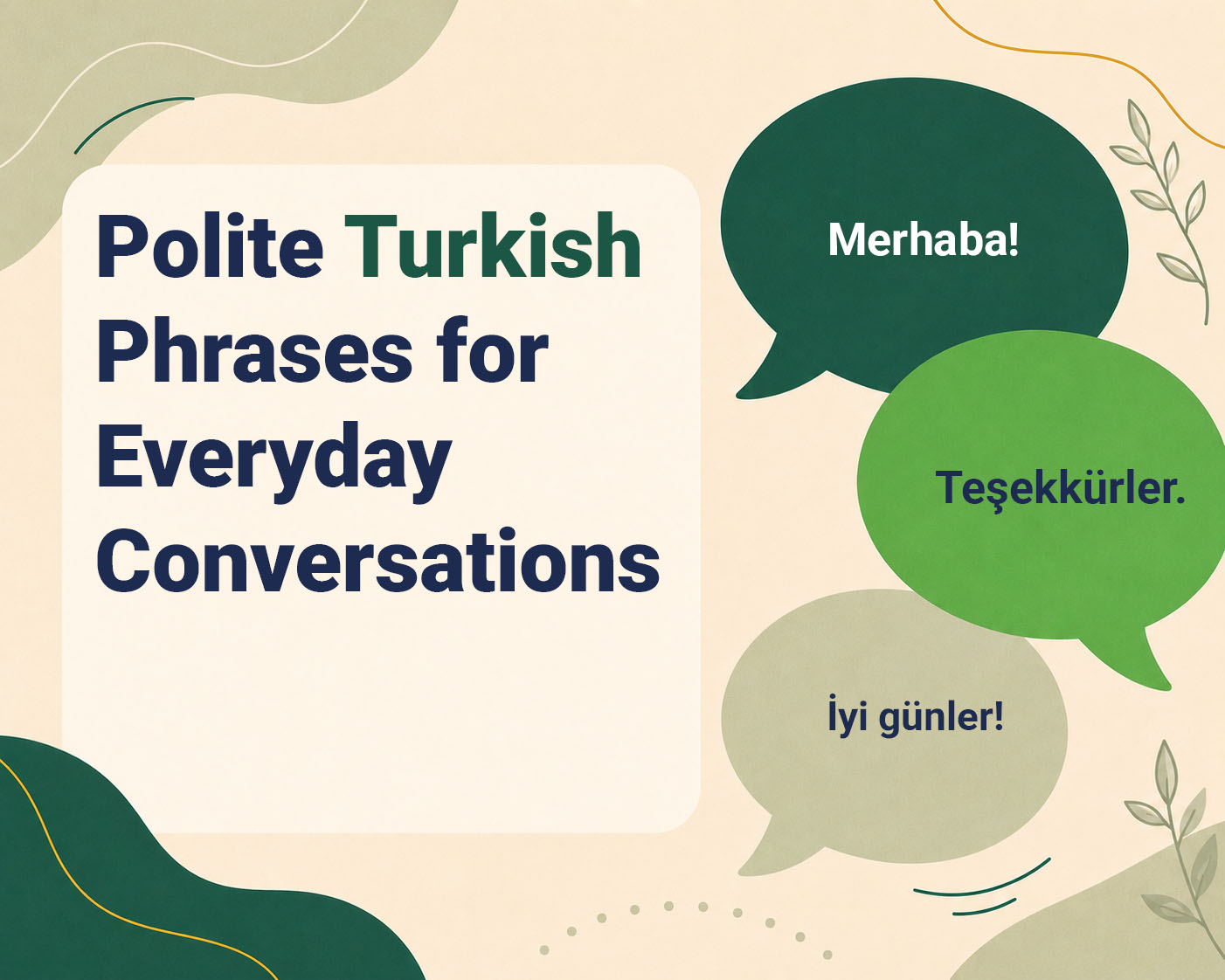
Politeness in Turkish is about more than adding a word equivalent to “please.” The way you greet someone, ask a question or say goodbye can change depending on how well you know the other person. Verb endings and pronouns help show whether the tone is informal, respectful or directed at more than one person.
That makes complete phrases especially useful. Expressions such as Nasılsın?, Nasılsınız?, Hoşça kal! and Hoşça kalın! reveal the difference between familiar and more respectful Turkish, while phrases such as Rahatsız ettiğim için üzgünüm, ama... help you approach a stranger without sounding abrupt.
You can hear every main phrase spoken by a native Turkish speaker. The pronunciation guides are approximate, but they can help English speakers get close to the sound.
Starting a conversation politely
Merhaba!
Natural translation: Hello!
Pronunciation: mehr-hah-BAH
Word for word: Merhaba = hello
Merhaba is the safest general greeting in Turkish. It works with friends, strangers, colleagues and service staff, and it can be used at almost any time of day.
The final syllable often receives noticeable stress. Turkish vowels are usually pronounced clearly, so avoid reducing the middle a to the very weak sound that English speakers sometimes use in unstressed syllables.
Another common greeting is Selam, which is closer to “Hi.” It sounds more casual, so Merhaba is usually the better choice when you are unsure how formal to be.
Nasılsın?
Natural translation: How are you?
Pronunciation: nuh-suhl-SUHN
Word for word: nasıl = how · -sın = you are
Nasılsın? is the informal singular form. Use it with a friend, a relative, a child or someone else you address casually.
For someone you do not know, an older person or a professional relationship, use:
Nasılsınız? — How are you? (formal or plural)
The ending changes from -sın to -sınız. The formal form is also used when speaking to several people, much like French vous or German Sie, although the grammar is not identical.
The dotless Turkish ı does not sound like English “i.” It is made farther back in the mouth, with relaxed, unrounded lips. The “uh” in the pronunciation guide is only an approximation.
İyiyim, teşekkürler.
Natural translation: I’m good, thank you.
Pronunciation: ee-YEE-yeem, teh-shehk-KOOR-lehr
Word for word: iyiyim = I am well · teşekkürler = thanks
This is a natural reply to Nasılsın? or Nasılsınız? The word iyiyim is built from iyi, meaning “good” or “well,” together with the ending that expresses “I am.”
Teşekkürler means “thanks.” A slightly fuller and more formal expression is:
Teşekkür ederim. — Thank you.
You may also hear Çok teşekkür ederim, meaning “Thank you very much.” The course phrase İyiyim, teşekkürler is friendly and suitable for most ordinary conversations.
The Turkish letter ş sounds like English “sh,” while ü is pronounced with rounded lips. To approach ü, shape your lips as if saying “oo” while trying to say “ee.”
Getting someone’s attention without sounding abrupt
Rahatsız ettiğim için üzgünüm, ama...
Natural translation: I’m sorry to bother you, but...
Pronunciation: rah-haht-SUHZ et-tee-eem ee-CHEEN ooz-goo-NOOM, ah-MAH
Word for word: rahatsız ettiğim = that I disturbed/bothered · için = for/because of · üzgünüm = I’m sorry · ama = but
This phrase is useful before asking a stranger for information or interrupting someone. It acknowledges the interruption before the request arrives, making the conversation sound considerate rather than demanding.
The phrase can introduce many different questions:
- Rahatsız ettiğim için üzgünüm, ama tren ne zaman kalkıyor? — I’m sorry to bother you, but when does the train leave?
- Rahatsız ettiğim için üzgünüm, ama burası benim yerim. — I’m sorry to bother you, but this is my seat.
- Rahatsız ettiğim için üzgünüm, ama bana yardım edebilir misiniz? — I’m sorry to bother you, but could you help me?
The last example uses the respectful -siniz form. With a friend, the informal equivalent would be Bana yardım edebilir misin?
In ettiğim, the letter ğ usually does not have a strong consonant sound. Here it helps connect or lengthen the surrounding vowel sounds.
Doktor bulmama yardım eder misin?
Natural translation: Could you help me find a doctor?
Pronunciation: dohk-TOR bool-mah-MAH yahr-DUHM eh-DEHR mee-SUHN
Word for word: doktor = doctor · bulmama = with my finding/to help me find · yardım eder misin = would you help?
This is an informal request because it ends in misin. It is suitable when asking someone you know or someone with whom an informal tone is appropriate.
To make the same request formal or address several people, say:
Doktor bulmama yardım eder misiniz? — Could you help me find a doctor?
The change from misin to misiniz carries the formality. Turkish often expresses respect through endings, so an English translation may look identical even though the Turkish relationship changes.
For a shorter general request, Yardım eder misiniz? means “Could you help?” in the respectful form.
The dotless ı appears in yardım and is again pronounced with the tongue farther back than an English “i.”
Responding kindly
Sorun değil.
Natural translation: It’s no bother. / No problem.
Pronunciation: soh-ROON deh-EEL
Word for word: sorun = problem · değil = not
Sorun değil is a reassuring response when someone apologizes, worries that they have interrupted you or thanks you for a small favor. Depending on the situation, it can mean “No problem,” “That’s all right” or “It’s no bother.”
The word değil is often difficult to judge from its spelling. The ğ is not pronounced like a hard English g. In this word, the phrase sounds approximately like deh-eel, with a smooth movement between the vowels.
Another very common response to thanks is Rica ederim, which can mean “You’re welcome.” Sorun değil is more directly reassuring: there is no problem.
Elbette.
Natural translation: Of course.
Pronunciation: el-BET-teh
Word for word: Elbette = of course/certainly
Elbette is a positive, helpful reply when agreeing to a request or confirming that something is possible. It can sound a little more deliberate than a simple “yes,” similar to “Of course” or “Certainly.”
For example:
Bana yardım edebilir misiniz? — Elbette.
Could you help me? — Of course.
The course also includes Tabii ki değil, meaning “Of course not.” Be careful with that response: just as in English, its tone depends strongly on the question and situation.
Tamam.
Natural translation: Okay. / All right.
Pronunciation: tah-MAHM
Word for word: Tamam = okay/all right/complete
Tamam is one of the most useful responses in everyday Turkish. It can show agreement, confirm a plan or simply acknowledge what someone has said.
It is not specifically formal or informal. The surrounding sentence, situation and tone of voice determine whether the exchange feels warm, neutral or impatient. Said calmly, Tamam is a natural equivalent of “Okay” or “All right.”
Meeting someone for the first time
Tanıştığıma memnun oldum!
Natural translation: Nice to meet you!
Pronunciation: tah-nuhsh-TUH-uh-mah mem-NOON ol-DOOM
Word for word: tanıştığıma = to having met/getting acquainted · memnun = pleased · oldum = I became
This expression is appropriate after being introduced to someone. Unlike English, it does not contain a separate word for “you,” so the same phrase works whether the conversation is formal or informal.
The literal structure is closer to “I’m pleased to have met you,” but the natural English equivalent is “Nice to meet you.”
Turkish ş sounds like “sh.” The ğ in tanıştığıma softens the transition between vowels rather than producing a hard g sound.
A natural reply is:
Ben de memnun oldum. — Nice to meet you too.
Here, ben de means “me too” or “I also.”
Ending a conversation politely
İyi günler!
Natural translation: Have a nice day! / Good day!
Pronunciation: ee-YEE goon-LEHR
Word for word: iyi = good · günler = days
İyi günler is a useful daytime expression when entering or leaving a shop, office or other relatively neutral setting. It can function as “Good day” or “Have a nice day,” depending on where it appears in the exchange.
It is polite without being unusually formal. In the evening, you may hear İyi akşamlar (“Good evening”), while İyi geceler means “Good night.”
The letter ü in günler is the same rounded front vowel heard in teşekkürler.
Hoşça kal!
Natural translation: Goodbye! / Take care!
Pronunciation: hosh-CHA kahl
Word for word: hoşça = pleasantly/well · kal = stay
Hoşça kal is the informal singular form, used when the other person is staying and you are leaving. Its literal sense is close to “Stay well.”
For a respectful goodbye or when speaking to several people, use:
Hoşça kalın! — Goodbye! (formal or plural)
That formal version is also included in the course:
Turkish traditionally distinguishes between the phrase said by the person leaving and the one said by the person staying. The person who remains may answer Güle güle, literally wishing the other person to go smiling.
Sonra görüşürüz!
Natural translation: See you later!
Pronunciation: SON-rah goh-roo-SHOO-rooz
Word for word: sonra = later/afterwards · görüşürüz = we’ll see each other
Sonra görüşürüz is a friendly way to leave when you expect to meet the person again. The verb contains the idea of seeing one another, so the literal structure is closer to “We’ll see each other later.”
You can make the timing more specific:
- Yarın görüşürüz. — See you tomorrow.
- Yakında görüşürüz. — See you soon.
- Sonra görüşürüz. — See you later.
The course phrase Yarın görüşürüz! also has native-speaker audio:
Kendine iyi bak!
Natural translation: Take care!
Pronunciation: ken-dee-NEH ee-YEE bahk
Word for word: kendine = to yourself · iyi = well/good · bak = look
Kendine iyi bak is warm and informal. It is often used between friends, relatives and people who know one another.
The respectful or plural version is:
Kendinize iyi bakın. — Take care.
Both kendine → kendinize and bak → bakın change in the respectful form. This illustrates an important feature of Turkish: formality may be marked in more than one part of the phrase.
Informal and formal Turkish at a glance
Turkish commonly uses singular sen forms with friends, relatives and children, while plural siz forms also serve as polite singular forms. The pronouns themselves are often omitted because the verb endings already show who is being addressed.
| Informal, one person | Formal or more than one person | Meaning |
|---|---|---|
| Nasılsın? | Nasılsınız? | How are you? |
| Yardım eder misin? | Yardım eder misiniz? | Could you help? |
| Hoşça kal! | Hoşça kalın! | Goodbye! |
| Kendine iyi bak! | Kendinize iyi bakın! | Take care! |
When you are unsure, the siz form is the safer choice with an adult you have just met. People may quickly move to the informal form in a friendly conversation, but beginning respectfully rarely sounds wrong.
A short polite exchange in Turkish
Here is how several of the phrases can fit into one everyday conversation:
Person 1: Merhaba! Rahatsız ettiğim için üzgünüm,
ama doktor bulmama yardım eder misiniz?
Person 2: Elbette.
Person 1: Çok teşekkür ederim.
Person 2: Sorun değil.
Person 1: İyi günler!
Person 2: Size de!
English:
Person 1: Hello! I’m sorry to bother you, but could
you help me find a doctor?
Person 2: Of course.
Person 1: Thank you very much.
Person 2: No problem.
Person 1: Have a nice day!
Person 2: You too!
This short exchange uses the respectful misiniz ending because the speakers do not know one another. The longer apology at the beginning softens the request, while Elbette and Sorun değil keep the response helpful and reassuring.
Politeness through complete phrases
Turkish politeness is closely connected to sentence endings. Learning misin and misiniz, or kal and kalın, in complete expressions makes the difference easier to notice than memorizing the endings alone.
The phrases also show that polite Turkish does not need to sound stiff. Merhaba, Teşekkürler, Sorun değil and İyi günler fit comfortably into ordinary daily conversations. The formal forms simply help you adjust the relationship when the situation calls for more respect.
The main examples in this article are taken from the LinguaBoost Turkish course and recorded by a native Turkish speaker.
Ready to speak more Turkish?
Build on the phrases in this article with structured practice, native-speaker audio and built-in review designed for everyday conversation.
Explore the Turkish course