
Spanish and Italian often look immediately familiar to speakers of the other language. Both developed from Latin, share a large amount of vocabulary and use related grammatical structures. A Spanish learner may recognize an Italian sentence without having studied it, and an Italian learner may guess the meaning of a Spanish phrase.
That familiarity is valuable, but it can also create overconfidence. Similar words may be pronounced differently, familiar structures may not be used in the same situations, and a word that looks obvious may mean something else. Learning both works best when similarity is used as a shortcut for noticing—not as permission to assume that one language is a changed accent of the other.
Why the languages feel related
Spanish and Italian share several broad features:
- nouns commonly have grammatical gender;
- articles change with gender and number;
- verbs change according to person and tense;
- subject pronouns are often omitted;
- adjectives frequently follow the noun;
- many words come from the same Latin root;
- spelling is more closely connected to pronunciation than in English.
These common features reduce the number of completely new concepts when you move from one language to the other. The details still differ: Italian has more article forms, Spanish uses two common verbs for “to be,” and everyday vocabulary does not always choose the same Latin descendant. The most useful comparisons therefore keep complete phrases side by side.
Similar phrases reveal a shared structure
Asking about interests
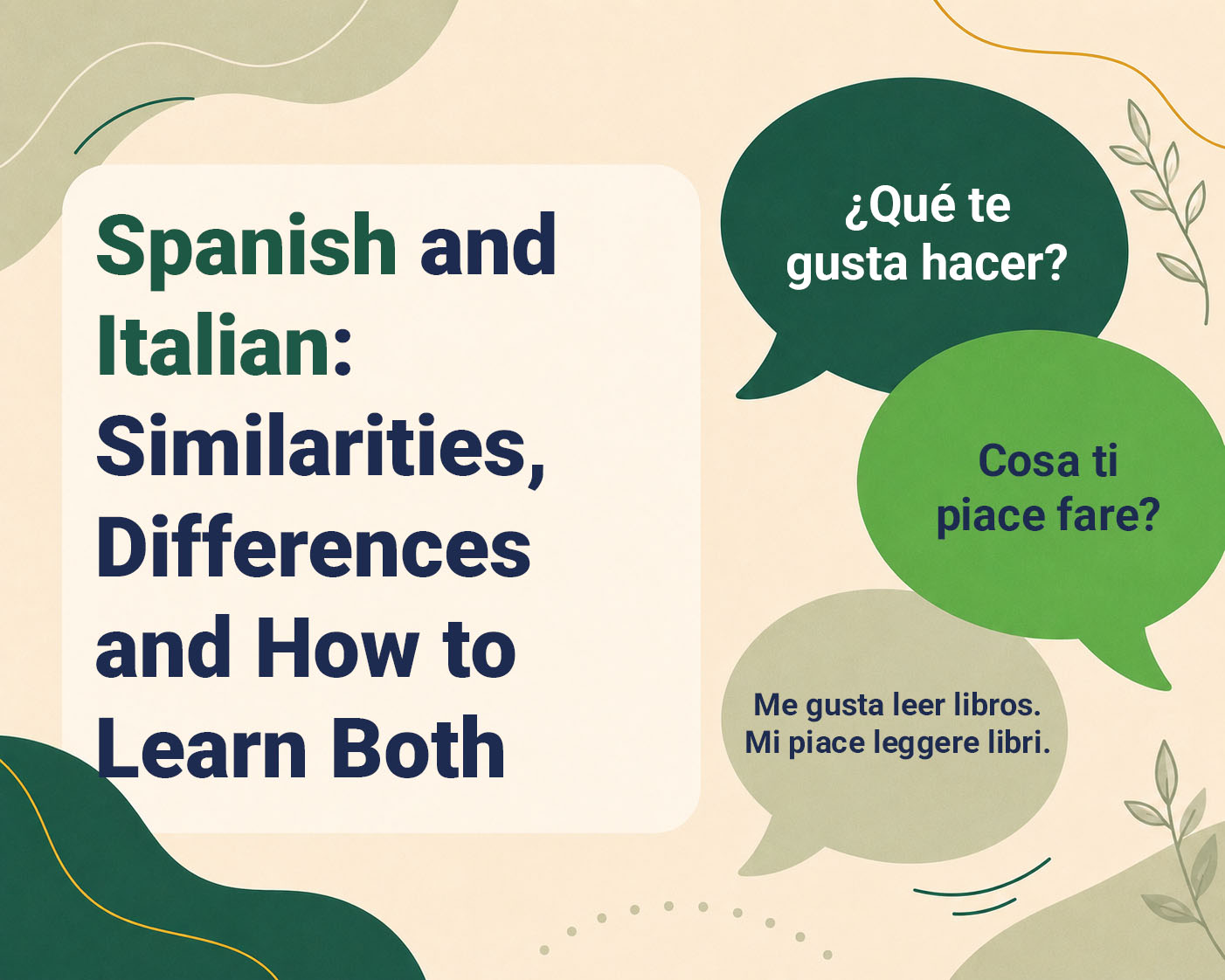
Spanish: ¿Qué te gusta hacer?
Italian: Cosa ti piace fare?
Meaning: What do you like to do?
Spanish te gusta and Italian ti piace use a similar underlying idea: an activity is pleasing “to you.” Neither behaves exactly like the English verb “to like.” The pronoun differs—te versus ti—and so does the main verb. The similarity helps you understand the pattern, but the complete phrase keeps each language distinct.
Reading books
Spanish: Me gusta leer libros.
Italian: Mi piace leggere libri.
Meaning: I like reading books.
Several correspondences are easy to see:
| Spanish | Italian | Meaning |
|---|---|---|
| me | mi | to me |
| gusta | piace | is pleasing |
| leer | leggere | to read |
| libros | libri | books |
The sentences are similar, but pronunciation is not interchangeable. Spanish leer keeps two vowel sounds, while Italian leggere contains a soft g sound and a lengthened consonant. Spanish forms the plural by adding -s to libro; Italian changes the final vowel from libro to libri.
Listening to music
Spanish: Me gusta escuchar música.
Italian: Mi piace ascoltare musica.
Meaning: I like listening to music.
The structure remains parallel, but the verb is different: escuchar in Spanish and ascoltare in Italian. This is a useful reminder that shared grammar does not guarantee shared vocabulary. Learning the whole expression prevents a learner from inventing a hybrid verb based on the other language.
Talking about travel
Spanish: Me gusta viajar.
Italian: Mi piace viaggiare.
Meaning: I like travelling.
Here the connection is obvious. Spanish viajar and Italian viaggiare share a root, but Italian marks the consonant more strongly and uses a different infinitive ending. Do not pronounce the Italian word as Spanish with an extra syllable. The recordings show two related but separate sound patterns.
Spending time with friends
Spanish: Me gusta pasar tiempo con amigos.
Italian: Mi piace passare del tempo con gli amici.
Meaning: I like spending time with friends.
The verbs pasar and passare are clearly related. Italian, however, includes del in passare del tempo and an article in con gli amici, while the Spanish phrase uses pasar tiempo con amigos without those articles.
This is exactly the kind of small difference that disappears when learners translate word by word. Store passare del tempo as one Italian expression and pasar tiempo as one Spanish expression.
Liking pizza
Spanish: Me gusta la pizza.
Italian: Mi piace la pizza.
Meaning: I like pizza.
This pair is highly similar. Both languages use the definite article before pizza, and both structures treat the thing liked as the grammatical subject. The resemblance is helpful because it reinforces one shared pattern. It is also a good place to practise keeping gusta and piace separate.
With a plural item, both verbs change: Me gustan los libros in Spanish and Mi piacciono i libri in Italian. The object that is pleasing controls the singular or plural form.
Pronunciation is less similar than spelling suggests
Spanish and Italian both have relatively regular spelling, but their sound systems are not identical. The written word can make a learner feel certain before the ear has actually learned the sound.
Double consonants matter more in Italian
Italian distinguishes single and double consonants. The middle sound in pala is shorter than in palla, and this difference can distinguish words. Spanish spelling includes some doubled letters, but it does not use consonant length in the same systematic way.
Learners coming from Spanish may understand an Italian word while making it sound too light. In passare, hold the s slightly longer than in Spanish pasar.
The letters c and g follow different patterns
Both languages change c and g before certain vowels, but the results differ by region and spelling. Italian c before e or i normally sounds like English ch, as in cena. In Latin American Spanish, c before e or i normally sounds like s, also as in cena.
The same spelling therefore begins with different sounds:
- Italian cena: approximately CHEH-nah
- Latin American Spanish cena: approximately SEH-nah
Italian keeps more pronounced final vowels
Many Italian words end in a clearly pronounced vowel. Spanish also has many vowel endings, but its rhythm and consonant patterns differ. Native audio matters because related spelling can persuade the eye that the pronunciation is already known.
Grammar that transfers well
Subject pronouns can often be omitted
Both languages usually identify the subject through the verb ending:
- Spanish: Vivo en Suecia. — I live in Sweden.
- Italian: Vivo in Svezia. — I live in Sweden.
The pronouns yo and io are possible, but speakers usually add them for contrast, clarification or emphasis rather than requiring them in a neutral statement.
Adjectives agree with nouns
Gender and number affect many adjectives in both languages:
- Spanish: un libro interesante / dos libros interesantes
- Italian: un libro interessante / due libri interessanti
The general idea transfers, while the exact plural endings must be learned separately.
Verbs carry substantial information
Spanish and Italian verbs show person, number, tense and mood through their forms. If you already understand conjugation in one language, the concept will not be new in the other. The forms still cannot simply be converted by changing the ending. High-frequency irregular verbs such as Spanish ser/ir and Italian essere/andare need their own complete phrases.
Important differences that need separate attention
Spanish has ser and estar
Spanish commonly divides meanings of “to be” between ser and estar. Italian generally uses essere for both, although other constructions may express a particular meaning.
Compare Spanish Soy italiano (“I am Italian”) with Estoy cansado (“I am tired”). Italian uses Sono italiano and Sono stanco. An Italian learner of Spanish must therefore make a distinction that Italian does not mark with two different basic verbs.
Italian has more definite articles
Spanish mainly uses el, la, los and las. Italian chooses among il, lo, la, l’, i, gli and le, depending on gender, number and the sound beginning the next word.
Compare Italian il libro, lo studente, l’amico, i libri and gli studenti. Italian requires detailed choices based on the following sound.
Plural formation differs
Spanish commonly adds -s or -es:
- libro → libros
- ciudad → ciudades
Italian more often changes the final vowel:
- libro → libri
- casa → case
- città → città
This difference affects the rhythm of nearly every plural noun phrase. It also means that copying a Spanish plural ending into Italian creates an immediately noticeable hybrid.
Common prepositions do not map perfectly
Spanish en and Italian in overlap, but not in every fixed expression. Spanish a and Italian a share several uses without being interchangeable everywhere.
Learn prepositions inside phrases such as Spanish en casa, en Italia and a Roma, and Italian a casa, in Italia and a Roma. The contrast en casa / a casa is a small but common example of why direct replacement fails.
False friends deserve special attention
Some words look related but differ in meaning or everyday use.
| Spanish | Italian | What to notice |
|---|---|---|
| salir — to leave/go out | salire — to go up/get on | Similar form, different basic meaning |
| burro — donkey | burro — butter | Identical spelling, unrelated everyday meaning |
| largo — long | largo — wide/broad | Different normal meaning despite shared history |
| pronto — soon/ready, depending on context | pronto — ready; also “hello” on the phone | Do not assume one fixed shared use |
| guardar — to keep/save/watch over | guardare — to look at/watch | Italian guardare often corresponds to Spanish mirar |
False friends are memorable when kept in pairs with a short example rather than in a long unconnected list.
How to study both without blending them
Learn parallel phrases, not conversion rules
Comparing Me gusta viajar with Mi piace viaggiare is useful because each sentence remains complete. A rule such as “Spanish -ar becomes Italian -are” will produce errors because it is only sometimes true. Let the comparison reveal a pattern, then retain each phrase independently.
Use different voices and separate listening blocks
Avoid switching after every sentence while pronunciation is still developing. Work with one language for a meaningful block, pause, and then change. Different speakers or notebooks can provide additional cues if you regularly mix the languages.
Keep a concise contrast notebook
Record only contrasts that have caused uncertainty or are likely to be useful:
| Meaning | Spanish | Italian | Difference to remember |
|---|---|---|---|
| I like travelling | Me gusta viajar. | Mi piace viaggiare. | gusta/piace; viajar/viaggiare |
| I live in Italy | Vivo en Italia. | Vivo in Italia. | en/in |
| I am tired | Estoy cansado/a. | Sono stanco/a. | estar/essere |
Practise retrieval in both directions
If you always study Spanish first, it may become the default cue. On another day, reverse the order. Before answering, identify which language the situation requires.
Accept slower separation at the beginning
Occasional mixing does not mean you cannot learn both. It means two developing, related systems are active. Correct the phrase, hear the appropriate native model and continue. Persistent mistakes deserve a contrast note; one accidental borrowed word does not require rebuilding the whole study plan.
Similarity helps when the differences stay visible
Spanish and Italian can support one another. Shared vocabulary and grammar make new sentences easier to understand, while comparisons reveal patterns that might otherwise remain unnoticed. The languages become confusing when recognition is mistaken for mastery. A familiar-looking phrase still needs its own pronunciation, word partnerships and social use.
Use similarities to enter each language more quickly. Use complete phrases and native-speaker audio to keep them real and distinct.
Further reading
- Costs and benefits of native-language similarity for non-native word learning
- Effects of linguistic distance on second-language brain activations
The parallel examples in this article are taken from the LinguaBoost Spanish and Italian courses and recorded by native Spanish and Italian speakers.
Keep Spanish and Italian Clear and Distinct
Continue with practical complete phrases, native-speaker audio and structured review in the language you want to strengthen.
Explore the Spanish course Explore the Italian course