
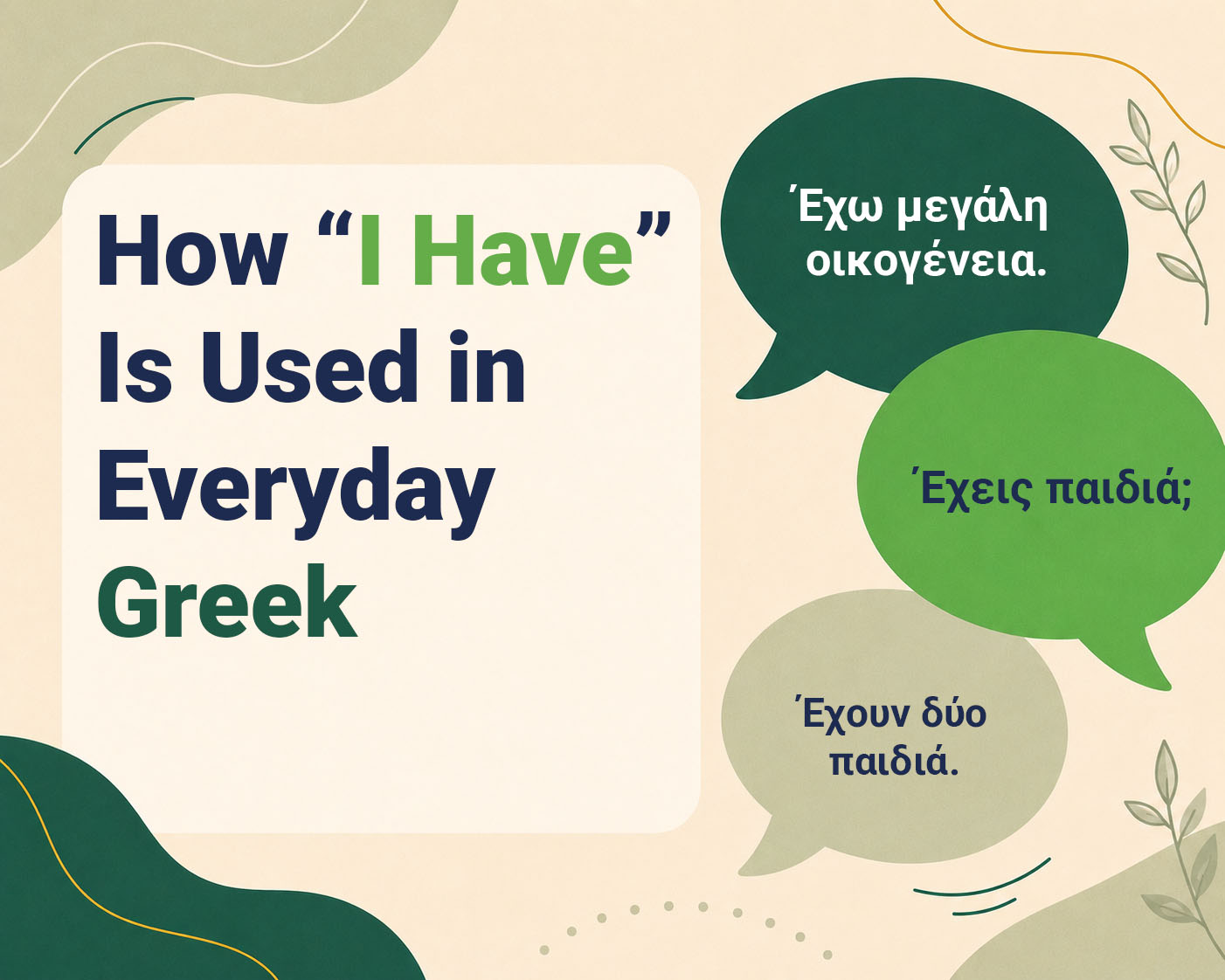
The Greek verb έχω usually means “to have,” and its most direct use is to talk about family, friends, pets and other things connected to your life. But it also appears in expressions that English translates with “to be,” in descriptions of health and weather, and as a helping verb when talking about experiences.
That makes έχω far more useful than a simple word for possession. At the same time, Greek does not use it everywhere English uses “have.” Hunger, thirst and need are expressed with different verbs.
You can hear every main example spoken by a native Greek speaker. The pronunciation guides are approximate, but they can help English speakers get close to the sound.
The most useful forms of έχω
The present-tense form changes according to the person:
| Greek | Meaning | Form of έχω |
|---|---|---|
| εγώ | I | έχω |
| εσύ | you — informal, singular | έχεις |
| αυτός / αυτή / αυτό | he / she / it | έχει |
| εμείς | we | έχουμε |
| εσείς | you — formal or plural | έχετε |
| αυτοί / αυτές / αυτά | they | έχουν |
Greek often leaves out the subject pronoun because the verb ending already identifies the person. Έχω normally gives enough information to mean “I have,” while έχεις means “you have.” Pronouns such as εγώ and εσύ are more likely when the speaker wants contrast or emphasis.
The accent mark shows which syllable receives the stress: Έ-χω, έ-χεις, έ-χει and έ-χουν, but έ-χου-με and έ-χε-τε.
Talking about your family
Έχω μεγάλη οικογένεια.
Natural translation: I have a large family.
Pronunciation: EH-khoh meh-GHAH-lee ee-koh-YEH-nee-ah
Word for word: έχω = I have · μεγάλη = large · οικογένεια = family
This is έχω in its most direct sense. The subject εγώ is not needed because the ending of έχω already tells us that the speaker is talking about themself.
Οικογένεια is a feminine noun, so “large” takes the feminine form μεγάλη. Greek adjectives change to agree with the noun they describe.
The letter χ in έχω is not pronounced like English “ch.” It is a breathy sound made farther back in the mouth, similar to the sound in Scottish “loch.”
Έχεις παιδιά;
Natural translation: Do you have children?
Pronunciation: EH-khees peh-THYAH
Word for word: έχεις = you have · παιδιά = children
Greek does not need an extra word equivalent to English “do” when forming this question. Έχεις παιδιά can be understood as a statement or a question according to intonation and punctuation.
Έχεις is informal and singular. When addressing someone formally or speaking to more than one person, use:
Έχετε παιδιά; — Do you have children? (formal or plural)
The noun παιδιά is the plural of παιδί, meaning “child.” The combination διά sounds approximately like “thya,” with the tongue lightly between the teeth for δ.
Έχουν δύο παιδιά.
Natural translation: They have two children.
Pronunciation: EH-khoon THEE-oh peh-THYAH
Word for word: έχουν = they have · δύο = two · παιδιά = children
The ending changes to -ουν for “they”: έχουν. As with έχω, the subject pronoun is usually unnecessary unless you want to emphasize exactly who has the children.
Compare the forms in these related course phrases:
- Έχω έναν γιο. — I have a son.
- Έχω μία κόρη. — I have a daughter.
- Έχω δύο παιδιά. — I have two children.
- Έχουν δύο παιδιά. — They have two children.
Greek distinguishes grammatical gender in words such as έναν before masculine γιο and μία before feminine κόρη. The number δύο does not change according to gender.
Making a sentence negative
Δεν έχω πολλούς φίλους.
Natural translation: I don’t have many friends.
Pronunciation: then EH-khoh poh-LOOS FEE-loos
Word for word: δεν = not · έχω = I have · πολλούς = many · φίλους = friends
To make έχω negative, place δεν before it: δεν έχω, “I do not have.” The verb itself does not need another change.
The same pattern works with the other present-tense forms:
- Δεν έχεις χρόνο. — You don’t have time.
- Δεν έχει αυτοκίνητο. — He/She doesn’t have a car.
- Δεν έχουμε παιδιά. — We don’t have children.
The δ in δεν sounds like the th in English “this,” not like an English d. In φίλους, φ sounds like f.
Saying that someone is right or wrong
Έχεις δίκιο.
Natural translation: You are right.
Pronunciation: EH-khees THEE-kyoh
Word for word: έχεις = you have · δίκιο = right/justice
Greek uses έχω where English uses “to be.” The expression έχω δίκιο is literally close to “to have right,” but its natural meaning is “to be right.”
The opposite expression follows the same pattern:
Έχεις άδικο.
Natural translation: You are wrong.
Pronunciation: EH-khees AH-thee-koh
Word for word: έχεις = you have · άδικο = wrong/injustice
These expressions change with the person:
- Έχω δίκιο. — I am right.
- Έχει δίκιο. — He/She is right.
- Έχετε δίκιο. — You are right. (formal or plural)
The word άδικο begins with a stressed AH sound. Its δ again sounds like the th in “this.”
Describing health with έχω
Έχω πονοκέφαλο.
Natural translation: I’ve got a headache.
Pronunciation: EH-khoh poh-noh-KEH-fah-loh
Word for word: έχω = I have · πονοκέφαλο = headache
Greek can use έχω for certain illnesses and physical problems, much as English says “I have a headache.”
Πονοκέφαλος is built from words connected with pain and the head. After έχω, it appears here as πονοκέφαλο, without the final -ς found in its dictionary form.
Έχω ένα κρύωμα.
Natural translation: I’ve got a cold.
Pronunciation: EH-khoh EH-nah KREE-oh-mah
Word for word: έχω = I have · ένα = a · κρύωμα = cold
Κρύωμα is a neuter noun, so the word for “a” is ένα. The related adjective κρύο means “cold.”
Not every health statement uses έχω. The course phrase Νιώθω άρρωστος means “I feel ill,” while Με πονάνε τα μάτια means “My eyes hurt.” Greek chooses the structure that sounds natural for the particular condition.
Talking about cold weather
Έχει κρύο.
Natural translation: It is cold.
Pronunciation: EH-khee KREE-oh
Word for word: έχει = it has · κρύο = cold
This weather expression uses the third-person form έχει, even though the natural English translation is “It is cold.” There is no separate stated subject equivalent to English “it.”
This phrase is about the weather or general conditions. To describe a cold object, food or person, Greek normally uses an adjective with the relevant noun instead.
The two vowels in κρύο remain audible: approximately KREE-oh. The χ sound in έχει is softer and farther forward than in έχω because it comes before an i sound.
Describing someone’s appearance
Έχει καστανά μαλλιά και μπλέ μάτια.
Natural translation: He has brown hair and blue eyes.
Pronunciation: EH-khee kah-stah-NAH mah-LYAH keh bleh MAH-tyah
Word for word: έχει = he/she has · καστανά = brown · μαλλιά = hair · και = and · μπλέ = blue · μάτια = eyes
Greek can omit the pronoun here, so έχει may mean “he has” or “she has.” The surrounding conversation normally makes the person clear.
Both μαλλιά and μάτια are neuter plural nouns, so the color words appear in forms that agree with them: καστανά μαλλιά and μπλέ μάτια.
The letter combination μπ at the beginning of μπλέ sounds like b. In μαλλιά and μάτια, the final vowel combination sounds approximately like “ya.”
Using έχω to talk about experience
Έχεις πάει ποτέ στην Αγγλία;
Natural translation: Have you ever been to England?
Pronunciation: EH-khees PAH-ee poh-TEH steen ang-GLEE-ah
Word for word: έχεις = have you · πάει = gone/been · ποτέ = ever · στην Αγγλία = to/in England
Here, έχεις is a helping verb rather than the main idea of possession. Together, έχεις πάει asks whether someone has had the experience of going somewhere.
The answer can use the same structure:
Δεν έχω πάει ποτέ εκεί.
Natural translation: I have never been there.
Pronunciation: then EH-khoh PAH-ee poh-TEH eh-KEE
Word for word: δεν = not · έχω = I have · πάει = gone/been · ποτέ = ever/never · εκεί = there
In a negative sentence, δεν ... ποτέ gives the meaning “never.” Greek keeps ποτέ, which can mean “ever” in a question and “never” when used with δεν.
This construction is close to the English present perfect: a form of “have” plus a form of the main verb. The two languages do not use their perfect forms in exactly every same situation, but the structure is useful when talking about life experience.
Where Greek does not use έχω
It is tempting to translate expressions word for word, but several common ideas use their own verbs in Greek.
Πεινάω.
Natural translation: I’m hungry.
Pronunciation: pee-NAH-oh
Word for word: πεινάω = I am hungry
Greek does not normally say “I have hunger.” Πεινάω is a verb that directly expresses being hungry. Similarly, Διψάω means “I’m thirsty.”
Χρειάζομαι ταξί.
Natural translation: I need a taxi.
Pronunciation: khree-AH-zoh-meh tah-KSEE
Word for word: χρειάζομαι = I need · ταξί = taxi
Need is expressed with χρειάζομαι, not with έχω. The same verb appears in Χρειάζομαι διακοπές (“I need a vacation”) and Χρειάζομαι λίγο χρόνο να σκεφτώ (“I need some time to think”).
These contrasts are worth noticing because another language may use its equivalent of “have” for hunger, need or similar states, while Greek chooses a separate verb.
One small verb with many roles
The core meaning of έχω is easy to recognize in a phrase such as Έχω μεγάλη οικογένεια. Its wider uses become clear in complete expressions: Έχεις δίκιο means “You are right,” Έχει κρύο describes cold weather, and Έχεις πάει ποτέ...; asks about an experience.
The verb forms also carry information that English often expresses with pronouns: έχω for “I have,” έχεις for informal “you have,” έχει for “he, she or it has,” and έχουν for “they have.”
Learning those forms inside everyday phrases makes it easier to recognize both the familiar meaning of “have” and the places where Greek uses the verb in its own way.
Hear Everyday Greek in Complete Phrases
The main examples in this article are taken from the LinguaBoost Greek course and recorded by a native Greek speaker.
Ready to speak more Greek?
Build on the phrases in this article with structured practice, native-speaker audio and built-in review designed for everyday conversation.
Explore the Greek course